
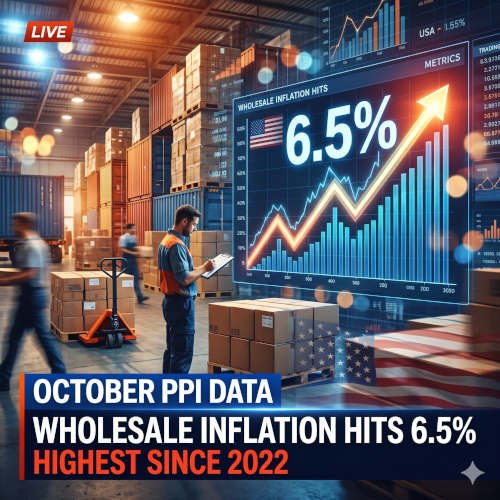
The latest USA PPI report shows that wholesale inflation remains a major concern for the American economy. October 2026 PPI data revealed that producer prices increased 0.3% during the month, while the annual inflation rate climbed to 6.5%, its highest level since November 2022
The latest Producer Price Index (PPI) report, released by the U.S. Bureau of Labor Statistics (BLS) on November 13, showed a slightly smaller monthly increase than economists expected. Analysts had forecast a 0.4% rise.
However, the annual increase in wholesale prices raised fresh concerns about persistent inflation. The figures also arrived shortly after consumer inflation increased more than expected, putting additional attention on the Federal Reserve’s December interest-rate decision.
Investors, businesses and American consumers are now watching the latest USA PPI data for clues about future prices, borrowing costs and the direction of the U.S. economy.
USA PPI Report: What October 2026 Data Reveals
The Producer Price Index measures the average change over time in selling prices received by domestic producers for their goods and services. It provides an important indication of inflation pressure before products reach consumers.
According to the October PPI report, final-demand producer prices increased 0.3% on a seasonally adjusted monthly basis. That was below the Dow Jones consensus forecast of 0.4%.
Core PPI, which excludes food and energy prices, also increased 0.3%, matching expectations.
Despite the relatively moderate monthly increase, annual headline PPI accelerated to 6.5%. The rate was 6.3% in September, making October’s reading the highest annual increase since November 2022.
The latest data presents a mixed inflation picture. Monthly price growth was slightly softer than expected, but the annual increase indicates that businesses continue to face substantial cost pressures.
Key Highlights From the October PPI Data
- Monthly USA PPI: Increased 0.3% in October.
- Economists’ forecast: A 0.4% monthly increase.
- Annual producer inflation: Reached 6.5%.
- Core PPI: Increased 0.3% during October.
- Goods prices: Rose 0.5% during the month.
- Final-demand services: Increased 0.2%.
- Freight transportation: Truck transportation of freight recorded a 3.9% increase.
- Federal Reserve: Investors were watching for a possible December interest-rate increase.
These figures show why the October PPI report matters beyond the wholesale market. Higher production and transportation expenses can influence business decisions and potentially affect prices paid by consumers.
Why Wholesale Inflation Reached 6.5%
The 6.5% annual increase in USA PPI indicates that inflation remains widespread across important parts of the supply chain.
Producer prices can rise because of higher raw-material expenses, transportation costs, labor-related expenses, energy prices and supply-chain disruptions. Businesses may absorb some increases, but companies facing prolonged cost pressure can eventually raise selling prices.
The October PPI data showed that goods prices increased 0.5% during the month. The annual goods index climbed 10.2%, representing its largest 12-month increase since October 2022.
This is important for manufacturers, wholesalers and retailers that depend on products and materials moving through multiple stages of production.
Higher costs at the producer level do not automatically mean consumers will experience the same percentage increase. However, persistent wholesale inflation can create additional pressure on household budgets if businesses pass some of their expenses along.
Goods and Transportation Costs Add to Inflation Pressure
The October PPI report showed increases across both goods and services.
Final-demand goods prices increased 0.5% during October. The report also showed that prices for goods excluding food and energy declined 0.1%, indicating that different product categories experienced different price movements.
Services prices increased 0.2%. Transportation and warehousing services contributed to the increase, with truck transportation of freight recording a 3.9% monthly gain.
Freight costs are important because trucks move products between factories, warehouses, distribution centers and retail stores. When transportation becomes more expensive, businesses may face higher costs throughout their supply chains.
Those expenses can affect several industries, including food distribution, construction, manufacturing and consumer retail.
The report also showed that prices for intermediate processed goods increased 14.6% over the 12 months ending in October. Intermediate services prices climbed 6.9% annually.
These figures provide further evidence that inflation pressure is affecting businesses before products reach final customers.
PPI Data Raises Questions About the Federal Reserve’s Next Move
The latest USA PPI report arrives at an important moment for U.S. monetary policy.
The Federal Reserve is scheduled to hold its next policy meeting on December 8–9, 2026. Investors are assessing whether policymakers will increase interest rates again to address persistent inflation.
Market expectations described in the November 13 report pointed to a quarter-percentage-point increase, with some possibility of a larger half-point move.
However, market pricing is not a confirmed policy decision. The Federal Reserve will consider incoming inflation, employment and economic activity data before deciding what action to take.
Higher interest rates can make mortgages, auto loans, credit cards and business financing more expensive. They can also slow consumer spending and investment, potentially reducing demand across the economy.
The Fed faces a difficult balance: it wants to bring inflation toward its 2% long-term target without unnecessarily damaging economic growth.
Consumer Inflation Adds to the Fed’s Challenge
The October PPI data followed a higher-than-expected Consumer Price Index report.
The headline CPI increased 0.4% in October, while core CPI also rose 0.3%. Both monthly readings were 0.1 percentage point above economists’ expectations.
PPI and CPI measure different parts of the economy. PPI tracks prices received by domestic producers, while CPI measures prices paid by consumers.
When both indicators show persistent price increases, policymakers may become more concerned that inflation is not cooling quickly enough.
The Federal Reserve also monitors the Personal Consumption Expenditures price index, which serves as its preferred inflation measure.
What USA PPI Means for American Consumers and Businesses
The latest PPI data could have implications for households and companies across the United States.
For consumers, higher wholesale prices may eventually contribute to more expensive products and services. The effect depends on whether businesses pass additional costs to customers or absorb them through lower profit margins.
Households already managing housing, insurance, transportation and grocery expenses may face further budget pressure if inflation remains elevated.
Small businesses could also experience difficulties. Companies that rely on wholesale suppliers, freight transportation and industrial materials may need to reconsider their budgets and pricing strategies.
Some businesses may respond by negotiating supplier contracts, improving efficiency or finding alternative sources of materials. Others may have fewer options for controlling expenses.
The impact will vary by industry, and the 6.5% annual PPI increase should not be interpreted as a 6.5% increase in every product’s retail price.
What Is Driving Inflation Pressure in the USA?
Several factors could influence the inflation outlook in the coming months.
Higher fuel prices can increase transportation and production expenses. Tariffs may also raise costs for imported goods and materials, depending on the products affected and how companies adjust their supply chains.
The November 13 report also highlighted concerns among policymakers about inflation pressure linked to the Iran war, fuel costs and tariffs spreading through the economy.
Chicago Federal Reserve President Austan Goolsbee expressed concern about limited progress in controlling inflation. He pointed to price increases in categories not directly driven by oil prices or tariffs.
His comments suggest that policymakers are paying attention to whether inflation is becoming more widespread rather than remaining concentrated in a few volatile categories.
However, no single factor explains the entire October PPI increase. The latest report showed price movements across goods, services and intermediate production categories.
What to Watch in the Next PPI Report
The next important development will be whether producer inflation begins to slow or continues rising across the supply chain.
Businesses and investors will monitor upcoming economic releases, including consumer inflation, employment figures and the next Producer Price Index report.
The BLS schedule lists December 15, 2026, as the release date for November PPI data.
A further increase in producer prices could strengthen concerns about persistent inflation. A sustained slowdown, meanwhile, could provide policymakers with more evidence that price pressures are easing.
For now, the October USA PPI report shows that the inflation challenge remains significant even though the monthly increase was below expectations.
USA PPI Outlook: Inflation Remains a Major Economic Concern
The October 2026 PPI report delivered a mixed message for the U.S. economy. Monthly producer prices increased 0.3%, below the 0.4% forecast, but annual wholesale inflation climbed to 6.5%, the highest level since November 2022.
Rising goods prices, freight expenses and intermediate production costs highlight the pressure businesses continue to face.
The latest PPI data will remain important as the Federal Reserve approaches its December policy meeting. Investors will watch for additional evidence about inflation and the possibility of higher interest rates.
For American households and businesses, the key question is whether wholesale price pressure will ease in the coming months or continue affecting the cost of goods, services and borrowing.
Frequently Asked Questions About USA PPI
1. What is USA PPI?
USA PPI stands for the United States Producer Price Index. It measures changes over time in the selling prices domestic producers receive for their goods and services.
2. What did the October 2026 PPI report show?
The October PPI report showed a 0.3% monthly increase in producer prices and a 6.5% annual increase.
3. Why is the latest PPI data important?
PPI data helps economists, businesses and policymakers understand inflation pressure earlier in the supply chain. Higher producer costs can eventually influence prices paid by consumers.
4. What was the annual USA PPI inflation rate in October 2026?
Annual producer inflation reached 6.5%, the highest 12-month increase since November 2022.
5. What is the difference between PPI and CPI?
PPI measures prices received by domestic producers, while CPI measures changes in prices paid by consumers for goods and services.
6. Will the Federal Reserve increase interest rates in December 2026?
Markets were pricing in a possible quarter-percentage-point increase, according to the November 13 report. However, the Fed had not confirmed its decision.
7. When will the next PPI report be released?
The BLS schedule lists December 15, 2026, for the November 2026 Producer Price Index release.
8. Does a 6.5% PPI increase mean consumer prices rose 6.5%?
No. PPI and CPI measure different prices. The annual PPI increase does not mean consumers paid 6.5% more for all goods and services.
Sources and Further Reading:
- U.S. Bureau of Labor Statistics: https://www.bls.gov/ppi/
- BLS Producer Price Index Release Schedule: https://www.bls.gov/schedule/news_release/ppi.htm
- Associated Press: https://apnews.com/article/5f427443fd31a4aa2bd2a1b6cebfe549