

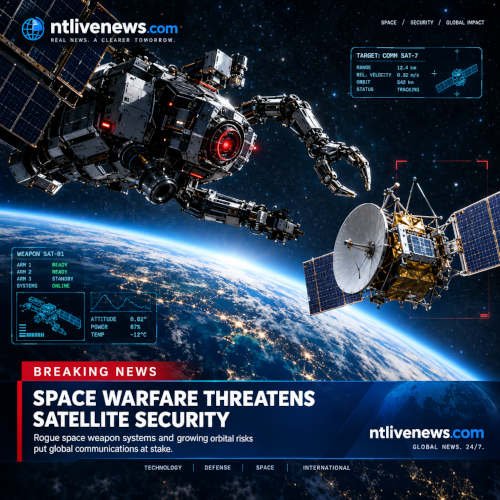
US Business Updates: China is expanding its space capabilities, and a new U.S. intelligence assessment warns that some of its developing technologies could threaten satellites belonging to other countries. The warning has renewed concerns about a potential arms race in orbit, where spacecraft used for communications, navigation, weather forecasting and military surveillance could become targets during a conflict.
The U.S. Defense Intelligence Agency (DIA) released its latest report, Challenges to Security in Space, on October 26, 2026. The assessment examines the space programs and military capabilities of China, Russia, Iran and North Korea. It identifies a growing range of technologies that could disrupt, damage or destroy satellites, including robotic mechanisms, electronic jamming and directed-energy systems.
One technology attracting particular attention is China’s Shijian-17 satellite, which carries a robotic arm. The DIA says this type of technology could potentially be used to grapple other satellites. However, the existence of a robotic arm does not establish that the spacecraft has attacked another country’s satellite.
The broader concern is that equipment designed for satellite inspection, maintenance or servicing could also have military applications. As more countries depend on space infrastructure, the possibility of hostile activity in orbit has become a significant national security issue.
What the Latest DIA Report Says About China’s Space Weapons
The 2026 report is the third edition of the DIA’s Challenges to Security in Space assessment, following earlier editions published in 2019 and 2022. It reviews the space-related strategies, capabilities and intentions of countries that Washington considers potential security challenges.
According to the assessment, China is developing space-based technology, including on-orbit counterspace systems, that could put other countries’ satellites at risk.
The report describes counterspace capabilities as technologies that can interfere with an opponent’s ability to use space. These systems do not all work in the same way. Some can temporarily disrupt satellite operations, while others could cause permanent physical damage.
A significant development highlighted in recent reporting on the DIA assessment is the growing role of systems operating directly in orbit. The agency also identifies electronic jamming capabilities that combine ground-based and on-orbit systems.
The DIA’s assessment is an intelligence judgment about capabilities and potential threats. It should not be interpreted as confirmation that China has deployed every weapon described or used those systems in an attack.
Shijian-17 and the Robotic Arm Technology
Shijian-17, also known as SJ-17, is a Chinese satellite that has drawn attention because of its ability to maneuver in orbit and its robotic-arm technology.
A robotic arm can perform useful tasks in space. Satellite operators could use similar mechanisms to inspect spacecraft, handle equipment, support maintenance operations or capture space debris. These capabilities may become increasingly important as countries explore ways to extend satellite lifespans and reduce orbital waste.
However, the same technology raises security questions.
A spacecraft capable of approaching another satellite and physically interacting with it could potentially interfere with that satellite’s operation. In a hostile situation, a robotic mechanism might be used to grapple, move or damage another spacecraft.
The DIA has previously identified Shijian-17’s robotic arm as an example of technology that could potentially be adapted for grappling other satellites. That possibility is not proof that SJ-17 has carried out such an attack.
The distinction matters because satellite servicing and military interference can involve similar technical capabilities. Determining a spacecraft’s actual purpose can be difficult when governments do not disclose detailed information about its mission.
How Anti-Satellite Weapons Could Work
Anti-satellite weapons, often called ASAT weapons, are designed to interfere with or destroy satellites. They can operate from the ground or from space, and they do not all rely on missiles.
The technologies discussed in the DIA assessment and related reporting include several broad categories:
- Robotic mechanisms: An orbital spacecraft could potentially approach and physically interact with another satellite.
- Electronic jamming: Radio-frequency interference can disrupt communications, navigation or other satellite signals.
- Directed-energy systems: Lasers and other energy-based technologies could interfere with sensitive satellite equipment.
- High-powered microwaves: These systems could potentially disrupt or damage electronic components.
- Kinetic weapons: A projectile or interceptor could physically collide with a satellite.
- Other disruptive technologies: Chemical or other materials could potentially interfere with spacecraft surfaces or sensitive components.
Not every technology has the same level of development or operational readiness. Some are established areas of military research, while others represent potential future capabilities.
The important point is that modern counterspace operations can involve reversible disruption as well as permanent destruction. A satellite does not necessarily need to be physically destroyed to become ineffective.
Why Satellite Jamming and Lasers Matter
Electronic jamming can create serious problems without producing visible physical damage. If a satellite’s communication signals are interrupted, military units and civilian users may lose access to important information.
Navigation systems are also vulnerable to interference. Aircraft, ships, emergency services and commercial operators rely on satellite signals for positioning and timing. Disruption could affect operations well beyond the military sector.
Lasers present a different challenge. Depending on their power and design, directed-energy systems could interfere with optical sensors or potentially damage sensitive equipment. A laser that temporarily blinds a satellite sensor creates a different level of threat from a system designed to cause permanent damage.
The DIA’s latest assessment also warns that China may field space-based directed-energy systems and more powerful ground-based systems capable of threatening satellites in higher orbits by the late 2020s.
That is a forward-looking intelligence assessment, not confirmation that such orbital weapons are already operational.
China’s Growing Military Interest in Orbit
China’s space program has developed significantly over recent decades. Its activities include satellite launches, navigation systems, communications infrastructure, scientific missions and human spaceflight.
Many of these programs have civilian and commercial benefits. However, some technologies can also support military operations.
For example, satellites that collect images of the Earth’s surface can help with environmental monitoring, agriculture and disaster response. Similar imaging capabilities can also support military surveillance and intelligence gathering.
This overlap is known as dual-use technology. It creates challenges for other governments because a satellite’s public description may not reveal every capability or potential application.
The DIA says China’s military is expanding its counterspace capabilities as space becomes more important to national security. The report also discusses China’s electronic warfare systems and its development of technologies that could threaten satellites in different orbital regions.
The assessment reflects U.S. intelligence concerns. It does not, by itself, establish that China intends to attack a particular country’s satellite network.
Close Approaches to Foreign Satellites
Satellite operators increasingly monitor spacecraft that maneuver close to other objects in orbit. These activities are often described as rendezvous and proximity operations, or RPO.
RPO allows one spacecraft to approach another and operate nearby. It can support legitimate activities such as inspection, repair, servicing and debris removal.
However, these operations can also create security concerns. A spacecraft that can approach another satellite may be able to observe its equipment, collect information about its behavior or potentially interfere with its operation.
Recent reporting on the DIA assessment highlights Chinese satellites that have maneuvered close to foreign spacecraft in geostationary orbit. The report describes some of these approaches as inconsistent with the satellites’ publicly stated missions.
Such activity can raise questions, but proximity alone does not prove hostile intent. Spacecraft may approach other objects for technical, scientific or servicing purposes.
For governments and commercial satellite operators, the challenge is understanding what another spacecraft is doing before a close approach becomes a security problem.
China’s Antarctic Stations and Space Monitoring Concerns
The DIA assessment also discusses China’s growing presence in Antarctica. China operates five research stations on the continent, including the Great Wall and Zhongshan stations.
According to the report, these facilities process signals that China relays to aircraft, ships and vehicles operating in the region.
The agency says China’s continued investment in Antarctica could create additional opportunities to monitor space facilities and signals associated with Australia and New Zealand.
This assessment adds a geographic dimension to the wider discussion about space security. Ground-based infrastructure can support satellite communications, data collection and other activities connected to space operations.
Antarctic research stations also serve scientific purposes, and their existence alone does not demonstrate military activity. The DIA’s concern relates to the possibility that facilities with civilian functions could also support broader strategic objectives.
China’s Robotic Space Weapons: Could They Attack US Satellites?
The United States depends heavily on satellites for military and civilian services. These systems support communications, navigation, weather forecasting, intelligence gathering and emergency response.
A disruption to satellite infrastructure could therefore affect several sectors at once.
For the U.S. military, losing access to satellite communications or navigation could complicate operations and reduce the flow of information between units. Surveillance satellites also help monitor developments around the world.
Commercial services face risks too. Airlines, shipping companies, telecommunications providers and financial institutions use satellite-enabled services or precise timing information in their operations.
A major conflict in space could create consequences beyond the countries directly involved. If a destructive anti-satellite attack generates debris, fragments could threaten other spacecraft sharing nearby orbital regions.
This is one reason military analysts distinguish between reversible interference and destructive attacks. Jamming may disrupt a service, but a collision that creates long-lasting debris could threaten the wider space environment.
The International Challenge of Preventing a Space Arms Race
Space security is not limited to the United States and China. Russia and other countries are also developing capabilities that could affect satellites.
The growing use of dual-purpose spacecraft makes international rules difficult to enforce. A satellite designed to inspect or repair another spacecraft may have legitimate applications, but similar capabilities could potentially be used for hostile purposes.
The international community has long debated how to prevent an arms race in outer space. The 1967 Outer Space Treaty establishes important principles for the peaceful use of space, including restrictions on placing nuclear weapons and other weapons of mass destruction in orbit.
However, it does not prohibit every type of conventional military technology in space. This leaves difficult questions about how countries should define, monitor and regulate certain counterspace capabilities.
Greater transparency, communication between satellite operators and clearer standards for responsible behavior could help reduce misunderstandings. Without such measures, an unusual maneuver near a foreign satellite could be interpreted as a threat even when its purpose is uncertain.
What Happens Next?
The DIA’s October 2026 report highlights how quickly space security is changing. Robotic satellite systems, electronic warfare, directed-energy research and close-proximity operations are becoming increasingly important parts of military planning.
China’s Shijian-17 illustrates the challenge of evaluating dual-use technology. A robotic arm can support useful satellite operations, but it could also provide a capability that raises military concerns.
The most important distinction is between technological potential and demonstrated weapon use. The report identifies capabilities and possible threats, but it does not establish that every system discussed is an operational weapon or that China has attacked foreign satellites with them.
For the United States, its allies and commercial space operators, the report reinforces the need to protect satellite infrastructure and improve the ability to identify suspicious activity in orbit.
As governments become more dependent on space-based services, protecting satellites will remain an important part of national security and the global economy.
Frequently Asked Questions About China’s Space Weapons
1. Is China developing weapons that can attack other satellites?
According to the U.S. Defense Intelligence Agency’s 2026 report, China is developing counterspace technologies that could disrupt, damage or destroy other countries’ space systems. The assessment describes developing capabilities and potential threats, not proof that every system is already operational.
2. What is China’s Shijian-17 satellite?
Shijian-17, or SJ-17, is a Chinese satellite known for its orbital maneuvering activities and robotic-arm technology. Such technology can support satellite inspection and servicing, but it could potentially be adapted to grapple other spacecraft.
3. Can a robotic arm destroy another satellite?
A robotic arm could potentially interfere with another spacecraft by physically grabbing, moving or damaging it. However, the presence of a robotic arm does not prove that a satellite has been used as a weapon.
4. What are anti-satellite weapons?
Anti-satellite weapons are systems designed to disrupt, damage or destroy satellites. They can include missiles, lasers, electronic jammers, high-powered microwave systems and spacecraft capable of physically interacting with other satellites.
5. Could China’s space weapons threaten American satellites?
The DIA says China’s developing counterspace capabilities could put U.S. and allied space systems at risk. Potential consequences include disrupted communications, interference with navigation services and damage to military or commercial satellites.
6. Why is China building research stations in Antarctica?
China operates Antarctic research facilities for scientific and logistical activities. The DIA says some of the infrastructure could also provide opportunities to monitor space facilities and signals in the region, including those associated with Australia and New Zealand.
7. Are space-based weapons already being used in combat?
The DIA report identifies developing technologies and potential threats, but it does not establish that China has used the systems discussed to attack foreign satellites in combat. Satellite maneuvering, inspection and servicing can also have legitimate purposes.
Conclusion
China’s growing counterspace capabilities are raising important questions about the future of satellite security. The DIA’s latest assessment points to a broad range of technologies, from robotic satellite mechanisms to electronic jamming and directed-energy systems.
Shijian-17 is an example of why dual-use technology deserves attention: equipment developed for satellite operations could potentially have military applications. But potential capability should not be confused with confirmed weapon deployment or an actual attack.
As the world becomes more dependent on satellites, governments and commercial operators will need stronger protection, better monitoring and clearer international standards to keep space infrastructure safe.
References
- U.S. Defense Intelligence Agency – Challenges to Security in Space
- Air & Space Forces Magazine – China Developing More On-Orbit Space Weapons: New Report
