

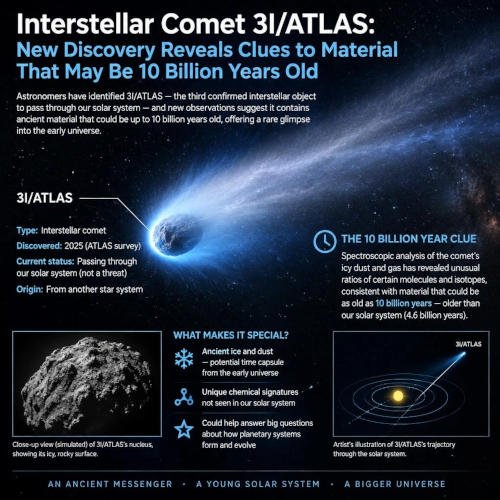
USA News: A remarkable visitor from beyond our Solar System is giving astronomers a rare opportunity to study material that may have formed billions of years before the Sun and planets. The interstellar comet 3I/ATLAS has attracted fresh attention after a study published in Nature Astronomy reported an unusually high level of deuterium in its methane.
The finding adds to evidence that 3I/ATLAS formed in an extremely cold environment unlike the one that produced our Solar System. Earlier research published in Nature suggested that the object could have originated in an ancient planetary system as long as 12 billion years ago. That is a possible formation-age estimate, not a direct measurement of the comet’s age.
The latest research does not independently prove that 3I/ATLAS is 10 billion years old. Instead, its unusual chemical composition offers another important clue about the conditions in which its icy material formed.
What Makes 3I/ATLAS Different From Other Comets?
Unlike ordinary comets that formed within our Solar System, 3I/ATLAS originated around another star. Its unusual trajectory confirms that it is an interstellar object rather than a body permanently bound to the Sun.
NASA’s ATLAS survey telescope in Chile first reported the object on July 1, 2025. Astronomers classified it as the third confirmed interstellar object detected passing through our Solar System, following 1I/’Oumuamua and 2I/Borisov.
The name also explains its identity. The number 3 marks its place as the third confirmed interstellar visitor, while the letter “I” stands for interstellar.
Its journey offers astronomers an unusual opportunity. Scientists can examine gases released from an object that formed in a different planetary system, helping them compare the chemistry of distant star systems with the material found around our Sun.
NASA says 3I/ATLAS follows a hyperbolic trajectory. Unlike planets and many comets, it is not travelling along a closed orbit around the Sun. It will continue moving away rather than remaining part of our Solar System. NASA Science
James Webb Telescope Detects Unusual Methane Chemistry
The latest research, published in Nature Astronomy on October 23, 2026, is titled “An enriched methane D/H ratio in the interstellar object 3I/ATLAS.”
Researchers used observations from the James Webb Space Telescope (JWST) to study the comet’s atmosphere, known as its coma. The coma develops when sunlight warms a comet and causes frozen substances to turn directly into gas.
The team examined the chemical signatures released by 3I/ATLAS, focusing on methane and its isotopes. Their measurements revealed a deuterium-to-hydrogen ratio of 3.18% ± 0.30% in methane.
That result is particularly striking because it is higher than any methane D/H ratio measured in the Solar System. It is also approximately 13 times the value measured in comet 67P/Churyumov–Gerasimenko, the only other comet in which scientists have detected deuterated methane.
The comparison highlights how unusual the interstellar visitor’s chemistry may be. Its methane appears to preserve clues about an environment that differed significantly from the conditions in which most familiar Solar System comets formed. Nature
What Is Deuterium, and Why Does It Matter?
Deuterium is a heavier form, or isotope, of hydrogen. Ordinary hydrogen has one proton in its nucleus, while deuterium contains one proton and one neutron.
Both forms of hydrogen can become part of molecules such as water and methane. However, the relative amount of deuterium in a substance can reveal information about the environment in which that material formed.
Astronomers use the deuterium-to-hydrogen ratio, commonly written as D/H, to investigate the temperature and chemical history of space environments.
Cold regions can produce molecules with distinctive isotope ratios. As a result, measuring deuterium in cometary gases can help researchers understand the conditions that existed when the comet’s frozen material developed.
For 3I/ATLAS, the unusually high methane D/H ratio points toward formation in a cold environment with particular chemical and radiation conditions.
Why the Methane Finding Is So Important
Methane is a simple molecule made of one carbon atom and four hydrogen atoms. It is common in space and can become trapped in icy material around young stars.
The researchers found that 3I/ATLAS contains an unusually high proportion of deuterium-bearing methane compared with ordinary methane.
The measured ratio was 3.18%, with an uncertainty of 0.30 percentage points. The researchers reported that this value was 13 ± 2 times higher than the methane measurement for comet 67P.
This is significant because deuterated organic molecules are difficult to detect in distant objects. The finding gives scientists another chemical marker for studying the origins of material beyond our planetary neighborhood.
The study does not establish the exact age of every molecule or the precise birth date of the comet. Instead, it provides evidence about the conditions in which its methane-bearing ice formed.
Could 3I/ATLAS Be 10 Billion Years Old?
The possibility that 3I/ATLAS contains material from an extremely ancient planetary system has become one of the most fascinating aspects of the discovery.
A separate study published in Nature on June 22, 2026, examined the comet’s water and carbon isotope measurements. That research found unusual chemical signatures that could help identify the environment in which the object formed.
The study reported a water D/H ratio of 0.98% ± 0.06%. It also found unusual carbon isotope ratios in carbon dioxide and carbon monoxide.
By comparing these measurements with models of Galactic chemical evolution, the researchers concluded that 3I/ATLAS may have accreted material as long ago as 12 billion years.
That estimate is one reason scientists have described the comet as a possible preserved fragment of an ancient planetary system.
However, there is an important distinction between an estimated formation age and a directly measured age. Scientists cannot simply determine the comet’s exact birthday from its current observations.
The researchers also noted that its precise origin and journey through the Milky Way remain uncertain. The object’s unusual chemical composition provides clues, but it does not establish a complete history. Nature
What the Two Studies Reveal Together
The June Nature study and the October Nature Astronomy study examine different chemical evidence.
| Research finding | What scientists learned |
|---|---|
| Water D/H ratio | 0.98% ± 0.06% |
| Methane D/H ratio | 3.18% ± 0.30% |
| Methane comparison | About 13 ± 2 times the value measured in comet 67P |
| Formation temperature | Water isotope evidence points to conditions at or below approximately 30 kelvin |
| Possible formation period | The carbon isotope analysis suggests material may have accreted as long ago as 12 billion years |
Together, the findings strengthen the case that 3I/ATLAS formed under unusual conditions in a distant planetary environment.
They do not prove that the comet itself is exactly 10 billion or 12 billion years old. The estimates depend on interpreting chemical measurements through models of how the Milky Way and its star-forming regions evolved.
What Happens When an Interstellar Comet Approaches the Sun?
Comets contain frozen gases, dust, and other material left over from the environments in which they formed.
When a comet approaches a star, sunlight warms its surface. Some frozen substances then sublimate, meaning they change directly from solid ice into gas without first becoming liquid.
That gas expands around the nucleus, forming the coma. Dust and gas released from the object can also create a tail, which may become more visible as solar heating increases.
For astronomers, this activity creates an opportunity to study a comet’s composition remotely. Instruments such as JWST can identify chemical signatures in the light coming from gases around the object.
In the case of 3I/ATLAS, the telescope’s infrared observations helped researchers identify methane and its deuterated form.
The measurements are valuable because astronomers cannot send a spacecraft to collect a sample from every interstellar visitor. Observing the gases released by the comet provides a way to investigate its chemistry from a distance.
Is 3I/ATLAS a Threat to Earth?
No. NASA has stated that 3I/ATLAS posed no threat to Earth.
The comet’s closest approach to our planet occurred on December 19, 2025, at approximately 1.8 astronomical units, or about 270 million kilometers (170 million miles).
Although the object travelled through the inner Solar System, it remained far from Earth. Its unusual origin and chemical composition make it scientifically interesting, but they do not make it a danger to our planet. NASA Science
What Scientists Still Want to Discover About 3I/ATLAS
The new methane findings have opened additional questions about the comet’s history.
Researchers still need to understand more about its original star system, the conditions that produced its unusual chemical composition, and how long it travelled through interstellar space before reaching our Solar System.
Future analysis of its chemical signatures may help scientists compare 3I/ATLAS with other interstellar objects and understand how planetary systems develop under different conditions.
The comet is especially valuable because interstellar visitors are rare. Each one provides a limited opportunity to study material formed around another star.
Frequently Asked Questions About Interstellar Comet 3I/ATLAS
1. What is 3I/ATLAS?
3I/ATLAS is the third confirmed interstellar object detected passing through our Solar System. Astronomers identified it in July 2025 and classified it as a comet.
2. Is 3I/ATLAS really 10 billion years old?
Its exact age is unknown. A separate isotope study suggests that its material may have accreted as long ago as 12 billion years, but this is a scientific estimate rather than a direct age measurement.
3. What did the James Webb Space Telescope discover?
JWST observations revealed an unusually high deuterium-to-hydrogen ratio in methane from 3I/ATLAS. The reported value was 3.18% ± 0.30%.
4. Why is deuterium important in comet research?
Deuterium is a heavier isotope of hydrogen. Its abundance can help scientists investigate the temperature, radiation conditions, and chemical environment in which cometary ice formed.
5. Is 3I/ATLAS different from Solar System comets?
Yes. Its interstellar origin and unusual isotope ratios distinguish it from comets formed around our Sun.
6. Could 3I/ATLAS hit Earth?
No. NASA reported that the comet posed no threat to Earth and passed at a distance of approximately 270 million kilometers.
7. Where was the latest 3I/ATLAS research published?
The methane isotope research appeared in Nature Astronomy on October 23, 2026. An earlier study on its water and carbon isotope composition appeared in Nature on June 22, 2026.
The Bottom Line
Interstellar comet 3I/ATLAS is providing scientists with a rare look at material from beyond our Solar System. Its unusually high methane deuterium ratio, combined with earlier water and carbon isotope findings, points toward an ancient and extremely cold formation environment. While its exact age remains uncertain, the possibility that some of its material dates back billions of years makes this visitor an important target for astronomical research.
:::
Trusted reference links
- Nature Astronomy – Methane isotope study of 3I/ATLAS
- Nature – Isotopic evidence for a cold and distant origin
- NASA – Comet 3I/ATLAS facts and observations
- NASA – Webb findings on the ancient origin of 3I/ATLAS
Editorial note: The headline uses the 10-billion-year angle, but the article carefully distinguishes the October methane discovery from the separate June age estimate. This avoids presenting a possible age as a proven fact.
