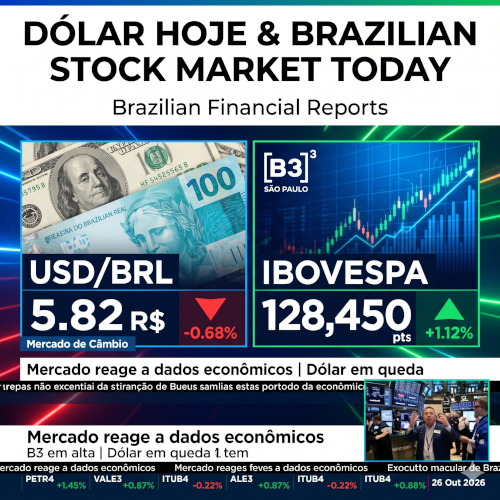
Texas, USA: What is the latest US news on the dollar is here. Read on this portal the recent news of Dolar Hoje: Brazilian Currency Faces Pressure After Lula’s Reelection. But why is it happening in the country? What is the circulating online news actually about? It is all about the US dollar to Brazilian real exchange rate, and it says it is 1 dollar to 4.98 Brazilian Real.
This news tells about the latest updates on Lula da Silva’s reelection as president of Brazil, and she defeated Flavio Bolsonaro.
The Dolar Hoje outlook became a major focus for investors on October 26, 2026, after President Luiz Inácio Lula da Silva secured reelection, triggering a sharp reassessment of Brazilian financial assets.
Offshore futures trading indicated a significant weakening of the Brazilian real, with the implied exchange rate reaching approximately R$5.56 per US dollar. At the same time, Brazilian equities and exchange-traded funds faced heavy selling pressure as investors reconsidered the country’s fiscal outlook and future economic policies.
According to reports published by UOL and Reuters, the market reaction reflected the reversal of election-related investment positions and concerns about Brazil’s economic direction.
However, investors tracking dolar hoje should understand that the R$5.56 figure refers to an implied exchange rate derived from offshore Brazilian real futures. It should not be interpreted as the official domestic commercial dollar exchange rate.
The distinction is important because offshore futures prices can move differently from Brazil’s domestic exchange rate, particularly during periods of political uncertainty and heightened market volatility.
Why Did the Exchange Rate Rise in Brazil?

The Brazilian real weakened sharply in offshore trading following Lula’s election victory.
Before the election, some investors had positioned themselves for a potential change in government, anticipating different approaches to fiscal policy, government spending and private-sector investment.
When the election result contradicted those expectations, traders began reassessing their positions.
This reversal contributed to pressure on the Brazilian real and increased attention to the dolar hoje exchange rate.
Several factors may influence the dollar’s direction in Brazil:
- Political uncertainty: Investors are reassessing the implications of Lula’s reelection.
- Fiscal policy: Concerns about government spending and public debt remain important.
- Interest-rate expectations: Changes in inflation expectations can affect monetary policy.
- International conditions: US interest rates, global risk appetite, and commodity prices can influence emerging-market currencies.
- Investor positioning: Rapid adjustments to election-related trades can amplify short-term price movements.
The exchange rate’s subsequent direction will depend on how these factors develop and whether the government provides clearer signals about its economic priorities.
Dolar Hoje and the Brazilian Stock Market Today reports

The currency sell-off coincided with substantial declines in Brazilian equities.
The US-listed iShares MSCI Brazil ETF (EWZ) fell sharply in premarket trading, reflecting concerns about Brazilian assets following the election.
A separate Japanese-listed ETF linked to the Ibovespa also declined.
These movements are related but should not be confused with one another. The EWZ tracks Brazilian equities through an MSCI benchmark, whereas an Ibovespa-linked ETF follows Brazil’s principal stock market index.
The relationship between dolar hoje and Brazilian stocks is particularly important for international investors.
When the real weakens against the US dollar, international investors may experience additional losses when converting the value of Brazilian investments into dollars. However, the precise effect depends on the investment, the timing of the currency conversion and the performance of the underlying assets.
A weaker real can also benefit certain exporters by increasing the domestic-currency value of their foreign revenues. Companies that rely heavily on imported inputs, meanwhile, may face higher operating costs.
Consequently, currency depreciation does not affect every Brazilian company in the same way.
What Could Influence Dolar Hoje in the Coming Days?
Investors will closely monitor several developments to assess the direction of the dollar exchange rate in Brazil.
1. Government Economic Policy
Announcements about government spending, taxation, and fiscal targets could influence investor confidence.
A credible strategy for managing public finances may help reduce uncertainty, while unclear policy signals could contribute to continued volatility.
2. Finance Minister Appointment
Investors will examine the finance minister’s appointment and public statements for indications of the government’s economic priorities.
The administration’s approach to debt management and fiscal discipline will be particularly important.
3. Inflation and Interest Rates
IN the coming future what is concern is the Currency depreciation can increase the cost of imported goods and dollar-priced inputs, potentially contributing to inflation.
If inflation expectations rise, Brazil’s central bank may have less flexibility to reduce interest rates.
4. US Dollar Strength
Another main concern is that the Brazilian real is also influenced by international market conditions.
Changes in US monetary policy, Treasury yields, and global demand for emerging-market assets can affect the dollar’s performance against Brazil’s currency.
5. International Investor Sentiment
Many Investors will watch whether the initial post-election sell-off continues or stabilizes as additional information becomes available.
For readers following dolar hoje, it is important to distinguish temporary market movements from longer-term economic trends.
How to Check Dolar Hoje Accurately
Anyone searching for dolar hoje should verify which exchange rate a financial report is quoting.
The principal rates and prices to distinguish include:
- Commercial dollar rate: Commonly used as a reference for many business transactions and international payments.
- Tourism dollar rate: Relevant to certain travel-related currency transactions and typically different from the commercial rate.
- Dollar futures: Contracts traded on exchanges that reflect market expectations and other pricing factors for future settlement.
- Offshore Brazilian real futures: Internationally traded contracts that can provide an indication of market sentiment outside Brazil’s domestic trading hours.
For more information regarding this, interested persons may also visit and read the Central Bank of Brazil publications on exchange-rate information and financial statistics through its official website: https://www.bcb.gov.br/en.
For stock-market information, investors can consult B3, Brazil’s principal stock exchange: https://www.b3.com.br/en_us/.
Conclusion :
Finally, the dollar exchange rate has become a key indicator of investor sentiment following Lula’s reelection.
Offshore futures indicated an implied dollar rate of approximately R$5.56, while Brazilian ETFs and other financial assets faced substantial selling pressure.
The reaction reflected concerns about fiscal policy, public debt, and the reversal of investment positions established before the election.
For businesses, travelers, and investors, monitoring dolar hoje alongside these underlying economic indicators can provide a more complete understanding of Brazil’s currency market.
Disclaimer: This article is for informational purposes only and does not constitute financial or investment advice.
Frequently Asked Questions About Dolar Hoje
1. What does dolar hoje mean?
“Dólar hoje” is Portuguese for “dollar today.” It is a common search term used by people looking for the current US dollar exchange rate in Brazil.
2. Why did dollar futures reach R$5.56?
Offshore Brazilian real futures reflected a sharp reassessment of market expectations after Lula’s reelection. The movement was associated with political uncertainty, fiscal concerns, and the reversal of election-related investment positions.
3. Is R$5.56 the current commercial dollar rate in Brazil?
Not necessarily. The reported R$5.56 figure represented an implied exchange rate derived from offshore futures trading. The domestic commercial dollar rate may differ and should be checked using current market data.
4. Where can I check dolar hoje?
You can consult the Central Bank of Brazil for official exchange-rate information and established financial-market data providers for live or indicative quotations.
Official source: https://www.bcb.gov.br/en.
5. How does a rising dollar affect Brazil Money Markets?
A stronger US dollar can increase the cost of imported goods, fuel, machinery, and other dollar-priced products. It can also increase the domestic-currency value of foreign revenues earned by some exporters.
6. Can Lula’s reelection cause further currency exchange rate rise?
Political developments can influence exchange rates, particularly when election results differ from market expectations. Future movements will also depend on fiscal policy, inflation, interest rates, and international economic conditions.
7. Does a weaker Brazilian real affect stock market Business?
Yes. International investors holding Brazilian equities may experience currency-related losses when converting investment values into US dollars. However, the effect varies depending on the underlying investment and the exchange-rate movement.
References and Further Reading
- UOL Economia: Brazilian dollar futures and ETF market reaction
- Reuters: Investors expect markets to unwind after Lula’s reelection
- Central Bank of Brazil: Official website and financial information
- B3: Brazilian stock exchange
About the Author