
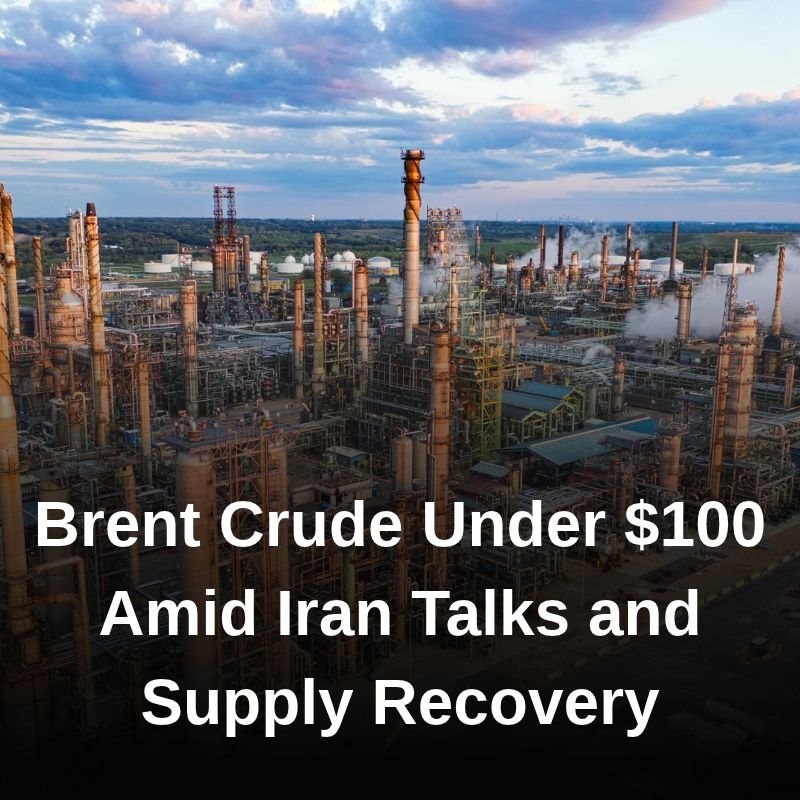
Oil prices moved higher on Thursday, November 5, 2026, but remained below the important $100-a-barrel level as investors weighed diplomatic developments between the United States and Iran against improving Middle Eastern oil supplies. The market is recovering from a sharp selloff that pushed both major crude benchmarks significantly lower in the previous session.
Front-month Brent crude, the global oil benchmark, rose 1.3% to $95.85 a barrel during European trading, according to the figures reported by The Wall Street Journal. U.S. West Texas Intermediate (WTI) crude gained 0.3% to $87.36 a barrel at that point.
Later market reporting from Reuters showed Brent at $96.81 and WTI at $89.44, reflecting a further recovery during Thursday’s trading. These figures represent different market snapshots rather than conflicting prices.
The latest movement highlights how quickly the oil market can respond to geopolitical developments, supply expectations and changing investor sentiment.
Why Oil Prices Are Moving After a Sharp Selloff
Oil prices experienced a major decline on Wednesday, when Brent and WTI both lost more than 8%. Investors reacted to expectations that the latest U.S. midterm election results could increase political pressure on President Donald Trump to pursue a diplomatic solution to the conflict involving Iran.
The possibility of reduced military tensions has become an important factor in energy market trading. If negotiations lead to a lasting agreement, oil shipments through the Middle East could become more reliable, easing concerns about global supply shortages.
However, traders are not treating a diplomatic agreement as guaranteed. The conflict remains unresolved, and uncertainty surrounding regional security continues to influence crude oil prices.
Reuters reported Thursday that investors were assessing the possibility of further escalation alongside hopes for negotiations. The combination of these opposing risks has contributed to volatility in Brent crude and WTI futures.
U.S.-Iran Diplomacy Remains a Major Oil Market Driver
Relations between Washington and Tehran are central to the current oil market outlook because Iran sits near one of the world’s most important energy shipping routes.
The Strait of Hormuz connects the Persian Gulf with international shipping routes. It is a critical passage for crude oil and other energy supplies moving from major Middle Eastern producers to global customers.
Any disruption to shipping through the strait can increase transportation costs, delay deliveries and push oil prices higher. Conversely, improved security and more predictable tanker movements could reduce the geopolitical risk premium included in crude prices.
Recent diplomatic efforts have raised hopes that the conflict could move toward negotiations. However, traders must consider the possibility that talks could stall or security incidents could disrupt shipping again.
For investors, the key question is whether diplomatic progress will produce a lasting improvement in physical oil supply.
Middle East Oil Supply Recovery Puts Pressure on Prices
Improving oil exports from the Middle East are another important reason crude prices have remained below $100.
According to figures cited by J.P. Morgan in the Wall Street Journal report, Middle Eastern oil exports recovered to approximately 20.7 million barrels a day in October. That represents a significant improvement from the reported low of 9.8 million barrels a day in March.
The bank also estimated that global oil supply exceeded demand by approximately 1.1 million barrels a day in September. The surplus widened to around 1.4 million barrels a day in October.
This suggests that the global market has been moving back toward a supply surplus.
At the same time, J.P. Morgan estimated that global oil demand had declined by 3.3 million barrels a day since the conflict began. Higher energy costs and supply disruptions can affect economic activity, transportation and industrial demand.
Nevertheless, recovering exports do not mean that all supply risks have disappeared. Security concerns, elevated shipping costs and uncertainty around tanker movements continue to complicate energy deliveries.
U.S. Oil Inventory Data Add Another Market Signal
U.S. inventory figures provide another important measure of the energy market’s condition.
The U.S. Energy Information Administration reported that commercial crude oil inventories fell by 865,000 barrels in the week ending October 30, bringing total stocks to approximately 409.8 million barrels.
Distillate inventories, which include products such as diesel and heating oil, declined by 3.6 million barrels to 99.3 million barrels.
These figures show that some U.S. fuel inventories remain under pressure even as international oil supply conditions improve.
A decline in inventories can support oil prices because it may indicate stronger demand, lower imports or reduced domestic supply. However, inventory movements need to be considered alongside production, exports, refinery activity and global demand.
Investors should avoid treating one weekly inventory report as proof of a long-term price trend.
What Lower Oil Prices Could Mean for American Consumers
Crude oil prices influence the cost of gasoline, diesel, aviation fuel and other petroleum products. A sustained decline in global crude prices could eventually reduce fuel costs for American households and businesses.
However, lower crude prices do not automatically produce immediate reductions at U.S. gas stations.
Retail gasoline prices also depend on refinery capacity, seasonal fuel requirements, transportation expenses, distribution costs and taxes. Regional supply conditions can create differences between states and cities.
For trucking companies, airlines and delivery businesses, lower oil prices may reduce operating expenses if the decline continues. Consumers could also benefit if cheaper wholesale fuel costs pass through to retail prices.
But a renewed disruption in the Middle East could reverse some of these benefits.
What Investors Should Watch in the Oil Market
People following oil prices, energy stocks and commodity investments should monitor several important indicators.
1. Brent crude and WTI prices: These benchmarks help investors understand global and U.S. oil market conditions.
2. Strait of Hormuz shipping: Changes in tanker movements and regional security can influence supply expectations.
3. U.S.-Iran negotiations: Diplomatic progress could reduce geopolitical risk, while renewed tensions could push crude prices higher.
4. EIA inventory reports: Weekly changes in crude and fuel stocks provide useful information about U.S. supply and demand.
5. Global oil demand: Economic growth, industrial activity and transportation trends can influence how much crude consumers need.
Investors should also remember that oil futures can be volatile. Energy stocks, exchange-traded funds and commodity contracts carry different risks, and short-term price movements do not guarantee future returns.
Will Oil Prices Fall Further Below $100?
Oil prices could remain below $100 if Middle Eastern exports continue recovering, global supply stays ahead of demand and diplomatic efforts reduce fears of further disruption.
However, a lasting decline is not guaranteed. Renewed military escalation, shipping interruptions or unexpected production losses could quickly change the market outlook.
The latest recovery in Brent and WTI shows that traders are still balancing optimism about diplomacy against concerns about regional security.
For American consumers, businesses and investors, the direction of oil prices will depend on whether improving supply conditions can continue and whether diplomatic progress becomes a lasting reality.
Frequently Asked Questions
Why did oil prices rise on November 5, 2026?
Oil prices recovered after falling more than 8% during the previous session. Traders reassessed geopolitical risks and the possibility of further disruption to Middle Eastern oil supplies.
What was the Brent crude price on November 5, 2026?
Brent crude rose to $95.85 a barrel during European trading in the Wall Street Journal’s reported snapshot. Later Reuters reporting showed it at $96.81.
Why is Brent crude below $100?
Expectations of improved U.S.-Iran diplomacy and recovering Middle Eastern oil exports have reduced some concerns about immediate supply shortages.
How does Iran affect global oil prices?
Iran’s location near the Strait of Hormuz makes regional security important to international energy shipments. Disruptions to shipping can increase supply concerns and oil prices.
Will lower crude prices reduce U.S. gasoline prices?
They could, if lower crude costs continue and pass through the refining and distribution system. Retail gasoline prices also depend on taxes, refinery costs, transportation and local supply.
Is now a good time to invest in oil stocks?
Oil investments involve market, geopolitical and company-specific risks. Investors should assess their financial goals, risk tolerance, diversification and the financial condition of individual energy companies before making decisions.
SEO Title: Oil Prices Today: Brent Crude Below $100 as Iran Talks Shape Market
Meta Description: Oil prices rise on November 5, 2026, but Brent stays below $100 as traders assess Iran diplomacy, Middle East supply recovery and U.S. inventories.
Primary Keyword: Oil prices today
Secondary Keywords: Brent crude oil price, WTI crude oil, oil prices November 2026, Iran diplomacy, U.S. oil prices, global oil supply, crude oil market outlook, Strait of Hormuz, oil investment news
Suggested URL Slug: oil-prices-today-brent-crude-below-100-iran-diplomacy-supply-outlook
Category: USA Business News / Energy News
Tags: Oil Prices Today, Brent Crude, WTI Crude, Iran News, Oil Market News, Global Oil Supply, U.S. Energy Market, Strait of Hormuz, Crude Oil Forecast, Energy Stocks, Gas Prices USA, Oil Investment
