
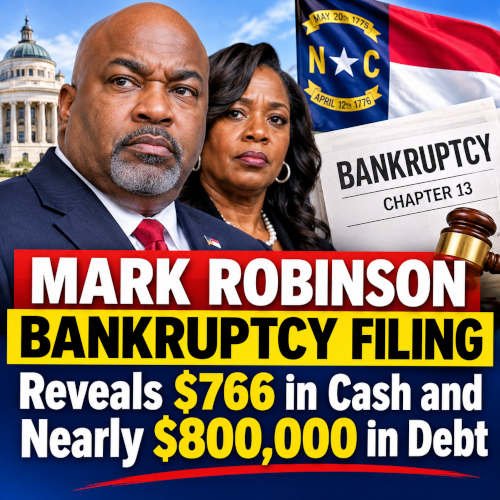
Former North Carolina Lieutenant Governor Mark Robinson and his wife, Yolanda Hill, have filed for Chapter 13 bankruptcy protection, according to court records reported by WRAL. Their November 3, 2026, filing lists just $766.98 in bank accounts and nearly $800,000 in debts, placing the couple’s financial circumstances under renewed public scrutiny.
The filing comes after Robinson’s unsuccessful 2024 campaign for North Carolina governor and years of reported financial difficulties. It also brings attention to outstanding financial disputes involving credit cards, collection accounts and a separate lawsuit brought by a former political adversary.
The bankruptcy petition does not mean the couple has already had their debts erased. Chapter 13 is a court-supervised repayment process that can allow eligible debtors to reorganize what they owe while retaining certain property.
What Mark Robinson’s Bankruptcy Filing Says About His Finances
According to WRAL state government reporter Will Doran, Robinson and Hill submitted their Chapter 13 bankruptcy filing on November 3. The documents report that the couple had $766.98 in the bank while owing creditors nearly $800,000.
The filing lists more than half a million dollars in property and other assets. Their largest reported asset is their home in Colfax, North Carolina, valued at approximately $437,000.
The couple also reported owning two 2021 vehicles: a Cadillac Escalade and a Chevrolet Silverado. Together, the vehicles were valued at approximately $80,000.
Other listed possessions include household furniture, clothing, electronics, a golf cart valued at $2,000, golf clubs worth $25 and a gun collection valued at approximately $6,000.
These figures provide a snapshot of the couple’s reported financial position when they filed the paperwork. They do not necessarily represent the final value of their property or the amount creditors will ultimately recover.
How Much Debt Do Mark Robinson and Yolanda Hill Owe?
The bankruptcy filing identifies several categories of outstanding obligations. Among the largest are approximately $120,000 in credit card debt, $94,000 in other debt and around $100,000 in accounts handled by collection agencies.
The filing also includes a potential disputed obligation connected to a lawsuit involving Greensboro-area musician Louis Love Money.
The nearly $800,000 figure represents the couple’s reported overall debt, rather than one single loan or creditor claim. Different debts may have different repayment rules, legal status and priority under bankruptcy law.
The reported credit card balances and collection accounts are particularly significant because they indicate that the couple’s financial problems extend beyond a single disputed legal matter.
Their filing also lists assets worth substantially more than the money available in their bank accounts. However, owning property does not mean a household has enough cash to meet immediate financial obligations.
Why Robinson and His Wife Chose Chapter 13 Bankruptcy
Chapter 13 bankruptcy is designed for individuals with regular income who need time to reorganize their financial obligations. Unlike Chapter 7 bankruptcy, which generally involves liquidation of nonexempt assets, Chapter 13 allows qualifying debtors to propose a repayment plan using future income.
Under the federal system, repayment plans usually last three to five years. Debtors make payments through a bankruptcy trustee, who distributes money to creditors according to the approved plan.
The couple’s filing seeks protection under this process. However, the filing itself does not establish that a judge has approved a repayment plan or that every listed debt will be paid in full.
The U.S. Courts explains that Chapter 13 can help debtors keep property while repaying all or part of their obligations over time. A repayment plan must meet legal requirements and receive court approval.
What Happens After a Chapter 13 Filing?
After filing, debtors generally receive protection from many collection actions through the automatic stay. This can temporarily stop qualifying creditors from pursuing collection lawsuits, wage garnishments and certain foreclosure or repossession proceedings.
The next steps involve financial disclosures, creditor review and development of a repayment plan. The bankruptcy trustee and creditors can examine the proposed arrangements, and a judge decides whether the plan meets the requirements for confirmation.
If the court approves the plan, the debtors must make the required payments. Failure to follow the plan can put the bankruptcy case at risk.
For Robinson and Hill, the important question is how much income they can use to support a repayment plan and what creditors may receive. The available reporting does not establish the final repayment terms.
A Disputed Lawsuit Adds Another Financial Complication
One unusual entry in the bankruptcy filing involves Louis Love Money, a Greensboro-area musician who previously became involved in a legal dispute with Robinson.
During Robinson’s 2024 campaign for governor, Robinson sued Money for defamation. Robinson later dropped that lawsuit after losing the election.
Money subsequently filed his own lawsuit against Robinson. He is seeking to recover money he says he spent defending himself against the earlier defamation case.
That lawsuit remains pending, according to WRAL. The bankruptcy filing lists the potential obligation as disputed, meaning Robinson’s responsibility for the amount has not been established as an uncontested debt.
The distinction matters because a bankruptcy filing can include disputed claims. Listing a potential obligation does not automatically mean the debtor agrees that the money is owed.
The legal dispute could therefore remain relevant as the bankruptcy case moves forward. Its eventual outcome may affect how the claim is treated in the proceedings.
Robinson’s Previous Financial Problems and Political Career
Mark Robinson served as North Carolina’s lieutenant governor from 2021 through 2025. During that period, he became a prominent Republican figure in state politics and later won the party’s nomination for governor in the 2024 election.
He lost the general election to Democrat Josh Stein by a wide margin.
Robinson had previously discussed financial difficulties during his political career. Reports have described earlier bankruptcy filings and liens involving unpaid taxes, rent and vehicle payments. Some of those obligations were later paid.
The latest filing has also prompted renewed attention to his earlier bankruptcy history. Reporting indicates that Robinson and Hill had previous bankruptcy cases, including a joint Chapter 13 filing in 2003. Some earlier cases were dismissed.
The current filing is therefore not the first time the couple has faced bankruptcy proceedings. However, each case has its own circumstances, and previous filings should not be confused with the new November 2026 petition.
What Happened to Yolanda Hill’s Balanced Nutrition Organization?
The financial situation also draws attention to Hill’s former nonprofit organization, Balanced Nutrition.
The organization worked with childcare centers participating in a federal food assistance program for low-income families. A 2024 state investigation raised concerns about its billing practices, including allegations that the organization had over-reported amounts billed by childcare centers.
Hill shut down the nonprofit in 2024 while Robinson was running for governor. She later argued that the investigation was politically motivated.
In 2025, North Carolina’s Department of Health and Human Services ordered Balanced Nutrition to repay more than $100,000. The amount was reported at more than $100,000 following the state’s review.
According to the latest information provided by WRAL, the debt remained unpaid as of November 10, 2026, and NCDHHS said it was determining the next steps for collection.
However, this nonprofit obligation should be distinguished from Robinson and Hill’s personal bankruptcy debts. The repayment order was issued to Balanced Nutrition, not automatically to Hill as an individual. WRAL reported that the organization’s debt would likely not appear as a personal obligation in the couple’s bankruptcy filing because it was incurred by the nonprofit.
What the Bankruptcy Means for Robinson’s Financial Future
The Chapter 13 filing places Robinson and Hill’s finances under the supervision of the bankruptcy court. Their next challenge will be demonstrating that they can meet the requirements of a repayment plan.
Their reported assets include a home and vehicles, but the filing shows that their available cash is extremely limited compared with their total debt.
Robinson previously earned a state salary as lieutenant governor. Members of North Carolina’s Council of State currently earn more than $173,000 annually, according to WRAL. However, that figure does not establish Robinson’s current income or the amount available to fund a repayment plan.
Other reporting has identified his current work as a podcast host. The bankruptcy court will consider the financial information and legal requirements relevant to the case rather than relying only on his former government salary.
The couple’s attorney declined to comment to WRAL about the filing. As a result, several details remain unknown, including the repayment proposal, the treatment of individual creditor claims and whether the court will approve the plan.
What Readers Should Understand About the Case
The most important point is that filing for bankruptcy is not the same as completing bankruptcy. Robinson and Hill have asked for Chapter 13 protection, but the court process must continue before the final treatment of their debts is known.
The filing also does not establish wrongdoing by itself. It is a legal process for addressing debts and property under federal bankruptcy rules.
For now, the reported figures are striking: less than $800 in bank deposits, nearly $800,000 in debt and more than half a million dollars in listed assets. The case could take months to develop as the court reviews the couple’s financial disclosures and proposed repayment arrangements.