
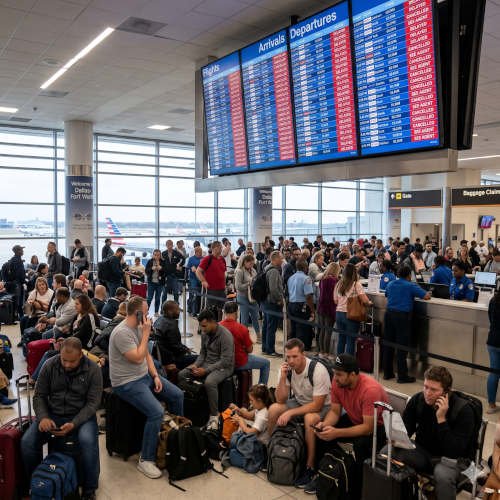
Thousands of travelers across the United States are still facing flight cancellations, delays and missed connections after a rare nationwide Federal Aviation Administration (FAA) ground stop disrupted air travel on Friday, November 13, 2026. Although the restriction was lifted after several hours, airlines and airports are still working to restore normal operations.
The disruption affected major travel hubs, including Dallas-Fort Worth International Airport, Denver International Airport and airports across the country. Passengers who expected to travel on Saturday continued to encounter schedule changes as airlines repositioned aircraft and crews.
Federal Aviation Administrator Bryan Bedford said on Saturday that the national air travel system was expected to return to normal by Sunday evening. However, individual passengers could continue experiencing delays beyond the initial recovery period, depending on their airline, route and connecting flights.
The incident has also affected college football travel, forcing teams to change flight arrangements ahead of important games. The disruption has raised renewed questions about the reliability of America’s aging air traffic control infrastructure and the need for modernization.
Why Are Flights Still Delayed After the Nationwide FAA Ground Stop?
The FAA issued a nationwide ground stop on Friday afternoon after telecommunications problems affected air traffic control operations.
The restriction prevented departing flights from taking off while officials worked to stabilize the system. Flights already in the air were allowed to land safely, and international arrivals were handled on a case-by-case basis.
The ground stop was lifted Friday evening after more than four hours. However, ending the restriction did not immediately restore the national flight schedule.
Airlines had to deal with aircraft that were no longer in their planned locations, pilots and flight attendants who had reached duty-time limits, and passengers who had missed connecting flights.
For example, an aircraft scheduled to operate several flights on Friday may have been delayed at an airport far from its next destination. That can affect multiple routes, even after the original technical problem has been resolved.
The FAA and airlines therefore faced a recovery challenge extending beyond the time the ground stop ended.
The Associated Press reported that more than 6,000 flights were canceled on Saturday as airlines worked through the disruption. Reuters also reported thousands of additional cancellations and delays during the recovery period.
What Caused the FAA Nationwide Ground Stop?
Federal officials said the disruption began during routine maintenance on the FAA’s telecommunications network.
Transportation Secretary Sean Duffy explained on Saturday that contractor L3Harris was working to replace older copper telecommunications lines with modern fiber-optic connections at a remote FAA location.
The upgrade was intended to modernize an aging system. However, the change triggered problems involving network equipment and communications between air traffic control facilities.
According to Duffy, a router involved in the replacement process began generating an unusually high number of connection attempts. He said the system experienced more than 1,000 connection attempts every four to five seconds.
That traffic overwhelmed other routers across the network and created communication problems affecting air traffic control operations. Some radar feeds were also disrupted.
The FAA issued the nationwide ground stop as a precaution because reliable communication and radar information are essential to maintaining safe aircraft separation.
Officials have not determined whether the failure resulted from contractor installation mistakes or faulty equipment. L3Harris said it was supporting the federal investigation and took the disruption and its impact on passengers seriously.
Was the FAA Outage Caused by a Cyberattack?
Federal officials said there was no evidence indicating that a cyberattack caused the nationwide disruption.
The available information points to a technical problem during a telecommunications upgrade. However, investigators are still examining the circumstances surrounding the equipment failure.
Officials have not announced a final determination about responsibility.
The distinction matters because a telecommunications failure can disrupt air traffic control without an outside attacker accessing the system. Investigators must establish what happened before making a final statement about the cause.
Dallas Airport Flight Delays and Cancellations
Dallas-Fort Worth International Airport became one of the major travel hubs affected by the nationwide ground stop.
The airport experienced extensive delays and cancellations after the FAA restriction prevented departing aircraft from taking off. Passengers faced crowded terminals and uncertainty as airlines tried to restart their schedules.
CBS Texas reported that DFW had recorded hundreds of cancellations and delays on Friday evening. Dallas Love Field also experienced significant disruption, with passengers waiting for updated departure information.
The impact at Dallas Airport was especially important because DFW is a major hub for American Airlines. Disruptions at a large connecting airport can affect passengers traveling between cities even when their original departure airport is operating normally.
For example, a traveler flying from another U.S. city to Dallas before connecting to an international destination could miss the second flight if the first aircraft arrives late.
Airlines may need to arrange alternative connections, rebook passengers or move aircraft to restore their planned operations.
Travelers using Dallas-Fort Worth International Airport should check their airline’s latest flight information before leaving for the terminal. A flight listed as scheduled earlier in the day may have changed as airlines adjust their operations.
Denver Airport and Other Major Hubs Face Recovery Challenges
Denver International Airport is another important airport for travelers monitoring the effects of the nationwide disruption.
Denver connects passengers across the western United States and serves as a major hub for domestic and international travel. When aircraft or crews become unavailable, delays can affect connecting passengers and flights operating through the airport.
The broader FAA disruption affected airports across the country, including major hubs in Texas, Colorado and other regions. The nationwide nature of the ground stop meant that a problem at the air traffic control network could affect flights far beyond the location where the technical issue began.
However, the available reporting does not establish that Denver experienced the same scale of cancellations as Dallas-Fort Worth. Travelers should check current airport and airline information rather than assume that every airport is facing identical conditions.
The key issue is the wider airline recovery process. Aircraft, crews and passengers may still be out of position even when the FAA’s systems are operating normally.
Eastern Washington vs Utah Tech: College Football Travel Also Disrupted
The FAA ground stop affected more than holidaymakers and business travelers. College football teams also faced major travel problems before scheduled games.
One example involved Eastern Washington vs. Utah Tech, a matchup that became uncertain after Eastern Washington’s charter flight could not depart as planned.
According to The Spokesman-Review, the Eastern Washington football team had been scheduled to travel from Spokane to St. George, Utah, on Friday. The nationwide ground stop prevented the charter flight from departing on its original schedule.
The team later arranged to fly on Saturday morning, creating a much tighter travel schedule before the game.
The matchup was scheduled for Saturday, November 14, at Greater Zion Stadium in St. George. The travel disruption forced the team to adjust its plans rather than follow its original Friday itinerary.
The incident illustrates how a nationwide aviation problem can affect events far beyond commercial passenger travel.
Eastern Washington Football and the Wider Sports Impact
Eastern Washington football was not the only college program affected by the FAA ground stop.
Other teams also faced delays, alternative travel arrangements and changes to kickoff times. Some programs had to wait for charter flights, while others considered buses or later departures.
The impact extended across college football and other sports because teams often travel the day before a game. A delay of several hours can affect hotel arrangements, practice schedules, meals and preparation.
The Eastern Washington situation showed how even a game with a fixed kickoff time can become vulnerable when a national air travel system experiences a major disruption.
When Will Flight Schedules Return to Normal?
The FAA expected the national air travel system to return to normal by Sunday evening, November 15, according to statements made by Administrator Bryan Bedford on Saturday.
That was the agency’s recovery expectation, not a guarantee that every canceled flight or delayed connection would be restored by that time.
Airlines must still reposition aircraft, arrange available crews and accommodate passengers whose original travel plans were disrupted.
Some travelers may receive new departure times, while others may need to accept different routes or travel dates.
Passengers should also remember that a flight can be delayed or canceled for reasons unrelated to the original FAA outage. Weather, staffing and operational constraints can add further complications during a busy recovery period.
For the latest information, travelers should use their airline’s official app or website and check airport departure boards before traveling.
What Should Passengers Do if Their Flight Is Canceled?
Travelers affected by the nationwide ground stop should take a few practical steps to reduce further disruption.
1. Check flight status before leaving home.
Use the airline’s app or website to confirm whether the flight is operating, delayed or canceled.
2. Contact the airline about rebooking.
Passengers whose flights are canceled should review the alternative travel options offered by their carrier. App-based rebooking may be faster than waiting in a long airport line.
3. Keep receipts for additional expenses.
Travelers should retain receipts for eligible expenses and review the airline’s policies and any applicable passenger protections.
4. Confirm connecting flights.
A delayed first flight can affect the rest of a journey. Passengers should check every segment of their itinerary.
5. Allow extra time at the airport.
Long lines, baggage delays and crowded customer-service counters may continue while airlines recover.
Passengers should also check whether they qualify for a refund. Under U.S. Department of Transportation rules, travelers are generally entitled to a refund if an airline cancels or significantly changes a flight and the passenger chooses not to accept the alternative travel arrangement.
Could Another FAA Technology Failure Disrupt U.S. Flights?
The incident has renewed concerns about the age of America’s air traffic control infrastructure.
Transportation officials have repeatedly discussed the need to modernize telecommunications equipment and other systems used to manage U.S. airspace.
The November 13 outage demonstrated how a technical problem during routine maintenance can create widespread consequences when multiple air traffic control facilities depend on connected systems.
Duffy has called for substantial investment to modernize the country’s air traffic control network. Officials have also said the investigation must determine whether contractor work, faulty equipment or a combination of factors caused the failure.
The disruption does not prove that another nationwide ground stop is likely. However, it highlights the importance of careful testing, reliable backup systems and effective oversight during major technology upgrades.
Frequently Asked Questions
Is the FAA nationwide ground stop still in effect?
No. The FAA lifted the nationwide ground stop on Friday evening, November 13, 2026. Flights resumed, although delays and cancellations continued during the recovery period.
Why are flights still canceled after the ground stop ended?
Airlines must reposition aircraft, arrange available pilots and flight attendants, and rebook affected passengers. These operational problems can continue after the original technical issue has been resolved.
Are Dallas Airport flights affected?
Yes. Dallas-Fort Worth International Airport and Dallas Love Field experienced significant delays and cancellations during the disruption. Travelers should check directly with their airlines for current flight status.
Is Denver Airport affected by the FAA disruption?
Denver International Airport is part of the wider U.S. air travel network affected by the ground stop. However, disruption levels vary by airport and airline, so passengers should check their specific flight.
What caused the nationwide FAA ground stop?
Federal officials said a telecommunications problem developed during a routine upgrade from copper lines to fiber-optic connections at an FAA location. Investigators are examining whether faulty equipment or contractor error caused the problem.
Was the FAA outage a cyberattack?
Officials said they had no evidence that a cyberattack caused the disruption. The investigation into the technical failure remains ongoing.
Was Eastern Washington football affected?
Yes. Eastern Washington’s charter flight was delayed by the ground stop, forcing the team to change its travel plans before its game against Utah Tech on November 14.
Flight Recovery Continues as Travelers Watch for Updates
The FAA’s nationwide ground stop may be over, but the effects are still being felt by travelers across the United States.
Dallas-Fort Worth International Airport, Denver Airport and other major travel hubs remain important points for passengers checking schedules and connections. The disruption also affected college sports travel, including Eastern Washington football’s trip for its game against Utah Tech.
Federal officials expect the national flight schedule to recover by Sunday evening, but individual delays and cancellations may continue as airlines reposition aircraft and crews.
For passengers, the most important step is to verify flight information directly with their airline before heading to the airport. The technical failure is under investigation, and officials have not yet issued a final determination about whether contractor error or faulty equipment caused the outage.