
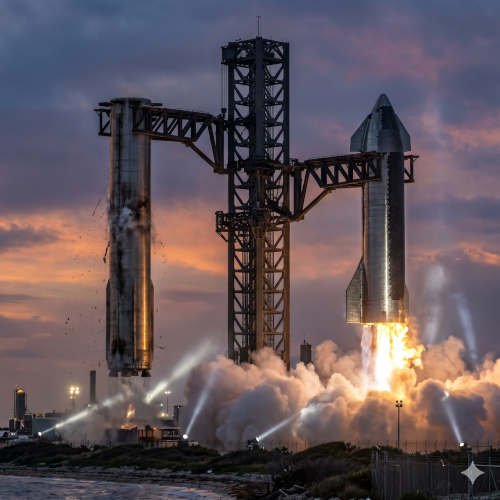
SpaceX is preparing for one of the most ambitious tests in the history of its Starship rocket program. The company is targeting Friday, November 13, 2026, for Starship Flight 15, a mission designed to attempt something it has never achieved before: catching both the Super Heavy booster and the Starship upper stage at its launch site in South Texas.
The planned mission could mark a major step toward fully reusable orbital rockets. SpaceX has already demonstrated that its giant launch tower can catch returning Super Heavy boosters. However, the company has not yet attempted to bring the Starship upper stage back to the tower after an extended orbital flight.
Flight 15 will test whether both parts of the enormous launch system can return safely to the same launch facility. If successful, the achievement could change how frequently large rockets can fly and how much it costs to launch satellites and other payloads.
The launch remains a target rather than a confirmed event. Technical readiness, weather, regulatory conditions and flight safety decisions could affect the schedule.
When Is SpaceX Starship Flight 15 Launching?
SpaceX is targeting Friday, November 13, for the 15th Starship test flight from its Starbase facility near Boca Chica in South Texas.
The reported launch window is scheduled to open at approximately 4:45 p.m. Central Time, or 5:45 p.m. Eastern Time. The window is expected to remain open for approximately 75 minutes, giving the company some flexibility during the countdown.
The timing may change if SpaceX encounters technical issues, unfavorable weather or other operational restrictions.
According to the published mission plan, the first major recovery attempt will take place only minutes after liftoff. The Super Heavy booster is expected to return to the launch site approximately six and a half minutes after launch.
The Starship upper stage will have a much longer journey. It is expected to travel into orbit, deploy satellites and complete approximately 14 orbits before attempting to return to Texas.
That means the two planned catches will happen on different days if the mission follows its expected schedule.
What Makes Flight 15 Different From Previous Starship Tests?
Previous Starship flights have helped SpaceX test the rocket’s engines, separation systems, heat shield, orbital capabilities and landing procedures.
The company has also demonstrated its ability to catch Super Heavy boosters using the mechanical arms attached to its launch tower. Those arms are commonly called chopsticks because of their shape and function.
However, recovering the upper stage presents a much bigger challenge.
The Ship vehicle travels farther and faster than the booster. It must survive the extreme heat of atmospheric reentry, control its descent and approach the launch tower with enough precision for a safe catch.
SpaceX has previously ended upper-stage test flights with ocean splashdowns. Flight 15 is designed to take the next step by attempting a return to the launch site.
Space.com reported that the company successfully caught Super Heavy boosters on three earlier occasions, but Flight 15 would be the first attempt to catch the Ship upper stage.
How SpaceX Plans to Catch Both Starship Stages
The Starship launch system has two major components. The first is Super Heavy, the powerful lower-stage booster that provides the initial thrust. The second is Ship, the upper-stage spacecraft designed to carry payloads into space.
Both vehicles are designed to be reusable. Recovering them at the launch site could reduce the need to build replacement hardware after every mission.
Step One: Starship Lifts Off From Starbase
The mission will begin with the ignition of Super Heavy’s Raptor engines.
The booster will generate the enormous thrust needed to lift the fully stacked Starship vehicle away from the launch pad. During the early part of the flight, the rocket will accelerate through the atmosphere.
The vehicle will also pass through a period known as maximum dynamic pressure, commonly called Max Q. This is the point when the rocket experiences its highest combination of atmospheric pressure and speed during ascent.
SpaceX must ensure that the rocket remains structurally stable as it moves through this demanding phase.
Step Two: Super Heavy Separates and Returns
After the initial ascent, Super Heavy will separate from the Ship upper stage.
The booster will then begin its return sequence. It is expected to perform a boostback maneuver that redirects it toward Starbase.
As it approaches the launch facility, the booster will slow down and prepare for its landing burn.
The launch tower’s mechanical arms will attempt to catch the returning booster. These arms are designed to grab the vehicle and hold it above the ground.
The planned catch is expected approximately six and a half minutes after liftoff.
This will also be an important test for Booster 22, a next-generation Super Heavy vehicle. SpaceX has performed catch operations with earlier booster versions, but Flight 15 will test the return and recovery of this newer configuration.
Step Three: Ship Continues Toward Orbit
While Super Heavy returns to Texas, the Starship upper stage will continue its journey.
The vehicle is expected to reach an orbital altitude of approximately 275 kilometers. It will then begin a much longer mission lasting more than 22 hours.
The flight plan calls for approximately 14 orbits around Earth. During this period, Ship will also deploy 26 Starlink V3 satellites.
This part of the mission will test whether the upper stage can complete its orbital operations and remain in suitable condition for a controlled return.
Step Four: Ship Attempts the First Return to Starbase
The most challenging part of Flight 15 will come after the upper stage completes its orbital mission.
Ship will need to prepare for atmospheric reentry. The spacecraft must manage extreme temperatures while maintaining control throughout its descent.
After reentering the atmosphere, the vehicle will move toward South Texas and approach the launch facility.
If the flight control team confirms that the vehicle’s critical systems are healthy, SpaceX will attempt the final landing sequence.
The upper stage will need to slow down, perform its landing maneuver and approach the tower at the correct speed and position.
The mechanical arms will then attempt to catch Ship.
A successful catch would demonstrate that SpaceX can recover both major stages of its orbital launch system during one mission.
Why the Starship Double Catch Is So Important
The main objective behind Starship is not simply to build a larger rocket. SpaceX wants to develop a fully reusable transportation system capable of flying frequently.
Traditional orbital rockets often discard major components during flight. Some boosters can be recovered, but upper stages are generally not returned for immediate reuse.
SpaceX wants to change that model.
Catching both Super Heavy and Ship could allow the company to inspect, maintain and prepare the vehicles for future flights without rebuilding the entire rocket after each launch.
This could eventually help reduce launch costs and increase the number of missions possible each year.
The technology is also important for SpaceX’s wider business plans. The company wants Starship to support larger Starlink satellite deployments and future missions beyond Earth’s orbit.
A successful double recovery would not immediately prove that Starship is ready for regular commercial operations. The company would still need to demonstrate reliable performance across repeated flights.
However, it would provide an important milestone toward that goal.
Starship Flight 15 Will Also Deploy 26 Starlink V3 Satellites
Flight 15 is not only a rocket recovery demonstration. The mission also includes a commercial payload objective.
SpaceX plans to deploy 26 Starlink V3 satellites during the flight.
These next-generation satellites are intended to increase the capacity of the Starlink broadband network. The additional capacity could support the company’s efforts to expand satellite internet services.
The deployment will also help SpaceX test Starship’s ability to transport and release larger satellite payloads.
The mission therefore combines several important objectives: booster recovery, orbital operations, satellite deployment and the first attempted return of the upper stage to the launch site.
SpaceX will need to complete each stage carefully to achieve the full mission goals.
What Could Go Wrong During the Mission?
Despite extensive testing, Starship Flight 15 carries significant technical risks.
The booster must perform a controlled return and reach the launch tower at the correct position. An issue with its engines, guidance systems or landing sequence could prevent a successful catch.
The upper stage faces an even more complicated challenge. It must survive orbital operations and the intense heating associated with atmospheric reentry.
Its heat shield must protect the vehicle as it moves through the atmosphere. Damage to critical components or problems with its control systems could make a return to Starbase unsafe.
SpaceX has also made clear that the upper-stage catch is conditional. Flight controllers will assess the vehicle before authorizing the final return-to-launch-site sequence.
If the team determines that Ship is not healthy enough for the maneuver, the company can use an alternative ocean disposal or splashdown plan.
This means the mission could still provide useful test data even if the planned upper-stage catch does not happen.
Why the Return Flight Is More Difficult Than the Booster Catch
The Super Heavy booster returns relatively soon after launch. Its flight path and recovery sequence are designed around a short return to the launch site.
Ship, however, must complete a long orbital journey before attempting its landing.
It will travel around Earth, deploy its payload and then begin the process of returning through the atmosphere.
The upper stage must manage its orientation, speed, thermal protection and final approach. The tower catch adds another demanding requirement because the vehicle must reach a precise position near the launch structure.
This combination makes the upper-stage recovery attempt one of the most important engineering tests in the Starship program.
What Happens If SpaceX Successfully Catches Both Stages?
A successful double catch would represent a major milestone for reusable rocket technology.
It would demonstrate that SpaceX can recover both the booster and the upper stage after an orbital mission. The company could then use the results to improve future Starship flights.
The achievement could also support plans to increase launch frequency.
SpaceX wants Starship to carry large numbers of Starlink satellites and eventually support missions to the Moon and Mars. NASA’s Artemis program also depends on future lunar landing capabilities, with Starship selected as part of the agency’s human lunar exploration plans.
However, a single successful test would not complete those goals. SpaceX would still need to demonstrate repeatable recovery, reliable vehicle turnaround, safety and operational readiness.
SpaceX Starship Flight 15: What to Watch on November 13
The most important moments will begin with liftoff and continue through the two planned recovery attempts.
Viewers should watch for the separation of Super Heavy and Ship, the booster’s return to Starbase and the tower’s attempt to catch it.
The second major moment will come much later, after Ship completes its orbital mission and attempts to return to Texas.
The mission could last more than 22 hours, meaning the upper-stage recovery attempt is expected on Saturday, November 14, if the schedule remains unchanged.
SpaceX and specialist spaceflight publications are expected to provide live coverage and mission updates. Viewers should check the company’s official channels for the latest launch timing and any schedule changes.
Final Outlook: A Potential Turning Point for Reusable Rockets
SpaceX Starship Flight 15 could become one of the most significant tests in the company’s rocket development program.
The planned mission aims to recover both the Super Heavy booster and the Ship upper stage, something SpaceX has never attempted in a single orbital flight.
The first catch will test the booster’s return capabilities. The second will challenge the upper stage to survive orbital operations, reenter Earth’s atmosphere and approach the launch tower safely.
Success would bring SpaceX closer to its long-term vision of a fully reusable orbital rocket system.
But the outcome remains uncertain. Until the flight takes place, both catches should be treated as mission objectives rather than completed achievements.
Frequently Asked Questions
1. When is SpaceX Starship Flight 15 scheduled to launch?
SpaceX is targeting Friday, November 13, 2026, from its Starbase facility in South Texas. The reported launch window is expected to open at 4:45 p.m. Central Time, subject to change.
2. What is special about Starship Flight 15?
The mission will attempt to catch both the Super Heavy booster and the Starship upper stage at the launch site. It would be the first attempt to recover both major stages during one orbital mission.
3. What time will SpaceX catch the Super Heavy booster?
The booster catch is planned for approximately six and a half minutes after liftoff.
4. When will the Starship upper stage return?
If the mission follows its planned schedule, Ship will return approximately 22 hours after launch, with the catch attempt expected on November 14.
5. How many Starlink satellites will Starship Flight 15 deploy?
SpaceX plans to deploy 26 Starlink V3 satellites during the mission.
6. Where will Starship Flight 15 launch from?
The rocket will launch from SpaceX’s Starbase facility near Boca Chica in South Texas.
7. Has SpaceX caught the Starship upper stage before?
No. SpaceX has previously caught Super Heavy boosters, but Flight 15 is planned as the company’s first attempt to catch the Ship upper stage.
8. What happens if the upper-stage catch is canceled?
SpaceX can use an alternative ocean deorbit or splashdown plan if the flight control team decides that returning to the launch tower is not safe.
Reference Links
- SpaceX official website: https://www.spacex.com/
- Space.com Starship Flight 15 mission coverage: https://www.space.com/space-exploration/launches-spacecraft/spacex-will-launch-epic-double-catch-starship-flight-15-test-mission-on-nov-13