
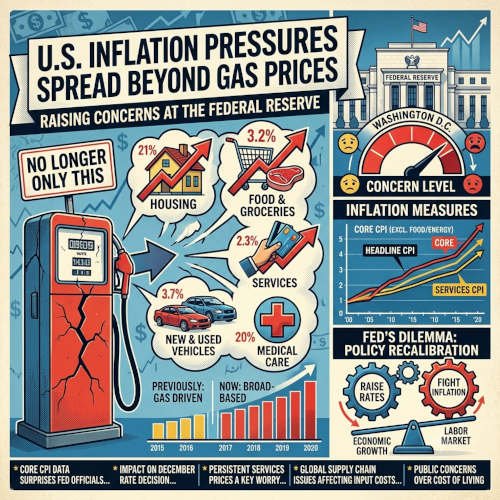
Inflation pressures in the United States are showing signs of spreading across more parts of the economy, creating fresh challenges for consumers and the Federal Reserve. Higher prices are no longer limited to gasoline, energy and products affected by import tariffs. Recent data point to continued increases in several everyday goods and services, raising concerns that inflation could remain elevated for longer than policymakers expected.
The latest Consumer Price Index (CPI) report, released by the U.S. Bureau of Labor Statistics on November 10, showed that consumer prices increased 0.4% in October compared with September. Although this was slower than September’s 0.6% monthly increase, it exceeded economists’ expectations of 0.3%.
The report has strengthened expectations that the Federal Reserve may raise interest rates again in December. Higher borrowing costs could affect mortgage payments, credit cards, auto loans and business financing, adding pressure to households already dealing with high living expenses.
October Inflation Data Raise Fresh Concerns
The October CPI report showed that inflation remains a significant concern despite some moderation in the monthly increase. Consumer prices rose 0.4% during October, following a 0.6% increase in September.
Core inflation, which excludes food and energy because their prices can fluctuate sharply, also increased 0.3% in October. That matched September’s monthly increase and came in above the 0.2% increase economists had expected.
One important detail is that the government did not publish a year-over-year inflation rate for October. A federal government shutdown in October 2025 prevented the collection of the data needed to make that comparison. Therefore, claims that annual inflation rose from 3.7% in September to 4% in October should not be presented as an official October CPI figure.
The monthly figures nevertheless indicate that price pressures remain persistent. Both headline and core inflation increased more than expected, suggesting that the problem extends beyond temporary movements in gasoline and other energy costs.
Price Increases Are Reaching More Consumer Categories
One of the Federal Reserve’s biggest concerns is the possibility that inflation is becoming more widespread. When prices rise across several unrelated categories, it becomes harder for policymakers to explain the problem as a temporary result of one specific event.
The October report showed increases in food, shelter, energy, medical care, insurance and other household expenses. The food index increased 0.5% during the month, while the shelter index rose 0.3%. Energy prices increased 0.7% after a much larger 5.2% increase in September.
Medical care costs also continued to climb. The medical care index increased 0.3% in October, with hospital services rising 0.8% and physicians’ services increasing 0.4%.
Insurance costs remain another pressure point. The insurance index rose 0.7% during the month, adding to the financial burden on households that already face higher expenses for housing, transportation and healthcare.
These increases matter because consumers cannot easily avoid many of these costs. Families may postpone buying a television or upgrading a smartphone, but they still need medical services, insurance, housing and food.
Why Services Inflation Matters to the Fed
Federal Reserve officials are paying particular attention to services inflation because many service prices do not respond immediately to changes in oil prices or international trade costs.
Healthcare, childcare, restaurant meals and hotel stays are examples of services that can remain expensive even when gasoline prices decline. Labor costs, rent, operating expenses and demand can influence these prices.
Lorie Logan, president of the Federal Reserve Bank of Dallas, highlighted these pressures in remarks on November 10. She pointed to continued price increases in services such as doctor visits, childcare, dining out and hotel accommodation.
Logan expressed concern that broader inflation could persist even if energy and manufactured-goods pressures eventually ease. Her comments indicate that policymakers are watching whether price increases have become more deeply established throughout the economy.
Federal Reserve Officials Consider Further Interest Rate Increases
The latest inflation report has increased pressure on the Federal Reserve to keep monetary policy restrictive. The central bank uses interest rates to influence borrowing, spending and investment. When inflation remains too high, policymakers may raise rates to slow economic activity and reduce demand.
Lorie Logan indicated that she supported two additional quarter-point interest rate increases. She also suggested that the Federal Reserve might need to move more quickly during the winter than it did during the autumn.
Her comments are important because Dallas Fed officials participate in monetary policy discussions, and Logan has a vote on the Federal Open Market Committee in 2026.
However, not every policymaker has expressed the same level of concern. Anna Paulson, president of the Federal Reserve Bank of Philadelphia, also questioned whether inflation would decline automatically as temporary pressures disappear. She said underlying inflation remained above the Fed’s target, although she indicated support for gradual rate increases.
The different comments show that policymakers are still evaluating the strength and persistence of inflation before deciding how aggressively to respond.
Christopher Waller Raises the Possibility of a Larger Rate Increase
Federal Reserve Governor Christopher Waller also discussed the possibility of stronger action before the October inflation figures were released.
Waller said that if monthly core inflation reached 0.3% or higher in October, the Fed should consider whether a half-percentage-point rate increase would be appropriate at its December meeting.
The October core CPI reading came in at exactly 0.3%. That result has added importance to Waller’s earlier comments, although it does not mean the Federal Reserve has decided to raise rates by half a percentage point.
A larger increase would represent a more aggressive move than the usual quarter-point adjustment. Policymakers would still need to consider other economic indicators, including employment, consumer spending and the next inflation reports.
Federal Reserve Governor Michelle Bowman also warned that price pressures appeared to be spreading. She said the latest information suggested inflation was no longer concentrated in only a limited number of categories.
How Higher Interest Rates Could Affect American Households
A Federal Reserve rate increase can have consequences far beyond financial markets. Higher interest rates generally make borrowing more expensive, affecting households that depend on credit to purchase homes, vehicles or everyday necessities.
Mortgage rates do not move in perfect lockstep with the Fed’s benchmark rate, but expectations about future monetary policy can influence longer-term borrowing costs. If investors expect interest rates to remain higher, mortgage rates may also face upward pressure.
Credit card customers could feel the impact as well. Many credit cards have variable interest rates linked to benchmark rates. When borrowing costs increase, consumers carrying unpaid balances may pay more interest.
Auto loans and personal loans could also become more expensive, depending on lender pricing and broader market conditions.
Small businesses may face higher costs when borrowing to purchase equipment, expand operations or manage cash flow. Companies that rely heavily on financing could delay investments if credit becomes more expensive.
For households already struggling with food, rent, insurance and healthcare costs, additional borrowing expenses could make financial planning more difficult.
Oil Prices, Iran Conflict and Tariffs Add to Inflation Risks
Energy prices remain an important part of the inflation outlook. The conflict involving Iran has raised concerns about oil supplies, shipping security and transportation costs.
Even when crude oil prices decline, the effects of geopolitical tensions can continue to influence energy markets. Insurance for oil tankers travelling through the Strait of Hormuz and other security-related expenses can add to the cost of transporting fuel.
Christopher Waller noted that these risks could keep some energy costs elevated. He also pointed to diesel supply concerns and limited refining capacity as factors that could affect prices.
Import tariffs represent another source of potential pressure. When businesses pay more to bring products into the United States, some may pass those additional expenses on to customers.
The Federal Reserve must therefore assess several overlapping forces: energy prices, trade costs, strong demand and rising prices in services. If these pressures continue together, inflation could prove more difficult to control.
Artificial Intelligence Investment Is Adding to Some Costs
The rapid expansion of artificial intelligence infrastructure is another factor attracting attention from economists and policymakers.
Technology companies are investing heavily in data centers, computing equipment and electricity infrastructure. This demand has increased competition for certain components and materials, including computer chips, copper and power-generation equipment.
The October CPI report also showed increases in some technology-related consumer products. Smartphone prices rose 1.4% from September to October, while television prices increased 3.3%. Computer prices rose 0.5%.
These movements are notable because consumer electronics have historically benefited from technological improvements that often reduce prices over time.
However, it would be inaccurate to attribute all these increases to artificial intelligence investment. Product pricing can reflect several factors, including production costs, supply conditions, tariffs and consumer demand.
What the December Federal Reserve Meeting Could Mean
The Federal Reserve’s next scheduled policy meeting is set for December 8–9, 2026. Investors are watching the meeting closely because the latest inflation report has strengthened expectations of another rate increase.
Market expectations can change quickly as new economic information becomes available. Futures-market pricing reflects investor estimates, not a confirmed decision by the Federal Reserve.
Policymakers will have to assess whether inflation is continuing to spread and whether the labor market and broader economy can withstand additional monetary tightening.
A quarter-point increase would represent a more gradual approach. A half-point increase would signal a stronger response to inflation, particularly if policymakers believe price pressures are becoming entrenched.
The central bank will also need to consider the possibility that raising rates too aggressively could weaken economic growth and increase financial pressure on households and businesses.
What Americans Should Watch Next
Consumers should pay attention to upcoming inflation reports, Federal Reserve announcements and changes in borrowing costs. The next CPI report, covering November 2026, is scheduled for December 10, according to the Bureau of Labor Statistics.
The Federal Reserve will also examine other economic indicators before making its next decision. These include consumer spending, employment conditions, wages and measures of underlying inflation.
For households, the practical issue is how long higher prices will continue to affect monthly budgets. Families with variable-rate debt may be particularly exposed if borrowing costs rise further.
Homebuyers should monitor mortgage rates rather than assuming that a Federal Reserve announcement will produce an immediate, identical change in mortgage pricing. Credit card customers may also benefit from reviewing outstanding balances and interest charges.
Conclusion: Inflation Remains a Major Challenge for the Federal Reserve
The latest U.S. inflation report has raised concerns that higher prices are spreading beyond gasoline, energy and tariff-affected goods. Increases in food, shelter, healthcare, insurance and other services suggest that inflation remains a broad economic challenge.
Federal Reserve officials are divided over how quickly interest rates should rise, but several have warned that inflation may not decline without further action. The December 8–9 meeting could therefore become an important moment for monetary policy and the financial outlook for American households.
For now, consumers and investors face continued uncertainty. The direction of inflation, energy prices and borrowing costs will help determine whether the Federal Reserve chooses a gradual response or a more aggressive effort to bring price increases under control.
Frequently Asked Questions
Why are inflation pressures worrying the Federal Reserve?
Inflation is increasing across several categories, including food, shelter, medical care and insurance. This suggests that price increases may be spreading beyond temporary energy and tariff-related pressures.
What was the U.S. inflation rate in October 2026?
The Consumer Price Index increased 0.4% from September to October. Core CPI, which excludes food and energy, rose 0.3%. The government did not publish an official year-over-year CPI rate for October because comparable data for October 2025 were unavailable following the federal government shutdown.
Will the Federal Reserve raise interest rates in December 2026?
Investors have increased their expectations of a December rate hike following the latest inflation report. However, the Federal Reserve has not confirmed its decision, and policymakers will review additional economic data before the meeting.
How could higher Fed interest rates affect mortgage rates?
Higher Federal Reserve rates can influence broader borrowing costs and market expectations. Mortgage rates may rise when investors expect monetary policy to remain tighter, although mortgage rates do not move directly in line with every Fed decision.
Why is core inflation important?
Core inflation excludes food and energy prices, which can change sharply over short periods. It helps policymakers assess whether price increases are spreading through the wider economy and becoming persistent.
When is the next Federal Reserve meeting?
The Federal Open Market Committee is scheduled to meet on December 8 and 9, 2026. Its decision will depend on economic conditions and the information available to policymakers at that time.
Sources and References
- U.S. Bureau of Labor Statistics: October 2026 Consumer Price Index report — https://www.bls.gov/news.release/cpi.nr0.htm
- Federal Reserve: Speeches and policy announcements — https://www.federalreserve.gov/newsevents.htm
- Associated Press: Reporting on inflation pressures and Federal Reserve officials — https://apnews.com/article/inflation-gas-federal-reserve-prices-1318a1694472e2926e0a4ab5d8ca6457
SEO Title: U.S. Inflation Spreads Beyond Gas Prices as Fed Weighs Rate Hikes
Meta Description: U.S. inflation pressures are spreading across food, healthcare, insurance and services, raising concerns about higher interest rates and borrowing costs.
Primary Keyword: U.S. inflation
Secondary Keywords: Federal Reserve interest rates, October 2026 inflation, U.S. CPI report, inflation in America, Fed rate hike December 2026, mortgage rates, core inflation, rising consumer prices
Suggested URL Slug: us-inflation-pressures-spread-fed-rate-hike-concerns-november-2026
Category: U.S. Economy / Finance
Tags: U.S. Inflation, Federal Reserve, Fed Interest Rates, CPI Report, October 2026 Inflation, Mortgage Rates, Consumer Prices, American Economy