
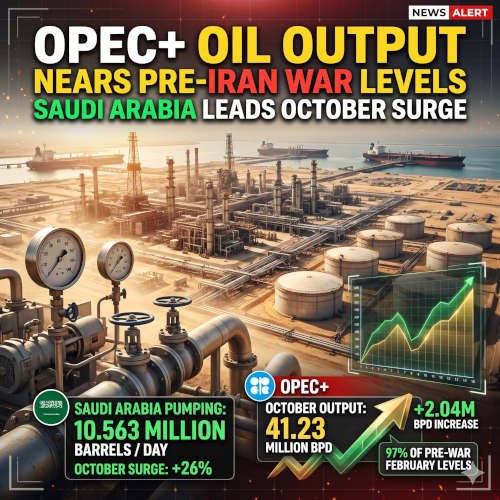
OPEC+ oil production climbed to 41.23 million barrels per day in October 2026, reaching 97% of its pre-Iran war level. Saudi Arabia led the recovery with a major increase in crude oil output, even as shipping disruptions continued through the Strait of Hormuz.
Global oil supply showed signs of recovery in October as Saudi Arabia and other major producers increased crude oil production despite continuing disruption from the Iran war. According to the latest monthly report from the Organization of the Petroleum Exporting Countries (OPEC), the wider OPEC+ alliance pumped approximately 41.23 million barrels per day (bpd) during the month.
That represented an increase of about 2.04 million bpd from September. It also brought the group’s production to approximately 97% of its February 2026 level, the final month before the conflict disrupted oil production and shipments across parts of the Middle East.
Saudi Arabia accounted for much of the increase. The kingdom reported October production of 10.563 million bpd to OPEC, compared with 8.372 million bpd in September.
The latest figures are important for the global crude oil market because they suggest that major Gulf producers are finding ways to restore production and move more oil despite security risks around critical shipping routes. However, higher production does not automatically mean that international oil supplies have returned to normal.
OPEC+ Oil Production Rises to 41.23 Million Barrels Per Day
OPEC said OPEC+ members produced 41.23 million bpd in October, based on secondary sources cited in its monthly report. The figure was approximately 2.04 million bpd higher than September’s production.
Reuters calculations show that October’s output was equivalent to 97% of the 42.72 million bpd produced by the alliance in February.
The recovery marks a significant improvement after months of supply disruption linked to the Iran conflict. Oil producers across the Gulf have faced difficulties transporting crude through the Strait of Hormuz, a strategically important waterway connecting the Persian Gulf with international markets.
The latest production figures indicate that some producers have managed to increase output while adapting their transportation arrangements. Reuters reported that workarounds, including ship-to-ship oil transfers, have helped Gulf producers recover some export activity.
Nevertheless, the remaining gap between October production and February’s level shows that the market has not completely returned to its pre-war position. Shipping security, insurance costs and the availability of alternative export routes remain important factors for oil supply.
Saudi Arabia Leads the October Oil Production Increase
Saudi Arabia was the biggest contributor to the latest production increase.
The kingdom told OPEC that its crude oil production reached 10.563 million bpd in October, up from 8.372 million bpd in September. The reported figure marked its highest production level since February 2026, when Saudi Arabia reported output of 10.882 million bpd.
The increase highlights Saudi Arabia’s important position in the global oil market. As one of the world’s largest oil producers and a leading OPEC member, the kingdom has significant influence over global crude supply decisions.
Saudi Arabia has historically adjusted production to respond to changing market conditions. It can increase supply when disruptions threaten availability or reduce production when demand weakens and the risk of oversupply grows.
The latest increase also comes as the kingdom works to maintain oil exports despite continuing security challenges in the region.
For energy traders, refiners and oil-importing countries, Saudi production figures are particularly important. Changes in Saudi crude supply can influence expectations about global oil availability, benchmark crude prices and future fuel costs.
Why Saudi Arabia’s Production Increase Matters
Saudi Arabia’s production recovery matters because the country is a major supplier to international oil markets. Higher output can help replace some of the barrels lost during regional disruptions and reduce concerns about an extended supply shortage.
However, the amount of oil produced is only one part of the supply picture. Producers must also transport crude safely, secure shipping capacity and deliver shipments to refineries and buyers.
If transportation routes remain restricted, additional production may not immediately translate into an equivalent increase in oil reaching international markets.
Russia Also Increases Crude Oil Production
Russia contributed to the October recovery as well.
According to secondary sources cited in OPEC’s monthly report, Russian oil production increased by approximately 41,000 bpd from September to reach 8.668 million bpd in October.
The increase followed a period in which Ukrainian attacks on Russian energy infrastructure had created additional challenges for the country’s oil industry.
Reuters reported that a temporary reduction in attacks on Russian refineries may have supported production during October. However, the broader security situation remains uncertain, and any renewed damage to energy infrastructure could affect future output.
Russia is a major participant in OPEC+ and plays an important role in the alliance’s production decisions. Its ability to maintain stable crude production is therefore relevant to the global oil supply outlook.
The latest increase in Russian output, combined with Saudi Arabia’s recovery, helped push total OPEC+ production significantly higher during October.
Strait of Hormuz Disruption Continues to Threaten Oil Supply
Despite the production recovery, the Strait of Hormuz remains a major concern for international energy markets.
The waterway is one of the world’s most important oil transportation routes. Large volumes of crude oil and petroleum products normally pass through it on their way to international buyers, particularly in Asia.
The Iran war has disrupted shipping activity and increased risks for vessels operating in and around the Gulf. Producers and shipping companies have consequently explored alternative arrangements to keep oil moving.
These include using different export routes, ship-to-ship transfers and other logistical measures designed to reduce dependence on the most disrupted shipping corridors.
Reuters reported that October’s higher production figures added to signs that Gulf producers were recovering exports through such workarounds. However, continued attacks and security concerns mean that shipping conditions remain unpredictable.
The distinction between production and exports is essential. A country may pump more crude oil, but international buyers will only receive the additional supply if producers can store, transport and deliver it.
Higher shipping costs and insurance premiums can also increase the final cost of imported oil. Those expenses may eventually affect refinery margins, transportation costs and consumer fuel prices.
OPEC Keeps Its Global Oil Demand Forecasts Unchanged
Alongside its production data, OPEC maintained its forecasts for global oil demand growth in 2026 and 2027.
The producer group expects global oil demand to increase by approximately 180,000 bpd in 2026. It also forecasts growth of 2.55 million bpd in 2027, taking average global demand to around 108.3 million bpd.
The unchanged outlook suggests that OPEC continues to expect a substantial increase in oil consumption next year.
Demand growth is influenced by several factors, including economic activity, industrial production, transportation, aviation and energy consumption in developing economies.
For oil producers, the balance between supply and demand is central to decisions about production levels. If demand grows faster than available supply, crude prices can face upward pressure. If production increases faster than consumption, the market may experience oversupply and weaker prices.
OPEC’s forecasts will therefore remain important for investors, energy companies and governments assessing the future direction of the global oil market.
What Higher OPEC+ Production Could Mean for Crude Oil Prices
The October production increase could influence international crude oil prices by easing some concerns about supply shortages.
When major producers increase output, the additional supply can improve market availability. If exports also recover and demand remains stable, the market may become less vulnerable to sudden supply disruptions.
However, higher production alone does not guarantee lower oil prices.
Crude oil prices respond to a combination of supply, demand, geopolitical risks, shipping costs, inventories, currency movements and expectations about future economic growth.
The continuing conflict involving Iran remains a major source of uncertainty. Any escalation affecting oil infrastructure or shipping routes could quickly reverse some of the confidence created by the production recovery.
Investors also monitor benchmark prices such as Brent crude and West Texas Intermediate (WTI). These benchmarks influence the pricing of many oil contracts and provide important signals for refiners, energy companies and financial markets.
For consumers, changes in crude prices can eventually affect gasoline, diesel, aviation fuel and other petroleum products. The timing and size of those changes depend on refining costs, taxes, distribution expenses and local market conditions.
What Oil Importing Countries Should Watch
Countries that depend heavily on imported crude oil will closely monitor the next developments in OPEC+ production and Gulf shipping.
A sustained recovery in exports could improve supply availability and reduce some of the pressure on international energy markets. However, continued disruption could keep transportation expenses elevated even when production increases.
India and other major oil-importing economies are particularly sensitive to changes in international crude prices because imported petroleum affects trade balances, domestic fuel costs and inflation.
A prolonged increase in crude oil prices can raise expenses for transportation companies, manufacturers and businesses that depend on energy. It can also put pressure on household budgets through higher fuel and transportation costs.
For governments, the challenge is to balance energy security, affordable fuel and economic stability while international oil markets remain exposed to geopolitical risks.
What Happens Next for OPEC+ and the Oil Market?
OPEC+ production figures will remain a major focus as the alliance prepares for its next ministerial meeting on November 29, 2026. The group’s decisions will help shape expectations about production policy and supply conditions heading into 2027.
Market participants will also watch whether Saudi Arabia and Russia can maintain their higher output levels and whether other Gulf producers continue restoring production and exports.
The next important question is whether the improvement seen in October can continue without further disruption to shipping routes or energy infrastructure.
If production and exports recover together, global oil supply conditions could become more stable. But if the Strait of Hormuz remains exposed to security threats, oil prices may continue to reflect a geopolitical risk premium.
Frequently Asked Questions About OPEC+ Oil Production
1. How much oil did OPEC+ produce in October 2026?
OPEC+ produced approximately 41.23 million barrels per day in October 2026, based on secondary sources cited in OPEC’s monthly report. This was about 2.04 million bpd higher than September.
2. How close is OPEC+ production to pre-Iran war levels?
October production reached approximately 97% of the alliance’s February 2026 output of 42.72 million bpd.
3. How much oil did Saudi Arabia produce in October 2026?
Saudi Arabia reported crude oil production of 10.563 million bpd to OPEC in October, compared with 8.372 million bpd in September.
4. Why did Saudi Arabia increase oil production?
The increase came as the kingdom worked to restore output and maintain its position in global energy markets despite disruption caused by the Iran war. Saudi Arabia regularly adjusts production in response to market conditions and supply risks.
5. Did Russia increase oil production in October?
Yes. Russia’s production increased by approximately 41,000 bpd from September to reach 8.668 million bpd in October, according to secondary sources cited by OPEC.
6. Will higher OPEC+ production reduce gasoline prices?
Higher crude oil production may ease supply pressure, but it does not guarantee lower gasoline prices. International crude benchmarks, refining costs, taxes, transportation expenses and local market conditions also influence retail fuel prices.
7. Why is the Strait of Hormuz important to global oil prices?
The Strait of Hormuz is a major route for international oil shipments. Disruptions can delay deliveries, increase shipping and insurance costs, and create concerns about global energy supply.
8. What is OPEC’s oil demand forecast for 2027?
OPEC expects global oil demand to grow by approximately 2.55 million bpd in 2027, reaching an average of around 108.3 million bpd.
Final Outlook
The October 2026 production figures show that OPEC+ is moving closer to its pre-Iran war oil output level, with Saudi Arabia leading the recovery and Russia also recording an increase. The improvement offers some reassurance to global energy markets, but the recovery remains vulnerable to shipping disruptions and geopolitical tensions.
For investors, oil companies, governments and consumers, the next few weeks will be important. The direction of crude oil prices will depend not only on how much oil producers pump, but also on how much they can safely deliver to international markets.
SEO Title: OPEC+ Oil Output Nears Pre-Iran War Levels as Saudi Arabia Boosts Production
Meta Description: OPEC+ oil production rose to 41.23 million barrels per day in October 2026, reaching 97% of pre-war levels as Saudi Arabia led the recovery.
Primary Keyword: OPEC+ oil production
Secondary Keywords: Saudi Arabia oil production October 2026, global crude oil supply, OPEC oil output, oil prices today, crude oil prices, Strait of Hormuz disruption, global oil market outlook, oil and gas market, energy market news, international oil prices.
Suggested Category: Business / Energy News
Tags: OPEC+, Saudi Arabia, crude oil, oil production, oil prices, Russia, Strait of Hormuz, Iran war, global energy market, energy news.
Image SEO
- Image Title: OPEC+ Oil Production Rebounds in October 2026
- Image Alt Text: Saudi Arabia leads OPEC+ oil production increase in October 2026 as output approaches pre-Iran war levels.
- Image Caption: OPEC+ oil production climbed to 41.23 million barrels per day in October, with Saudi Arabia driving much of the increase.
- Image Description: News illustration showing oil pump jacks and the Saudi Arabian flag, representing the recovery in OPEC+ crude oil production despite continuing disruption to Gulf shipping routes.
References:
- Reuters: OPEC+ oil output in October nears pre-Iran war rate, led by Saudi Arabia.
- OPEC: Official production policy statements and market updates.