
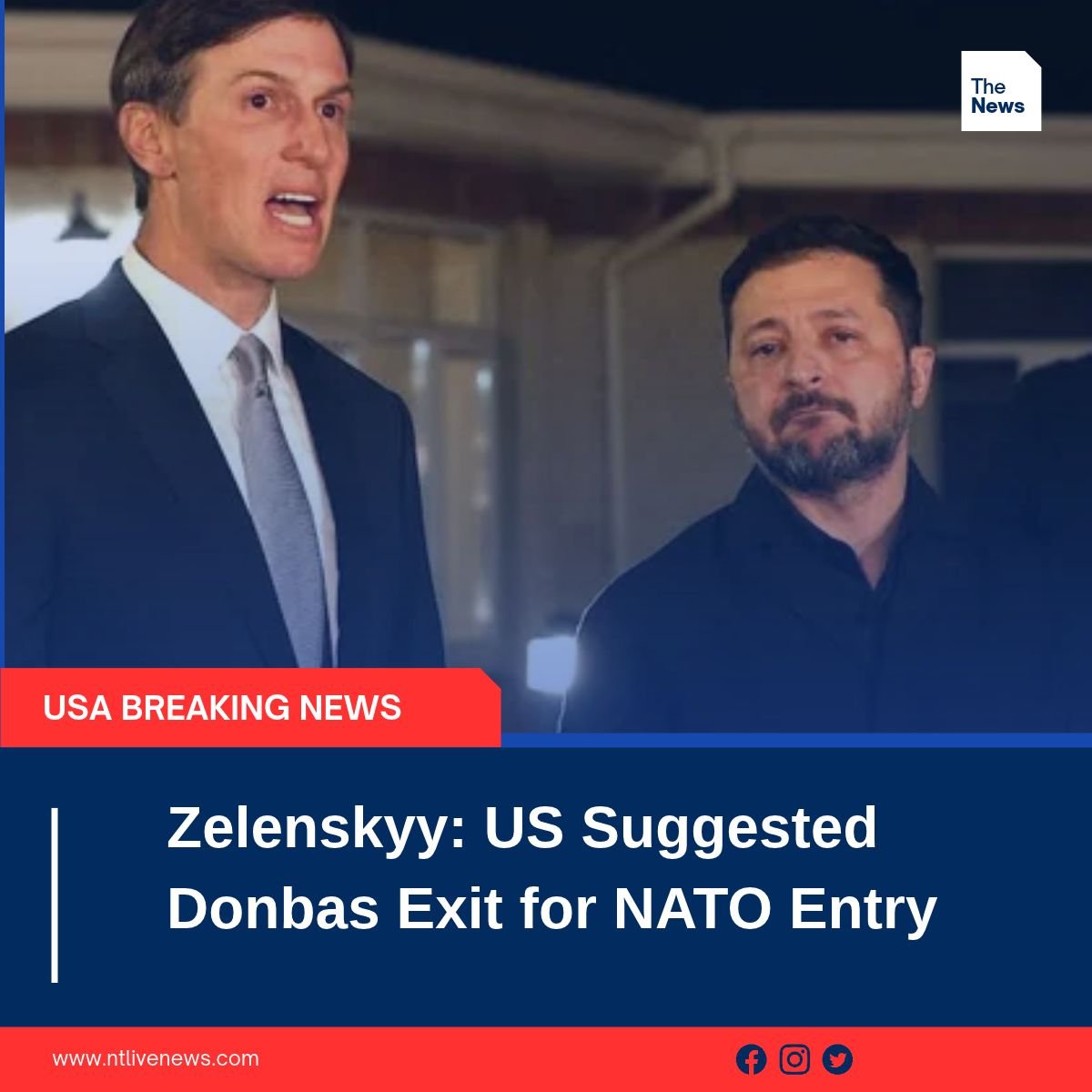
Ukrainian President Volodymyr Zelenskyy says US negotiators have raised a significant question during recent peace discussions: Would Ukraine withdraw its remaining forces from the eastern Donbas region if it were allowed to join NATO?
The reported proposal could reshape discussions about ending Russia’s war against Ukraine, which began with Moscow’s full-scale invasion in February 2022. However, Zelenskyy stressed that Ukraine has no intention of recognizing occupied Ukrainian territory as Russian land.
He also made clear that no final agreement exists. Any possible arrangement would require specific security guarantees, continued military support and a funded plan to rebuild Ukraine. Zelenskyy said he would consult the Ukrainian public rather than make such a decision alone.
The comments, reported on November 14, 2026, followed US-mediated discussions involving Ukrainian and Russian representatives in Abu Dhabi earlier in the week.
Zelenskyy Says US Raised Donbas Withdrawal Question
Zelenskyy told reporters on November 13 that American negotiators had asked whether Ukraine would leave Donbas if the country joined NATO.
He described it as the first time the question had been raised in this form during the negotiations.
The Ukrainian president said his government had repeatedly rejected the idea of voluntarily surrendering national territory. He emphasized that Ukraine would not recognize areas occupied by Russia as legally belonging to Moscow.
However, Zelenskyy did not completely dismiss discussing a wider security arrangement with international partners. He said that if the United States and other NATO countries presented clear and concrete guarantees, he would explain the potential benefits and disadvantages to the Ukrainian public.
His comments indicate that the discussion remains exploratory. Washington has not publicly confirmed the proposal described by Zelenskyy, and no finalized agreement has been announced.
The distinction is important because a question raised during negotiations does not automatically represent an approved US policy or a formal offer accepted by Ukraine.
What Is Donbas and Why Does It Matter?
Donbas is an industrial and strategically important region in eastern Ukraine. It primarily includes the Donetsk and Luhansk regions, which have been at the center of the conflict between Ukraine and Russia.
Russia has supported separatist forces in parts of eastern Ukraine since 2014. Following its full-scale invasion in February 2022, Moscow expanded its military operations and occupied additional territory.
In September 2022, Russia announced the annexation of Donetsk and Luhansk, along with two other Ukrainian regions. Ukraine and most of the international community rejected those claims.
Russian forces control substantial areas of Donbas, but Ukrainian troops continue to hold territory in the region.
Moscow has repeatedly demanded that Ukraine withdraw from the remaining areas of Donetsk that it does not control. Kyiv has rejected demands that would require it to abandon territory or recognize Russia’s annexation claims.
That makes Donbas one of the most difficult issues in negotiations aimed at ending the war.
For Ukraine, withdrawing from the remaining territory would carry major military, political and security consequences. For Russia, gaining control of the entire region has remained a central objective.
NATO Membership Returns to the Negotiating Discussion
Zelenskyy’s comments have renewed attention on Ukraine’s potential membership in the North Atlantic Treaty Organization.
NATO is a military alliance of 32 countries in Europe and North America. Its collective-defense principle, outlined in Article 5 of the North Atlantic Treaty, states that an armed attack against one member is considered an attack against all members.
Ukraine is not currently a NATO member. It has sought membership for years, arguing that joining the alliance would provide stronger protection against another Russian invasion.
Russia strongly opposes Ukrainian membership. President Vladimir Putin has repeatedly described NATO expansion and Ukraine’s potential entry into the alliance as major security concerns for Moscow.
Before the latest discussions, US officials had indicated that Ukrainian NATO membership was not part of the available peace framework. The question described by Zelenskyy therefore represents a notable development in the diplomatic conversation.
However, NATO membership cannot be granted by the United States alone. The alliance operates through decisions made by its member countries, which must agree on the terms of admitting a new member.
Even if Washington supports a possible arrangement, other NATO governments would need to consider and approve any membership proposal.
What Security Guarantees Does Ukraine Want?
Zelenskyy said Ukraine is discussing a comprehensive security package with the United States, European partners and NATO countries.
He identified several important elements that would need to be included before Ukraine could seriously consider a major territorial compromise.
1. Clear security guarantees
Ukraine wants specific commitments from the United States, NATO countries and European partners to help prevent another Russian attack.
Zelenskyy has repeatedly referred to guarantees modeled on NATO’s Article 5. Such arrangements would need to explain what countries would be required to do if Russia attacked Ukraine again.
2. A strong Ukrainian military
The president said Ukraine would need to maintain an adequately equipped and funded armed force.
That includes sufficient troops, weapons, military equipment and financial support over an agreed period.
Kyiv is concerned that a peace agreement without a capable Ukrainian military could leave the country vulnerable to another invasion.
3. Long-term financial assistance
Ukraine also wants reliable funding to support its defense and economic recovery.
Zelenskyy referred to a proposed Prosperity Plan that would provide reconstruction assistance through clearly identified funding sources.
The plan would be important because years of fighting have damaged infrastructure, homes, energy facilities and industrial operations across the country.
4. Specific commitments from international partners
Zelenskyy emphasized that general promises would not be enough.
Ukraine wants details explaining how the guarantees would work, which countries would participate and what support would become available during a future security crisis.
Without those details, the Ukrainian government cannot properly assess the consequences of any proposed arrangement.
Zelenskyy Says Ukrainian Citizens Must Have a Say
One of the most important parts of Zelenskyy’s statement concerned the role of the Ukrainian public.
He said he could not make a decision about such a significant territorial and security arrangement on his own.
If the United States and other NATO partners confirmed a comprehensive proposal, he would present the details to Ukrainian citizens and explain the possible advantages and disadvantages.
That approach recognizes the political sensitivity of territorial concessions after years of war and civilian suffering.
Any proposal involving the withdrawal of Ukrainian forces from Donbas would likely generate difficult questions about national sovereignty, the security of residents and the future of occupied communities.
Zelenskyy did not announce that a referendum had been scheduled. He said that public consultation would be necessary if a concrete proposal emerged.
He also maintained that Ukraine would not legally recognize occupied territories as Russian, even if negotiations involved changes to military positions.
Abu Dhabi Peace Talks Produce No Major Breakthrough
The reported US question emerged after trilateral discussions involving representatives from Ukraine, Russia and the United States in Abu Dhabi on November 10 and 11.
The meetings were part of Washington’s continuing diplomatic efforts to bring the war toward an end.
Following the discussions, US envoys Steve Witkoff and Jared Kushner held separate meetings with Russian President Vladimir Putin and Zelenskyy.
The negotiations addressed several issues, including territorial questions, security guarantees and possible steps to reduce fighting.
However, the latest round did not produce a comprehensive peace agreement.
One development involved preparations for a large-scale prisoner exchange. Zelenskyy later described discussions involving approximately 1,200 to 1,300 people on each side, although final arrangements and numbers remained subject to confirmation.
The prisoner exchange discussions represent a potential humanitarian outcome from the diplomatic process, even as major disagreements continue over territory and security.
The absence of a broader breakthrough shows how difficult it remains for Ukraine and Russia to reach terms that both governments would accept.
Russia’s Position Remains a Major Obstacle
Russia has consistently demanded that Ukraine withdraw from territory in Donetsk that remains under Kyiv’s control.
Moscow has also opposed Ukraine joining NATO, arguing that the alliance’s presence near Russian territory would threaten its security interests.
These positions create a major problem for any proposal linking Donbas withdrawal with NATO membership.
Ukraine wants stronger protection against future Russian aggression, while Russia has opposed the very alliance that Kyiv views as an important security guarantee.
There is also uncertainty over whether Moscow would accept an arrangement involving Ukrainian NATO membership, even if Ukraine withdrew from parts of Donbas.
No Russian agreement to the reported proposal has been announced.
The Kremlin’s position on territorial control and NATO expansion will therefore remain central to the next stage of negotiations.
What Happens Next in the Ukraine Peace Negotiations?
The next phase of diplomacy will likely focus on clarifying what security guarantees the United States and European partners could provide.
Ukraine will need to understand whether those guarantees would be legally binding, how military assistance would be delivered and what financial resources would support reconstruction.
NATO members would also need to discuss whether membership is realistically available under any proposed territorial arrangement.
Meanwhile, Russia’s demands over Donbas remain unresolved.
European governments are also seeking a role in discussions about the continent’s long-term security. Their participation matters because any agreement affecting Ukraine and NATO could have consequences well beyond the immediate battlefield.
For now, Zelenskyy’s statement has revealed a new question in the diplomatic process, not a completed agreement.
The future of Donbas, Ukraine’s NATO ambitions and the security of the country remain closely connected. Whether negotiators can turn these discussions into a workable peace framework remains uncertain.
Frequently Asked Questions
1. Did the United States offer Ukraine NATO membership in exchange for Donbas?
Zelenskyy said US negotiators raised the question of whether Ukraine would withdraw from Donbas if it joined NATO. Washington had not publicly confirmed a formal offer as of November 14, 2026.
2. What is Donbas in Ukraine?
Donbas is an eastern Ukrainian region primarily comprising Donetsk and Luhansk. It has been a major focus of the Russia-Ukraine conflict since 2014.
3. Does Ukraine agree to withdraw from Donbas?
No final agreement exists. Zelenskyy has maintained that Ukraine will not voluntarily surrender its territory or recognize Russian occupation claims.
4. Would Ukraine’s NATO membership guarantee its security?
NATO’s Article 5 provides collective-defense commitments to member countries. However, Ukraine is not currently a member, and any future membership would require agreement from NATO’s existing members.
5. Will Ukrainians vote on a possible Donbas agreement?
Zelenskyy said he would present any concrete proposal to the Ukrainian public for discussion. He did not announce a referendum date or confirm that a vote would take place.
6. What happened during the November 2026 Abu Dhabi talks?
Representatives from Ukraine, Russia and the United States held discussions on November 10 and 11. They did not reach a major peace breakthrough but made progress toward preparations for a large-scale prisoner exchange.
7. Does Russia support Ukraine joining NATO?
No. Russia has strongly opposed Ukraine’s NATO membership and has repeatedly described the alliance’s expansion as a security concern.
Conclusion: Zelenskyy’s statement has brought the Donbas territorial dispute and Ukraine’s NATO ambitions back to the center of international diplomacy. Although the United States reportedly raised the possibility of linking withdrawal from Donbas with NATO membership, no confirmed agreement exists. Ukraine is demanding clear security guarantees, military support and reconstruction funding before considering any major proposal.