
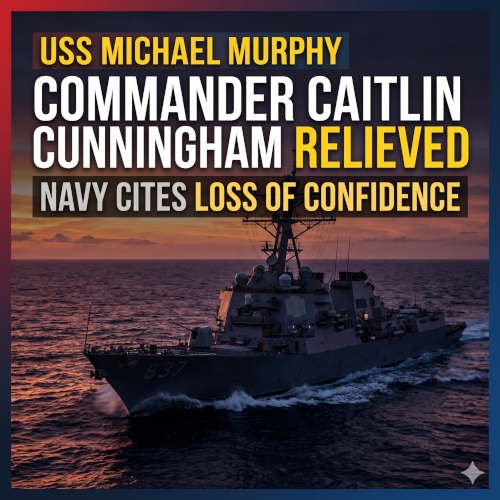
The U.S. Navy quietly removed Cmdr. Caitlin Cunningham from her position as commanding officer of the guided-missile destroyer USS Michael Murphy on September 27, 2026, citing a “loss of confidence to command.” The decision took place while the warship was still deployed in the Middle East, but the Navy did not publicly disclose the leadership change until November, after the destroyer returned to Hawaii.
The announcement has raised questions about the Navy’s handling of command dismissals, particularly because the service has not explained what led to Cunningham’s removal. The decision also came during an extended deployment involving operations connected to the conflict with Iran and the U.S. naval blockade of the Strait of Hormuz.
However, the Navy has not publicly accused Cunningham of misconduct, identified a specific operational failure or confirmed that an investigation is underway. The available information therefore leaves the central question unanswered: why was the USS Michael Murphy commander relieved?
Why the Navy Relieved USS Michael Murphy Commander Caitlin Cunningham
The Navy confirmed that Cunningham was removed from command on September 27, according to reporting by USNI News and other defense publications. A Navy official described the decision as a “loss of confidence to command,” but did not provide a detailed explanation.
Rear Adm. Todd F. Cimicata, commander of Carrier Strike Group 10, reportedly made the decision to relieve Cunningham. She had assumed command of the USS Michael Murphy in October 2025, meaning her leadership ended less than a year after taking charge.
The Navy’s wording is important. A loss-of-confidence decision means military leadership no longer believes an officer should continue in a particular command position. However, the phrase does not automatically establish that the officer committed misconduct or violated military rules.
The Navy has not publicly identified the circumstances behind Cunningham’s removal. It has also not released details about any disciplinary action, investigation or specific incident connected to the decision.
Cunningham has not publicly commented in the reports available as of November 14, 2026.
What Does “Loss of Confidence to Command” Mean?
The phrase “loss of confidence” is commonly used by the U.S. military when senior officials remove an officer from a leadership position.
It can apply to different circumstances, including concerns about leadership, performance, judgment, operational decisions or personal conduct. In some cases, a commander’s removal follows an accident or operational incident. In others, the reasons may involve matters that have not been disclosed publicly.
The phrase itself does not explain which circumstances apply.
For that reason, Cunningham’s removal should not be treated as proof of wrongdoing. The Navy has provided no public finding establishing that she committed misconduct, mishandled an operation or caused an incident aboard the destroyer.
The absence of a detailed explanation also means that outside observers cannot determine whether the decision involved operational performance, leadership concerns or another matter.
When Was Cunningham Removed From Command?
Cunningham was relieved on September 27, while the USS Michael Murphy was still deployed. USNI News reported the change on November 12, following confirmation from a Navy spokesperson.
The timing is significant because the Navy did not announce the removal when it happened. Instead, the change became public weeks later, during the same week the destroyer returned to its homeport in Hawaii.
Cunningham had taken command on October 24, 2025, according to USNI News. Her tenure therefore lasted approximately 11 months.
The available reports do not explain why the Navy waited to disclose the decision or whether officials considered the change a matter requiring a public announcement at the time.
USS Michael Murphy Returns After 346 Days at Sea
The leadership change became public as the USS Michael Murphy completed one of its longest deployments in recent years.
The Arleigh Burke-class guided-missile destroyer returned to Joint Base Pearl Harbor-Hickam, Hawaii, on November 12, 2026, after spending 346 days away from its homeport.
According to the U.S. Department of Defense’s Defense Visual Information Distribution Service (DVIDS), the ship departed Pearl Harbor on December 1, 2025. It operated across the U.S. 3rd, 7th and 5th Fleet areas of responsibility during the deployment.
The destroyer initially operated with the USS Abraham Lincoln carrier strike group before moving into the Middle East as military operations developed.
Its deployment included operations connected to Operation Epic Fury, maritime security activities and the U.S. naval blockade targeting Iranian ports.
The ship’s return brought relief to sailors’ families after nearly a year apart. Local reporting described emotional reunions as crew members returned to Hawaii.
The homecoming also brought renewed attention to the fact that Cunningham had been removed while the ship was still at sea.
What the Destroyer Did During the Iran Operations
The USS Michael Murphy played a role in U.S. naval operations in the Middle East during its deployment.
Reporting by Task & Purpose described the destroyer’s involvement in enforcing the naval blockade of the Strait of Hormuz, escorting tankers and responding to Iranian drone and missile threats.
The ship also conducted Tomahawk cruise missile strikes, according to reporting about its deployment. These operations placed the destroyer in a demanding operational environment.
The Strait of Hormuz is one of the world’s most strategically important maritime routes. It connects the Persian Gulf with the Gulf of Oman and the Arabian Sea, making it important for international energy shipments and commercial shipping.
The destroyer’s extended deployment meant its sailors operated away from their homeport for 346 days. The USS Abraham Lincoln returned to San Diego in early October, while the Michael Murphy remained deployed before eventually arriving in Hawaii in November.
Importantly, the operational history does not establish a connection between those missions and Cunningham’s removal. The Navy has not publicly linked the decision to a combat incident, missile strike, blockade operation or other specific event.
Who Commands the USS Michael Murphy Now?
Cmdr. David Nicolas was identified as the destroyer’s current commanding officer when it returned to Pearl Harbor.
Nicolas spoke about the crew’s performance during the homecoming and praised the sailors for their work throughout the extended deployment.
The Navy’s official homecoming coverage identified him as the ship’s commanding officer. However, some media reports spell his surname as Nicholas, creating a minor discrepancy in published coverage.
Task & Purpose reported that Nicolas took over after Cunningham’s removal. Stars and Stripes reported that he had led the ship for approximately a month before its November 12 return.
The available reports do not fully explain the command transition or identify every officer who may have temporarily held responsibility between Cunningham’s departure and Nicolas’s appointment.
The Navy has not publicly provided a detailed timeline explaining the leadership arrangements during that period.
Why the Delayed Announcement Is Raising Questions
The timing of Cunningham’s removal has attracted attention because the Navy did not publicly announce the decision in September.
Traditionally, the Navy has disclosed significant changes involving commanding officers, particularly when an officer is relieved of duty. The delayed disclosure has therefore raised questions about transparency and how the service communicates personnel decisions.
The issue has gained additional attention because another Navy command team was removed in October.
On October 14, 2026, the commanding officer, executive officer and chief of the boat aboard the submarine USS South Dakota were relieved of their positions.
Reps. Joe Courtney and Adam Smith raised concerns about the Navy’s failure to notify the House Armed Services Committee about those removals. In a November 12 letter to Navy leadership, the lawmakers said the committee had not received the customary information about the personnel changes.
The letter described the lack of communication as unacceptable and emphasized the importance of sharing information about at-sea incidents, accidents and command dismissals.
The USS South Dakota case is separate from Cunningham’s removal. The circumstances also differ: the lawmakers’ letter discussed an alleged grounding incident involving the submarine, while the Navy has not publicly identified a comparable incident involving the USS Michael Murphy.
Nevertheless, the two cases have placed renewed attention on the Navy’s communication practices.
What Congress Wants the Navy to Explain
Courtney and Smith called on acting Navy Secretary Hung Cao and Chief of Naval Operations Adm. Daryl Caudle to address the submarine command changes.
Their November 12 letter focused on the USS South Dakota and the Navy’s failure to inform the committee about the October 14 dismissals.
The lawmakers argued that timely communication helps Congress oversee military readiness, personnel decisions and operational safety.
Their concerns are relevant to the broader discussion about how the Navy reports command changes, although their letter does not establish that the Navy violated a specific legal requirement in Cunningham’s case.
The separate incidents have also drawn attention to other senior Navy personnel changes reported in November, including the departure of Rear Adm. Brian Monahan amid an investigation by the Defense Department’s inspector general.
These developments have increased scrutiny of the Navy’s handling of leadership transitions and public disclosures.
What Remains Unknown About Cunningham’s Removal
Several important questions remain unanswered as of November 14, 2026.
First, the Navy has not explained the specific reason for removing Cunningham. Its public statement only cited a loss of confidence to command.
Second, officials have not confirmed whether an investigation was conducted or whether any findings will eventually become public.
Third, the Navy has not explained why it did not announce the leadership change immediately after September 27.
There is also no publicly confirmed evidence connecting Cunningham’s removal to the destroyer’s combat operations, its role in the Strait of Hormuz blockade or any particular incident during the deployment.
These unanswered questions matter because command dismissals can have different causes and consequences. Without additional information, it would be inaccurate to present one explanation as established fact.
The Navy may provide further details in response to media inquiries or congressional questions, but no additional explanation was included in the reporting available at the time of publication.
What Happens Next for the USS Michael Murphy?
The USS Michael Murphy has now returned to Pearl Harbor following its extended deployment. Its crew members can reunite with their families while the ship returns to its homeport schedule.
The broader questions surrounding Cunningham’s removal remain separate from the destroyer’s homecoming.
Attention is likely to remain on whether the Navy provides a clearer explanation of the September decision and whether its approach to announcing command dismissals changes following congressional criticism.
For now, the confirmed information is limited: Cunningham was relieved on September 27, the Navy cited a loss of confidence, and the service has not publicly explained the underlying reason.
Until officials release further details, the circumstances behind her removal remain unknown.
Frequently Asked Questions About USS Michael Murphy Commander Caitlin Cunningham
1. Why was USS Michael Murphy commander Caitlin Cunningham relieved?
The Navy said Cunningham was removed because of a “loss of confidence to command.” Officials have not publicly explained the specific reason behind the decision.
2. When was Caitlin Cunningham removed from command?
Cunningham was relieved on September 27, 2026, while the USS Michael Murphy was still deployed in the Middle East.
3. Who relieved Cmdr. Caitlin Cunningham?
Rear Adm. Todd F. Cimicata, commander of Carrier Strike Group 10, reportedly made the decision.
4. Did the Navy accuse Cunningham of misconduct?
No public accusation of misconduct has been identified in the reports available as of November 14, 2026. The Navy has not provided details explaining its loss-of-confidence decision.
5. Who is the current commander of the USS Michael Murphy?
Cmdr. David Nicolas was identified as the ship’s commanding officer when it returned to Pearl Harbor on November 12, 2026.
6. When did the USS Michael Murphy return to Hawaii?
The guided-missile destroyer returned to Joint Base Pearl Harbor-Hickam on November 12, 2026, after 346 days away from its homeport.
7. Was the USS Michael Murphy involved in operations against Iran?
Yes. The destroyer participated in U.S. naval operations in the Middle East, including activities connected to Operation Epic Fury and the blockade targeting Iranian ports.
8. Has the Navy explained why it delayed announcing Cunningham’s removal?
No. The Navy has not publicly explained why the September 27 leadership change was not disclosed until November.
Sources and Reporting References
- USNI News: Navy Quietly Removed USS Michael Murphy Commander in September — https://news.usni.org/2026/11/12/navy-quietly-removes-uss-michael-murphy-commander
- U.S. Department of Defense DVIDS: USS Michael Murphy Returns to Pearl Harbor Following an 11-Month Combat Deployment — https://www.dvidshub.net/news/printable/579226
- Task & Purpose: Navy Quietly Relieved USS Michael Murphy Commander — https://taskandpurpose.com/news/navy-uss-michael-murphy-caitlin-cunningham-fired/
- Stars and Stripes: Navy Destroyer Returns to Hawaii from Middle East After Nearly a Year at Sea — https://www.stripes.com/branches/navy/2026-11-13/navy-destroyer-11-month-deployment-23450500.html
- U.S. House Armed Services Committee: Courtney and Smith Express Frustration Over Failure to Notify Congress — https://democrats-armedservices.house.gov/2026/11/courtney-smith-express-deep-frustration-over-failure-to-notify-congress-of-uss-south-dakota-command-triad-relief
Editorial Accuracy Note: The Navy’s stated reason is “loss of confidence to command.” Do not describe Cunningham’s removal as a confirmed misconduct case or connect it to a specific combat incident unless the Navy releases supporting information.