
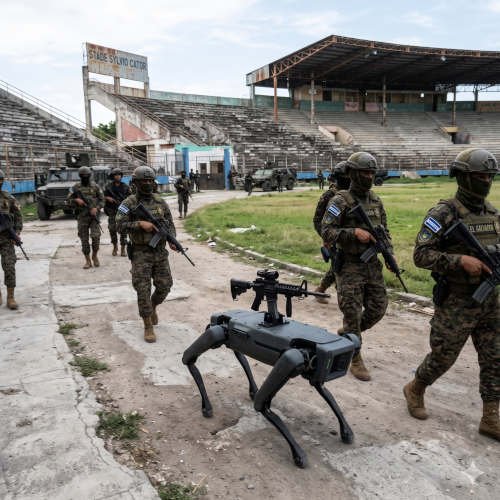
Armed robot dogs have appeared in military footage from Haiti after Salvadoran and Haitian security forces carried out a joint operation to retake the country’s Sylvio Cator Stadium from gang control. The unusual deployment has drawn international attention because the four-legged machines were shown carrying rifles while moving through the stadium.
El Salvador’s President Nayib Bukele released video footage of the operation on November 12 and 13, 2026. The footage showed military personnel moving through the facility alongside robotic devices equipped with firearms.
The operation involved the Haitian National Police, the Haitian Armed Forces, a Haitian government task force, and Salvadoran Special Forces. Bukele said the forces had successfully secured the stadium and planned to establish an operational base there for further action against gangs.
He also reported that several human skulls were discovered inside the sports facility.
However, important questions remain about the robots’ actual role. The published footage shows them carrying rifles, moving through hallways, and climbing stairs, but it does not independently establish that they fired weapons or engaged gang members.
Armed Robot Dogs Appear in Haiti Military Operation
The Haiti robot dogs footage has attracted attention because it shows robotic technology carrying firearms during an actual security operation rather than a conventional military demonstration.
In the video shared by Bukele, four-legged machines can be seen moving alongside Salvadoran military personnel. One sequence shows a robot navigating a narrow hallway, while another shows it climbing a set of stairs.
Other footage reportedly shows armed robots positioned with soldiers inside the stadium.
The machines are designed to move on four mechanical legs, allowing them to navigate environments that may be difficult for traditional wheeled equipment. Depending on their design, robotic platforms can carry cameras, sensors, communication equipment, and other payloads.
However, officials have not released a detailed technical explanation of the machines used in Haiti.
They have also not confirmed whether the robots were remotely controlled throughout the operation or operated with some autonomous functions.
What the Video Shows About the Armed Robots
The footage released by the Salvadoran president provides a limited view of the technology’s deployment.
The most noticeable feature is the rifle mounted on top of each robotic platform. The machines move through parts of the facility while soldiers conduct security operations nearby.
The video does not provide enough information to establish the exact weapon-control system, the robots’ manufacturer, or whether their firearms can be activated remotely.
It is also unclear whether the devices were used primarily for surveillance, reconnaissance, or another operational purpose.
This distinction matters because carrying a firearm does not automatically mean a robotic platform has fired it during an operation.
For now, the footage confirms the presence of armed robotic dogs alongside military personnel in Haiti, but not that the machines participated in a shooting.
Haitian and Salvadoran Forces Retake Sylvio Cator Stadium
The joint operation took place at Sylvio Cator Stadium in Port-au-Prince, Haiti’s capital.
According to Bukele, the mission was conducted under a bilateral security agreement between the Haitian and Salvadoran governments.
The participating forces included the Haitian National Police, the Haitian Armed Forces, a government task force, and Salvadoran Special Forces.
The operation successfully secured the stadium, according to statements from the Salvadoran president and Haitian police.
The stadium had been under gang control for more than two years, according to reporting on the operation. Its recovery represents an important development in efforts to regain access to strategic locations in the capital.
Footage released by Bukele showed military vehicles and armed personnel inside the facility.
The Salvadoran leader said the stadium would become an operational base from which security forces could continue advancing into gang-controlled areas.
Why the Stadium Matters to Haiti’s Security Operations
Sylvio Cator Stadium is a major sports facility in Port-au-Prince. Its location and size make it a potentially important site for security forces operating in the capital.
Gangs have expanded their influence across several parts of Haiti, particularly around Port-au-Prince. Their control of roads, neighborhoods, and public infrastructure has made it difficult for authorities to restore normal government operations.
Recovering a major facility can provide security forces with a position from which to coordinate personnel, vehicles, and future operations.
Bukele described the stadium’s recovery as a significant step in the campaign against armed groups.
He also warned gang members to leave the surrounding area before further operations began.
Bukele Reports Human Skull Discovery Inside the Stadium
Another major development from the operation was Bukele’s claim that security forces discovered several human skulls inside Sylvio Cator Stadium.
In his announcement, the Salvadoran president said the remains were found during the operation to secure the facility.
The video shared by his government reportedly included images of objects appearing to be human skulls among debris inside the stadium.
However, the available public information does not establish the identities of the individuals or explain how the remains came to be inside the sports complex.
There has also been no publicly confirmed forensic report identifying the remains, establishing their age, or connecting them to specific crimes.
The discovery claim adds to concerns about the conditions inside locations previously controlled by armed gangs. Nevertheless, the circumstances surrounding the reported remains require further investigation.
Authorities would need forensic examinations and additional evidence to determine their origin.
Why El Salvador Sent Military Personnel to Haiti
El Salvador’s involvement in Haiti has expanded following an attack in October that left four Salvadoran aviation technicians missing.
The technicians were serving in connection with an international security operation when their armored vehicle came under attack in the Port-au-Prince area.
According to the Associated Press, El Salvador deployed special forces to Haiti to help locate the missing personnel. Bukele announced a military rescue operation and threatened a stronger response if the technicians were not returned safely.
The subsequent deployment increased El Salvador’s military involvement in Haiti.
The operation at Sylvio Cator Stadium is part of the wider security effort involving Salvadoran and Haitian forces.
The situation also highlights the challenges facing international efforts to reduce gang violence in Haiti.
Haiti Continues to Face Serious Gang Violence
Haiti has experienced prolonged instability involving armed criminal groups, weak government institutions, and limited security resources.
Gang coalitions have established influence across parts of the capital and other regions, affecting transportation, businesses, schools, and access to essential services.
Residents have faced displacement, violence, extortion, and disruptions to daily life.
International security assistance has sought to support Haitian authorities in restoring control, but the mission has faced significant operational challenges.
The deployment of Salvadoran personnel adds another international dimension to the effort.
The stadium operation may provide a new position for security forces, but controlling one facility does not automatically mean surrounding neighborhoods are secure.
The effectiveness of the broader campaign will depend on sustained operations, cooperation with Haitian institutions, and the ability to protect civilians.
What Armed Robot Dogs Could Mean for Future Military Operations
The use of rifle-equipped robotic dogs in Haiti raises wider questions about the growing role of unmanned technology in military and security operations.
Four-legged robots can travel through narrow corridors, climb stairs, and move across certain uneven surfaces. Cameras and sensors can help operators observe areas that may be dangerous for soldiers to enter.
Armed versions introduce another layer of complexity because they combine mobile robotic platforms with firearms.
Military organizations in several countries have explored or demonstrated similar technologies.
For example, American defense companies have previously demonstrated robotic platforms equipped with firearms. Other countries have also displayed armed robotic systems during military exercises.
However, demonstrations do not necessarily prove that these systems are reliable or effective in real combat environments.
The footage from Haiti is significant because it shows armed robots accompanying forces during a security operation. Still, it does not establish how much operational responsibility the machines carried.
Questions About Human Control and Weapon Safety
One of the biggest questions surrounding armed robotic dogs is how their weapons are controlled.
A remotely operated system allows a human operator to control the machine or its weapon from a distance. More autonomous systems may perform certain navigation or detection functions without continuous human input.
The distinction is especially important when firearms are involved.
Questions include whether a human must approve every firing decision, how the system identifies potential targets, and what safeguards prevent accidental firing.
The Salvadoran government has not publicly explained these details for the machines shown in Haiti.
Without that information, it would be premature to describe the robots as fully autonomous weapons or claim that they independently selected targets.
What Happens Next in Haiti’s Anti-Gang Operation?
Bukele said the recovered stadium would serve as an operational base for further action in areas controlled by gangs.
He also issued a warning to armed groups operating near the facility, urging members to leave before the next phase of the offensive.
The next challenge will be determining whether security forces can maintain control of the stadium and expand their presence into surrounding neighborhoods.
The operation also raises questions about the protection of civilians who live near gang-controlled areas.
Further developments may clarify the role of Salvadoran forces, the number of robotic systems deployed, and whether the armed platforms will be used in additional operations.
For now, the Haiti robot dogs deployment represents a notable example of military robotics appearing in a real-world security operation.
But the most important unanswered questions remain their actual operational role, the level of human control over their weapons, and whether the broader campaign can improve security for Haitian residents.
Frequently Asked Questions
Why were robot dogs deployed in Haiti?
Armed robotic dogs appeared in footage from a joint Haitian and Salvadoran operation to retake Sylvio Cator Stadium in Port-au-Prince. Their exact operational role has not been fully explained.
Were the robot dogs carrying rifles?
Yes. Video released by Salvadoran President Nayib Bukele showed four-legged robotic platforms carrying rifles during the operation.
Did the robot dogs shoot gang members?
There is no confirmed public evidence that the robots fired their weapons or engaged gang members during the stadium operation.
Who participated in the Sylvio Cator Stadium operation?
The operation involved the Haitian National Police, the Haitian Armed Forces, a government task force, and Salvadoran Special Forces.
What did Bukele say was discovered inside the stadium?
Bukele said security forces discovered several human skulls inside the facility. Their identities and origins have not been publicly established through forensic findings.
Why is El Salvador involved in Haiti?
El Salvador expanded its involvement after four Salvadoran aviation technicians went missing following an attack in Haiti in October 2026. Salvadoran forces were deployed to assist with security and search operations.
Will Sylvio Cator Stadium become a military base?
Bukele said security forces would establish an operational base at the stadium to support further advances into gang-controlled territory.
Are armed robot dogs autonomous?
The Salvadoran government has not explained whether the machines used in Haiti were remotely controlled or had autonomous functions. Their exact weapon-control arrangements remain unclear.
Sources and Further Reading
- Associated Press: https://apnews.com/article/03ec2bf89616d8b313c54da34c24eab1
- The Independent: https://www.independent.co.uk/tv/news/robot-dogs-el-salvador-haiti-stadium-b3084709.html
- The Peninsula: https://thepeninsulaqatar.com/article/14/11/2026/el-salvador-haiti-deploy-robot-dogs-in-national-stadium-joint-operation
- SOFX: https://www.sofx.com/haiti-police-salvadoran-troops-and-armed-robot-dogs-retake-haitis-national-stadium-from-gangs/