
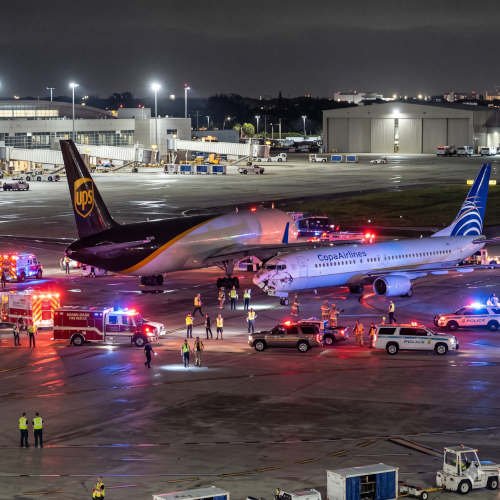
A UPS cargo plane and a Copa Airlines passenger aircraft collided while taxiing at Miami International Airport on Saturday night, November 14, 2026. The incident damaged the aircraft and prompted an emergency response, while two people received medical treatment for minor injuries.
The collision happened at approximately 9:15 p.m. at the intersection of two taxiways, according to airport officials. The Federal Aviation Administration (FAA) confirmed that the wingtip of the Copa Airlines Boeing 737 struck the nose of a UPS Boeing 767.
Although the incident raised immediate concerns about airport safety, officials said the collision did not disrupt overall airport operations. Flights were redirected to other taxiways while emergency personnel responded.
The FAA is investigating the circumstances surrounding the Miami airport plane collision. Officials have not announced a final explanation for how the aircraft made contact.
What Happened in the Miami International Airport Plane Collision?
The collision involved two commercial aircraft moving on the ground at Miami International Airport (MIA) in Florida.
According to the FAA, the Copa Airlines Boeing 737 was taxiing toward its gate after arriving at the airport. At the same time, the UPS Boeing 767 was moving toward its departure position for a scheduled cargo flight to Bogotá, Colombia.
The two aircraft made contact at the intersection of taxiways at approximately 9:15 p.m. Saturday.
The FAA said the wingtip of the Copa Airlines aircraft struck the nose of the UPS cargo plane. Photographs from the scene showed visible damage to the nose area of one aircraft.
The incident was reported to airport authorities, and emergency responders arrived to assess the situation. Miami-Dade Fire Rescue treated two people at the scene for minor injuries.
Neither person required transportation to a hospital, according to Miami-Dade Aviation.
The airport said aircraft movements continued using alternative taxiways. Officials reported no impact on overall airport operations.
Which Aircraft Were Involved in the Collision?
The incident involved a Boeing 767 operated by UPS and a Boeing 737 operated by Copa Airlines.
The UPS aircraft was operating as Flight 358. It was scheduled to depart Miami for Bogotá, the capital of Colombia.
The Copa Airlines aircraft was operating as Flight 427. It had arrived from Panama City, Panama, and was taxiing toward its gate when the collision occurred.
These details are important because the incident involved an arriving passenger aircraft and a departing cargo aircraft moving through the airport’s ground traffic system.
The FAA’s initial statement identified the aircraft involved and described how their structures made contact. Investigators will need to examine the available evidence to establish the complete sequence of events.
What Did Air Traffic Control Tell the UPS Crew?
Air traffic control instructions are an important part of the investigation.
According to the FAA, controllers had instructed the UPS crew to give way to the Copa Airlines aircraft.
Audio from air traffic control captured a pilot reporting the collision. One pilot was heard saying, “Somebody hit us.”
The recording drew attention because it provides an account of the incident as it was reported to controllers. However, radio communication alone does not establish every detail of the aircraft movements or determine responsibility.
Investigators will likely examine the relevant communications, taxiway layout, aircraft positions, and other available records to understand what happened.
The FAA has not announced a final finding about whether a communication issue, taxiway movement, crew action, or another factor contributed to the collision.
Two People Treated for Minor Injuries
Two people received treatment from Miami-Dade Fire Rescue after the aircraft made contact.
Airport officials described the injuries as minor. Neither person needed to be taken to a hospital.
Authorities have not publicly provided further details about the individuals or the exact circumstances of their injuries.
The reported injuries were limited, but any collision involving commercial aircraft requires a careful safety review. Even when an incident happens at low speed on the ground, investigators must assess potential risks to passengers, flight crews, airport workers, and aircraft.
The available information does not indicate that the collision caused a major passenger emergency or forced the airport to shut down.
FAA Investigation and Airport Safety Questions
The FAA confirmed that it is investigating the collision at Miami International Airport.
The investigation will focus on how the two aircraft approached the taxiway intersection and why contact occurred despite the reported instruction for the UPS crew to give way.
Investigators may review air traffic control recordings, aircraft movement information, crew statements, airport surveillance footage, and other available evidence. The FAA has not publicly released a complete investigative timeline or final conclusions.
It is important not to treat the initial reports as a final determination of fault. The fact that controllers instructed the UPS aircraft to give way is relevant, but investigators must establish what happened before assigning responsibility.
The collision also highlights the importance of ground movement procedures at busy international airports. Taxiways connect runways, gates, cargo facilities, and other airport areas. Aircraft must follow clearances and maintain safe separation while moving through these shared spaces.
Air traffic controllers coordinate aircraft movements, but safe taxiing also depends on flight crews following instructions, maintaining awareness, and communicating clearly.
Miami Airport Operations Continued After the Collision
Despite the aircraft damage, Miami International Airport said there was no overall impact on airport operations.
Flights were directed to other taxiways to avoid the affected area. This allowed airport traffic to continue while authorities handled the incident.
The response is significant because Miami International Airport is a major gateway for domestic and international travel. A prolonged closure of an important taxiway could affect aircraft movements, departure schedules, and arriving flights.
However, airport officials said the incident did not require a broader operational shutdown.
Passengers traveling through Miami should still check directly with their airlines for current flight information. Individual flight schedules can change for reasons unrelated to this collision, including weather, aircraft availability, and wider air traffic conditions.
UPS Responds to the Miami Aircraft Incident
UPS acknowledged that one of its aircraft was involved in the ground collision.
In a statement, the company said its crew was safe and that it would work with authorities to determine what happened.
UPS also emphasized that employee and public safety remained its highest priority.
The company did not provide a detailed explanation of the collision or identify a cause. The FAA investigation remains the main official process for establishing the circumstances.
Copa Airlines’ aircraft was also involved, but the initial reports did not provide a detailed public account from the airline about the condition of its passengers or the aircraft beyond the information released by airport and federal officials.
Collision Occurs During a Difficult Weekend for U.S. Air Travel
The Miami airport incident happened during a weekend of significant disruption across the U.S. aviation network.
On Friday, November 13, the FAA issued a nationwide ground stop after communication problems affected multiple air traffic control facilities. The restriction was later lifted, but airlines continued dealing with cancellations, delays, and aircraft repositioning.
The nationwide disruption was separate from the Miami taxiway collision. Officials have not said that the earlier FAA ground stop caused or contributed to the aircraft contact.
The timing nevertheless placed additional attention on airport operations and aviation safety.
Miami International Airport, like other major U.S. hubs, had been dealing with the wider effects of the air travel disruption. Airlines were working to restore schedules and reposition aircraft and crews after the ground stop.
Travelers should not assume that every delay at Miami International Airport is connected to the collision. The airport reported that aircraft were using alternative taxiways and that overall operations were not affected by the incident.
What Happens Next?
The FAA investigation will determine the sequence of events that led to the collision. Investigators will need to examine the aircraft movements, controller instructions, and available communications before reaching conclusions.
The condition of the aircraft and any necessary inspections will also be important to understanding the operational consequences.
For now, the confirmed facts remain limited: a UPS Boeing 767 and a Copa Airlines Boeing 737 made contact while taxiing, two people were treated for minor injuries, and the airport continued operating using other taxiways.
Passengers, airline employees, and aviation observers will be watching for further information from the FAA and the airlines involved.
Until investigators release additional findings, the cause of the Miami airport plane collision remains under review.
Frequently Asked Questions
1. What happened at Miami International Airport on November 14, 2026?
A UPS Boeing 767 cargo plane and a Copa Airlines Boeing 737 passenger aircraft collided while taxiing at Miami International Airport. The incident happened at approximately 9:15 p.m. Saturday.
2. Were there any injuries in the Miami airport plane collision?
Two people were treated at the scene for minor injuries by Miami-Dade Fire Rescue. Neither person required transportation to a hospital.
3. Which airlines were involved in the Miami airport collision?
UPS and Copa Airlines were involved. The aircraft were a UPS Boeing 767 and a Copa Airlines Boeing 737.
4. Which flights were involved?
The UPS aircraft was operating as Flight 358 and was scheduled to fly from Miami to Bogotá, Colombia. The Copa Airlines aircraft was Flight 427, arriving from Panama City, Panama.
5. What caused the UPS and Copa Airlines planes to collide?
The FAA said the Copa Airlines Boeing 737’s wingtip struck the nose of the UPS Boeing 767. The FAA is investigating the circumstances and has not announced a final cause.
6. Did Miami International Airport close after the collision?
No. Airport officials said flights were redirected to other taxiways and there was no impact on overall airport operations.
7. Is the FAA investigating the Miami airport incident?
Yes. The FAA confirmed that it is investigating the collision and will examine the circumstances surrounding the aircraft movements.
8. Should travelers expect flight delays because of the collision?
Airport officials said the incident did not affect overall operations. Travelers should check their airline’s flight status for individual updates, especially because wider U.S. flight disruptions were also affecting schedules that weekend.