
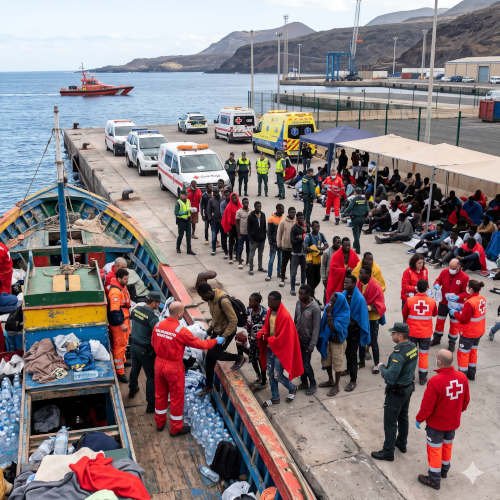
Spain is facing renewed attention over migration to its Canary Islands after nearly 2,200 migrants arrived by boat over a two-day period, according to the country’s Maritime Rescue Service. The latest arrivals highlight the continuing challenges surrounding irregular migration, dangerous Atlantic crossings, and border security in southern Europe.
Spanish maritime authorities reported that rescue teams assisted 1,324 migrants aboard 14 inflatable boats, with most of the people reaching the island of El Hierro. The arrivals occurred as people, mainly from West African countries, continued attempting the hazardous journey across the Atlantic Ocean toward Spanish territory.
The development has renewed concerns about migrant safety, emergency response capacity, and the pressure on reception facilities in the Canary Islands.
The Associated Press reported the figures on November 15, 2026, citing Spain’s Maritime Rescue Service. The incident also comes amid a broader increase in arrivals reported during November.
What Happened in the Latest Canary Islands Migrant Arrivals?
Nearly 2,200 migrants reached Spain’s Canary Islands by boat during the two days preceding November 15, according to the Spanish maritime rescue authorities.
Rescue teams assisted 1,324 people traveling aboard 14 inflatable boats. Most of these migrants were brought to El Hierro, one of the smaller islands in the Canary Islands archipelago.
The operation involved people attempting to reach European territory through the Atlantic migration route, which connects parts of West Africa with Spain’s Canary Islands.
The latest arrivals attracted attention because the number of people rescued in a short period approached the previous daily record for the route.
According to the Associated Press, the previous record was 1,461 people rescued on November 7, 2020.
The latest incident demonstrates how quickly the number of people arriving can increase when multiple boats reach the islands within a short period.
It also places additional demands on Spanish rescue personnel, local authorities, and organizations responsible for providing emergency assistance to newly arrived migrants.
Canary Islands Migration Statistics: What the 2026 Numbers Show
The Canary Islands remain one of Spain’s most important entry points for migrants arriving by sea.
Statistics published by Spain’s Ministry of the Interior show that 13,327 migrants reached the Canary Islands by sea between January 1 and October 31, 2026.
During the same period in 2025, the islands recorded 14,099 arrivals.
This represents a decrease of 772 people, or approximately 5.5%, compared with the previous year.
However, the latest November arrivals show that migration activity continues despite the lower cumulative figures recorded during the first ten months.
Spain’s wider maritime migration statistics also provide important context.
Between January and October 2026, approximately 28,155 migrants reached Spain by sea. The Canary Islands accounted for a substantial share of those arrivals.
The figures demonstrate why the archipelago remains central to discussions about European immigration policy, border management, and humanitarian protection.
Importantly, the overall year-to-date decline does not mean the migration route has become less dangerous or that emergency operations are no longer necessary.
A small number of days can bring unusually large groups of people to the islands, creating immediate logistical challenges for local authorities.
Why Are Migrants Using the Atlantic Route to the Canary Islands?
The Atlantic migration route connects the western coast of Africa with Spain’s Canary Islands.
Many migrants attempting this crossing come from countries in West Africa, including Senegal, The Gambia, and Guinea.
Mauritania is also an important departure point for boats heading toward the Spanish archipelago.
People undertake these journeys for different reasons, including economic difficulties, insecurity, limited employment opportunities, and hopes of finding better living conditions in Europe.
However, the journey can be extremely dangerous.
Although the Canary Islands are approximately 105 kilometers from the nearest point on the African coast, many migrants travel considerably longer distances.
Some boats depart from locations farther south to avoid coastal security patrols and other enforcement measures.
These longer journeys can take several days or even weeks, depending on the departure location, weather, sea conditions, and the condition of the vessel.
Many migrants travel in overcrowded wooden boats or inflatable vessels that are not designed for long-distance ocean journeys.
Limited fuel, insufficient food and drinking water, mechanical problems, and exposure to changing weather conditions can make the crossing particularly dangerous.
The Atlantic Ocean also presents risks from strong currents, rough seas, and unpredictable weather.
For people traveling without proper navigation equipment or safety equipment, even a relatively small technical problem can become life-threatening.
Atlantic Migration Route Remains One of the World’s Deadliest
The Atlantic crossing between West Africa and the Canary Islands is widely recognized as one of the world’s most dangerous migration routes.
The dangers extend beyond the people who successfully reach the islands.
Boats can disappear during the journey, while passengers may die from drowning, dehydration, exhaustion, or exposure to harsh ocean conditions.
The International Organization for Migration (IOM) monitors migration routes and collects information about deaths and disappearances through its Missing Migrants Project.
Its June 2026 report on the West African Atlantic migration route highlighted the continuing humanitarian risks.
According to the report, 3,708 migrants reached the Canary Islands irregularly by boat during the first half of 2026. This represented a 67% decrease compared with the 11,321 arrivals recorded during the same period in 2025.
However, the organization also reported that 59 boats failed to reach the islands during the first six months of 2026, resulting in 168 migrant deaths or disappearances.
These figures underline an important point: fewer recorded arrivals do not necessarily mean fewer people are attempting dangerous journeys or that the route has become safer.
Some boats never reach their destinations, making it difficult to establish the full number of people affected by the crossing.
Rescue operations therefore remain essential to protecting lives at sea.
El Hierro Faces Additional Pressure From Migrant Arrivals
El Hierro has become an important arrival point along the Canary Islands migration route.
Its location makes the island a destination for boats crossing the Atlantic from parts of West Africa.
However, El Hierro has a relatively small population and limited infrastructure compared with larger Spanish islands.
When hundreds of people arrive within a short period, local authorities must coordinate several urgent responsibilities.
These include providing temporary accommodation, medical assessments, food, drinking water, sanitation, and transportation.
Emergency services also need to identify people requiring immediate medical attention.
Children, pregnant women, and people suffering from dehydration or injuries may require additional assistance.
The latest arrivals therefore create challenges that extend beyond maritime rescue operations.
Local authorities must coordinate with national government agencies and humanitarian organizations to manage reception facilities and arrange transfers when necessary.
The situation also highlights the importance of maintaining sufficient resources for smaller islands that experience sudden increases in migrant arrivals.
Spain’s Immigration and Border Security Challenges
Spain occupies an important position in European migration policy because of its geographic location.
The country has several migration routes connecting Europe with North Africa and West Africa.
The Canary Islands are particularly significant because of their proximity to the African Atlantic coast.
Managing these routes requires cooperation between Spanish authorities, neighboring African countries, European institutions, and humanitarian organizations.
Spain’s maritime rescue service plays a central role in responding to boats in distress.
Its operations involve locating vessels, assisting passengers, and coordinating their safe arrival at designated ports.
However, rescue operations are only one part of the wider immigration challenge.
Authorities must also manage identification procedures, medical support, temporary reception, and decisions regarding the legal status of people arriving in the country.
European immigration policy must balance border management with international obligations to protect people seeking safety.
This includes ensuring that people rescued at sea receive appropriate assistance and that individual protection claims are handled according to applicable laws.
The latest arrivals demonstrate why migration remains a major issue for Spain and other European countries.
What Happens After Migrants Reach the Canary Islands?
People rescued or intercepted at sea generally undergo initial reception procedures after reaching Spanish territory.
Authorities may conduct identity checks, medical assessments, and other administrative procedures.
People who need medical assistance can receive treatment, while vulnerable individuals may require additional protection and support.
The next steps depend on individual circumstances and the applicable Spanish and European immigration rules.
Some migrants may be transferred to other facilities or locations on the Spanish mainland as part of reception arrangements.
Others may enter immigration procedures to determine whether they qualify for international protection or another legal status.
Not everyone arriving irregularly by boat automatically qualifies for asylum or permission to remain in Spain.
Immigration decisions depend on individual cases, relevant evidence, and applicable legal requirements.
The government must also coordinate with regional authorities to ensure that reception facilities have sufficient capacity.
For the Canary Islands, this becomes especially important when several boats arrive within hours or days.
What the Latest Arrivals Mean for Spain
The arrival of nearly 2,200 migrants in two days highlights the continuing importance of the Atlantic migration route.
Although Spain recorded fewer arrivals in the Canary Islands during January through October 2026 than during the same period in 2025, the latest November developments demonstrate that sudden increases remain possible.
The rescue of hundreds of people in a short period also highlights the risks faced by migrants attempting the crossing in overcrowded and poorly equipped boats.
For Spanish authorities, the immediate priorities include maritime safety, emergency assistance, reception capacity, and coordination with other agencies.
For humanitarian organizations, the continuing challenge is reducing preventable deaths and ensuring that vulnerable people receive appropriate protection.
The coming weeks will provide further information about migration patterns, rescue operations, and the ability of the Canary Islands to manage additional arrivals.
For now, the latest incident serves as another reminder that the Atlantic route remains a dangerous journey for people seeking to reach Europe.
Frequently Asked Questions About Spain Canary Islands Migration
1. How many migrants arrived in the Canary Islands in November 2026?
Nearly 2,200 migrants arrived by boat over the two-day period reported by Spain’s Maritime Rescue Service on November 15, 2026.
2. Which Canary Islands received the most recent migrant arrivals?
Most of the migrants assisted during the reported rescue operations reached El Hierro. Other islands in the archipelago also receive migrant boats.
3. Why do migrants travel to the Canary Islands?
Many migrants travel from West African countries in search of employment, improved living conditions, safety, and opportunities in Europe. Individual circumstances vary.
4. How dangerous is the Atlantic migration route?
The route is extremely dangerous because migrants often travel in overcrowded boats with limited safety equipment, food, drinking water, and fuel. Rough seas and strong currents increase the risks.
5. How many migrants reached the Canary Islands in 2026?
According to Spain’s Ministry of the Interior, 13,327 migrants arrived by sea between January 1 and October 31, 2026.
6. Is migration to the Canary Islands increasing in 2026?
The official cumulative figures through October 31 showed a 5.5% decrease compared with the same period in 2025. However, substantial arrivals were reported in November, demonstrating that migration activity can fluctuate considerably.
7. What happens to migrants after they arrive in Spain?
Authorities generally carry out initial reception, identification, and medical procedures. Individual cases are then handled under Spanish and European immigration laws.
Sources and References
- Associated Press – Spain says nearly 2,200 migrants have reached Canary Islands in 2 days
- Spain’s Ministry of the Interior – Official Immigration Statistics and Reports
- International Organization for Migration – West African Atlantic Migration Route Report, June 2026
- Reuters – Nearly 1,500 migrants arrive in Canary Islands in one day
Editorial Note: This article uses information available as of November 15, 2026. Figures from different rescue reports may reflect different reporting periods and operational updates.