
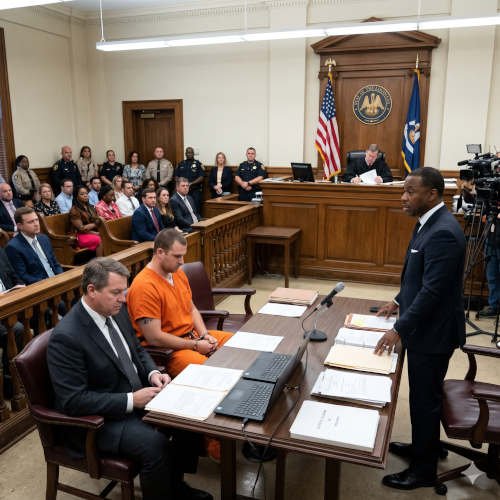
A former Louisiana police officer has been sentenced to three life terms in prison and chemical castration after a jury convicted him of sexually abusing multiple children. The case has renewed attention on Louisiana’s unusual sentencing laws, which allow judges to order certain sex offenders to undergo hormone-suppressing treatment.
Kedreyon K. Williams, 31, a former New Roads police officer and volunteer firefighter, received the sentence on November 12, 2026. District Judge Kevin Kimball presided over the case in Pointe Coupee Parish.
The sentence includes three mandatory life terms for first-degree rape. The additional chemical castration order came after District Attorney Tony Clayton requested the punishment as another penalty for the crimes.
The case also highlights an important distinction in Louisiana law. Chemical castration has been available to judges since 2008. A separate law permitting surgical castration for certain aggravated sex crimes against children took effect in 2024.
Former New Roads Officer Sentenced to Three Life Terms
Williams was convicted following a four-day jury trial in October 2026. According to the 18th Judicial District Attorney’s Office, jurors deliberated for approximately 39 minutes before finding him guilty.
The jury convicted Williams of three counts of first-degree rape, indecent behavior with a juvenile and possession of pornography involving juveniles.
Prosecutors said the victims were children between 8 and 11 years old. The abuse took place at several locations, including New Roads fire stations, a business where Williams worked and his residence.
The investigation began after the mother of one child contacted authorities with information about the alleged abuse. Investigators later identified additional victims.
Williams previously worked as a part-time New Roads police officer from 2017 to 2019. He also served as a volunteer firefighter.
Pointe Coupee Parish sheriff’s deputies arrested him in July 2024. His conviction and sentence have since drawn attention because of the additional punishment ordered by the court.
Why the Judge Ordered Chemical Castration
Louisiana law already requires a life sentence for a first-degree rape conviction. However, District Attorney Tony Clayton sought an additional punishment through the state’s chemical castration law.
The district attorney described the treatment as another layer of punishment for the crimes. He also said the families deserved comfort in knowing that the case had resulted in a severe sentence.
During sentencing, Judge Kevin Kimball described the case as the worst instance of child sexual abuse he had encountered.
The chemical castration order is separate from Williams’ prison sentences. It involves medication intended to suppress testosterone rather than a surgical procedure.
The district attorney’s office confirmed that Williams would face chemical castration, not surgical castration. Officials had not publicly announced when the treatment would begin.
The distinction matters because Louisiana has two different legal provisions covering chemical and surgical castration. They have separate eligibility requirements and medical procedures.
What Chemical Castration Means Under Louisiana Law
Chemical castration generally involves medication that reduces testosterone levels and can lower sexual drive. It does not involve surgically removing a person’s reproductive organs.
Louisiana authorized court-ordered treatment with medroxyprogesterone acetate, commonly known as MPA, in 2008. The law was established through Act 441 and added provisions to the state’s criminal statutes.
The treatment is sometimes described as a form of medical punishment because courts can impose it following qualifying criminal convictions.
The medication is administered under medical supervision. Its effects are generally linked to continued treatment, meaning it is not the same as permanent surgical castration.
Louisiana’s law has also been amended over time. The current statutory provisions address medical administration, treatment requirements and penalties for refusing to comply with a court order.
The Associated Press reported in 2024 that the chemical castration law had been used relatively rarely. Officials could identify only one or two cases between 2010 and 2019.
That limited history makes the Williams case especially notable. It has brought renewed public attention to a punishment that has existed in Louisiana law for nearly two decades.
Louisiana’s 2024 Surgical Castration Law
Louisiana expanded its castration laws in 2024 by authorizing judges to order surgical castration for certain aggravated sex offenses involving children under 13.
The legislation, enacted as Act 651, created Louisiana Revised Statutes 14:43.7. It allows a judge to impose surgical castration in addition to other criminal penalties when the offense meets the law’s requirements.
However, the surgical procedure is not automatic. The law establishes several conditions before it can take place.
A court-appointed medical expert must determine whether the offender is an appropriate candidate for surgery. That assessment must occur within 60 days after sentencing.
The Department of Public Safety and Corrections is responsible for arranging the procedure through a licensed physician. The law also states that surgical castration should not be required when it is not medically appropriate.
For an offender serving a prison sentence, the procedure must take place no later than one week before release. The statute also provides penalties for an offender who fails to appear or refuses to undergo a court-ordered procedure.
A person convicted of failing to comply can face an additional three to five years in prison without probation, parole or suspension of sentence.
The law applies to qualifying offenses committed on or after August 1, 2024. It also excludes offenders who were under 17 years old.
The 2024 legislation attracted national attention because the Associated Press reported that the National Conference of State Legislatures knew of no other state with a law specifically allowing judges to impose surgical castration as a criminal sentence.
Chemical Castration and Surgical Castration: Key Differences
The two Louisiana laws involve different forms of treatment.
Chemical castration uses medication to reduce testosterone and suppress sexual drive. It does not require surgery, and its effects depend on continued medical treatment.
Surgical castration is a permanent physical procedure. Louisiana’s 2024 law allows it only for qualifying aggravated sex offenses involving victims younger than 13, and only after a medical expert determines that the offender is suitable for surgery.
The two forms of castration should not be confused when reporting criminal sentences. In Williams’ case, the district attorney’s office specifically confirmed that the court ordered chemical castration.
Legal Debate Over Castration as Criminal Punishment
Louisiana’s castration laws have faced criticism from people who question whether forced medical treatment is an appropriate criminal punishment.
Opponents have raised concerns about bodily autonomy, medical ethics, effectiveness and the Eighth Amendment to the U.S. Constitution, which prohibits cruel and unusual punishment.
Supporters argue that severe penalties are justified in cases involving sexual violence against children. They say the laws can provide an additional consequence for offenders convicted of serious crimes and may help protect children.
The debate became more prominent when Louisiana lawmakers approved surgical castration in 2024. During the legislative process, critics questioned whether permanently altering an offender’s body could be considered excessive punishment.
The constitutional debate is significant because castration laws involve both criminal sentencing and medical intervention. Courts may need to consider whether the punishment is proportionate, medically appropriate and consistent with constitutional protections.
A legal challenge to a castration order would need to be considered on its specific facts and applicable law. Public criticism alone does not establish that a statute or sentence is unconstitutional.
What Happens Next in the Williams Case?
Williams has received three life sentences following his first-degree rape convictions, along with the chemical castration order. The district attorney’s office has confirmed the type of treatment but has not publicly specified when it will begin.
The available reports also do not establish whether Williams has filed an appeal challenging his convictions or sentence.
The case has renewed attention on how Louisiana applies its chemical castration law. It has also prompted questions about the state’s newer surgical castration statute and the circumstances in which judges can use it.
For now, the central point is that Williams was sentenced under a chemical castration order, not a surgical one. Louisiana’s separate 2024 surgical law has different eligibility rules and medical safeguards.
Frequently Asked Questions
1. Who is Kedreyon K. Williams?
Kedreyon K. Williams is a former New Roads, Louisiana, police officer and volunteer firefighter. He was convicted in October 2026 of three counts of first-degree rape, indecent behavior with a juvenile and possession of pornography involving juveniles.
2. What sentence did Williams receive?
On November 12, 2026, Williams received three life sentences and an additional order for chemical castration.
3. Is Louisiana chemical castration the same as surgical castration?
No. Chemical castration uses medication to suppress testosterone. Surgical castration is a permanent medical procedure involving surgery.
4. When did Louisiana approve chemical castration?
Louisiana authorized court-ordered chemical castration treatment in 2008 through Act 441.
5. When did Louisiana approve surgical castration?
Louisiana enacted its surgical castration law in 2024. Act 651 took effect for qualifying offenses committed on or after August 1, 2024.
6. Does every child sex offender in Louisiana face castration?
No. Castration is not an automatic punishment for every sex offense involving a child. The applicable law sets out specific eligibility requirements, and the court must have legal grounds to impose the treatment or procedure.
7. Has Williams appealed his sentence?
The reports available at the time of publication did not identify a filed appeal. Any later appeal or court development would need to be confirmed through court records or an official announcement.
Sources and Further Reading
- 18th Judicial District Attorney’s Office — official sentencing announcement.
- Louisiana Legislature — Revised Statutes 14:43.7, surgical castration law.
- Louisiana Legislature — Revised Statutes 14:43.6, chemical castration provisions.
- Associated Press — reporting on Louisiana’s 2024 surgical castration legislation.
- WAFB — coverage of Williams’ conviction and sentencing.