
Latest update: November 15, 2026
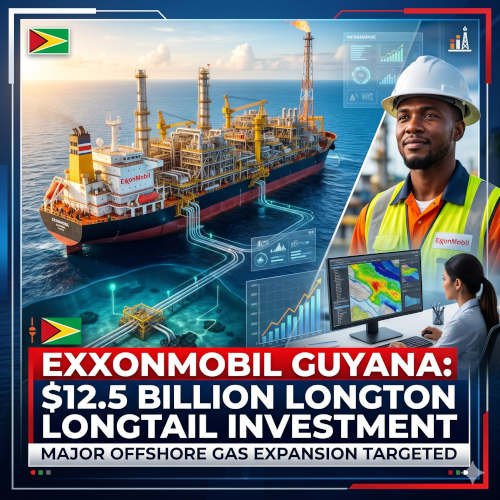
ExxonMobil and its partners have approved a major new offshore energy investment in Guyana, committing an additional $12.5 billion to the Longtail development in the Stabroek Block. The project marks an important shift in the country’s energy industry because it will focus on producing natural gas and condensate rather than relying only on conventional oil production.
The announcement, made on November 12, follows the Guyanese government’s approval of the Longtail Field Development Plan and the issuance of its petroleum production licence. ExxonMobil has taken the final investment decision, with production expected to begin in 2030.
The development will use a new floating production, storage and offloading vessel, commonly known as an FPSO. The facility is designed to process approximately 1.2 billion cubic feet of natural gas per day and produce up to 250,000 barrels of condensate daily.
The investment could strengthen Guyana’s position in the global energy market while creating opportunities for domestic industries that need reliable natural gas supplies. However, important questions remain about gas transportation, future buyers and the infrastructure required to bring the resource to shore.
ExxonMobil Approves $12.5 Billion Longtail Offshore Gas Project
ExxonMobil announced its final investment decision for the Longtail project on November 12, 2026, following the required government and regulatory approvals.
Longtail will become the eighth development in the Stabroek Block, one of the most important offshore oil and gas areas in Guyana. It is located in the southeastern section of the block and will target reservoirs containing non-associated natural gas and condensate.
The planned $12.5 billion investment represents another major commitment by ExxonMobil and its partners to Guyana’s growing petroleum industry.
Unlike conventional oil projects, Longtail is designed primarily to develop natural gas that exists separately from oil. This makes it a significant development for Guyana as the government looks to expand its energy sector beyond crude oil exports.
ExxonMobil Upstream Company President Dan Ammann described Longtail as the next phase in developing Guyana’s natural resources. The company says the project could help meet growing global energy demand while creating additional value from the country’s offshore resources.
The project is expected to begin production in 2030.
How Much Natural Gas and Condensate Will Longtail Produce?
The scale of the planned Longtail development is one of its most important features.
According to ExxonMobil, the new FPSO will have the capacity to process approximately 1.2 billion standard cubic feet of natural gas per day. It will also be designed to produce as much as 250,000 barrels of condensate daily.
Condensate is a light hydrocarbon liquid that is separated from natural gas during production. It can be processed and used as a valuable energy and industrial feedstock.
Guyana’s Ministry of Natural Resources has provided additional details about the project’s expected production system. The development is planned to target nine reservoirs through a network of 27 production wells and 18 gas injection wells.
The government estimates that Longtail could produce approximately 776 million barrels of condensate over a 30-year production period.
These figures demonstrate the project’s substantial production potential. However, the planned processing capacity should not be confused with guaranteed daily output. Actual production will depend on reservoir performance, operating conditions and the development’s progress after startup.
The project will also include full gas reinjection capabilities. This means some produced gas can be returned to the reservoirs as part of the production and reservoir-management process.
Why Guyana’s First Non-Associated Gas Project Matters
Longtail is particularly important because it will become Guyana’s first major development focused on non-associated gas.
Non-associated gas refers to natural gas found in reservoirs that are not primarily producing crude oil. Developing these resources requires different infrastructure and commercial arrangements from projects focused on oil extraction.
For Guyana, the investment creates an opportunity to develop a larger natural gas industry. The country has already become a significant offshore oil producer, but natural gas could support additional economic activities within its borders.
The government has discussed using domestic gas supplies to support electricity generation and industrial development. Potential industries include fertilizer production, mineral processing, alumina-related activities and data centers.
These businesses require substantial and dependable energy supplies. A larger natural gas industry could help attract investment in facilities that need electricity, heat and industrial feedstock.
However, the benefits will depend on whether the country can develop the necessary infrastructure and secure businesses capable of purchasing and using the gas.
Longtail’s development therefore represents more than another offshore investment. It could become an important part of Guyana’s longer-term plan to expand its industrial economy.
ExxonMobil, Hess and CNOOC: Who Owns the Longtail Project?
The Longtail development is being undertaken by three companies operating together in the Stabroek Block.
ExxonMobil Guyana Limited is the project operator and holds a 45% interest in the block. Its partners are Hess Guyana Exploration Limited, with a 30% interest, and CNOOC Petroleum Guyana Limited, with the remaining 25%.
These companies are already involved in developing Guyana’s offshore petroleum resources.
ExxonMobil has played a central role in the country’s energy expansion since major offshore discoveries began transforming its petroleum industry. The Stabroek Block has become the foundation of that growth, attracting substantial investment and supporting a series of large offshore developments.
The Longtail investment extends that partnership into natural gas and condensate production.
The ownership structure also means the development’s progress will depend on coordination between the three companies, their contractors and Guyana’s regulatory authorities.
What Happens to Guyana’s Other Offshore Oil Projects?
Longtail is part of a wider development program in the Stabroek Block.
ExxonMobil reported that it was producing approximately 900,000 barrels of oil per day from four operating projects in the block as of its November 12 announcement. The company expects production to exceed 1 million barrels per day following the anticipated startup of its Uaru development.
The wider project schedule includes several additional developments.
Whiptail, the sixth approved project, is expected to begin production in 2027. Hammerhead, the seventh development, is expected to follow in 2029.
Longtail will be the eighth development, with its startup targeted for 2030.
These projects illustrate the scale of ExxonMobil’s investment program in Guyana. Rather than relying on one offshore facility, the company and its partners are developing multiple production systems to increase the country’s energy output.
The expansion also creates opportunities for contractors, engineering companies, equipment suppliers and offshore service providers.
However, production schedules remain targets. Offshore construction, equipment delivery, regulatory requirements and technical challenges can affect project timelines.
How Will Longtail Gas Reach Guyana’s Onshore Industries?
One of the biggest questions surrounding Longtail is how its natural gas will reach potential customers.
ExxonMobil said gas from the development could be transported to shore through a pipeline. However, this possibility depends on future investment decisions, market demand and the construction of the required infrastructure.
The Guyanese government has also connected the project with its broader plans for natural gas development in the Berbice region.
The proposed industrial expansion includes a second offshore Gas-to-Energy pipeline. The government wants additional gas supplies to support electricity generation and attract energy-intensive businesses.
Potential developments include fertilizer plants, data centers and mineral-processing facilities.
A reliable natural gas supply could help these industries manage energy costs and support long-term industrial operations. It could also create opportunities for local suppliers, construction companies and technical service providers.
Nevertheless, a pipeline and an established customer base are essential to making this plan commercially viable.
The government’s announcement requires gas utilization and export studies to assess reservoir performance, production forecasts, export timelines and potential gas markets. It also includes provisions relating to safety and gas-export infrastructure.
These requirements highlight the importance of planning the natural gas market before production begins.
What Could the $12.5 Billion Investment Mean for Guyana’s Economy?
The Longtail development could have significant economic implications for Guyana.
A project of this size requires engineering services, offshore construction, specialized equipment, transportation, maintenance and other industrial support. These activities can create opportunities for domestic companies and international contractors.
ExxonMobil said approximately 6,000 Guyanese people currently support operations in the Stabroek Block. The company also reported that ExxonMobil Guyana and its contractors have spent more than $3.9 billion with Guyanese suppliers since 2015.
Longtail could extend those commercial opportunities as construction and development activities move forward.
The government also hopes natural gas will help diversify the economy. While oil production has driven much of Guyana’s recent energy growth, domestic gas use could support businesses outside the petroleum sector.
However, the size of the investment does not automatically determine how much money will remain in Guyana or how widely economic benefits will be distributed.
Government revenue, local employment, supplier participation and long-term industrial development will depend on the project’s contractual terms, operating performance and the country’s ability to manage its natural resources effectively.
Transparency, environmental oversight and careful management of petroleum revenues will also remain important as offshore production expands.
What Investors Should Watch After the ExxonMobil Announcement
The Longtail decision is an important development for investors following ExxonMobil stock, global energy markets and offshore oil and gas companies.
The $12.5 billion commitment strengthens ExxonMobil’s long-term development pipeline in Guyana. It also demonstrates the company’s continued interest in expanding its offshore resource portfolio.
Investors may watch how the company manages construction costs, project schedules and future production capacity. They will also be interested in the development of gas transportation infrastructure and the commercial market for Guyana’s natural gas.
The project could create business opportunities for companies involved in FPSO construction, subsea engineering, offshore equipment, pipeline development and energy services.
However, the announcement does not guarantee an immediate increase in ExxonMobil’s revenue. Longtail is expected to begin production in 2030, meaning its financial contribution will depend on successful construction and future market conditions.
Natural gas prices, condensate demand, global energy consumption and regulatory developments could also influence the project’s long-term value.
ExxonMobil Longtail Project: Key Facts
- Project: Longtail offshore development
- Investment: Approximately $12.5 billion
- Location: Stabroek Block, offshore Guyana
- Operator: ExxonMobil Guyana Limited
- Partners: Hess Guyana Exploration and CNOOC Petroleum Guyana
- ExxonMobil interest: 45%
- Hess interest: 30%
- CNOOC interest: 25%
- Natural gas processing capacity: Approximately 1.2 billion cubic feet per day
- Condensate production capacity: Up to 250,000 barrels per day
- Planned wells: Approximately 45 production and injection wells
- Expected startup: 2030
Why Is ExxonMobil Investing $12.5 Billion in Guyana?
ExxonMobil is investing in Longtail to develop natural gas and condensate resources in the Stabroek Block. The project will expand the company’s offshore operations and support Guyana’s plans to develop its natural gas industry.
When Will the Longtail Project Start Production?
ExxonMobil expects the Longtail development to begin production in 2030. The project must progress through engineering, construction, installation and operational preparation before production can start.
How Much Gas Can the Longtail Project Process?
The planned floating production vessel is designed to process approximately 1.2 billion standard cubic feet of natural gas per day.
Will Longtail Gas Be Used in Guyana?
Gas could be transported to shore through a pipeline, subject to future investment decisions, market demand and the necessary infrastructure. The Guyanese government wants natural gas to support electricity generation and industrial development.
Who Are ExxonMobil’s Partners in Guyana’s Longtail Project?
ExxonMobil Guyana Limited operates the project with a 45% interest. Hess Guyana Exploration Limited holds 30%, while CNOOC Petroleum Guyana Limited owns 25%.
The Bottom Line
ExxonMobil’s $12.5 billion Longtail investment marks a major new stage in Guyana’s offshore energy development. The project will expand the Stabroek Block beyond conventional oil production by targeting natural gas and condensate, with startup expected in 2030.
Its long-term importance will depend not only on offshore production but also on whether Guyana can build pipelines, attract industrial customers and turn natural gas resources into broader economic opportunities.
For ExxonMobil, the investment strengthens its long-term position in one of the world’s most closely watched offshore energy regions. For Guyana, it creates an opportunity to develop a larger natural gas industry while facing the challenge of managing rapid petroleum-sector growth.