
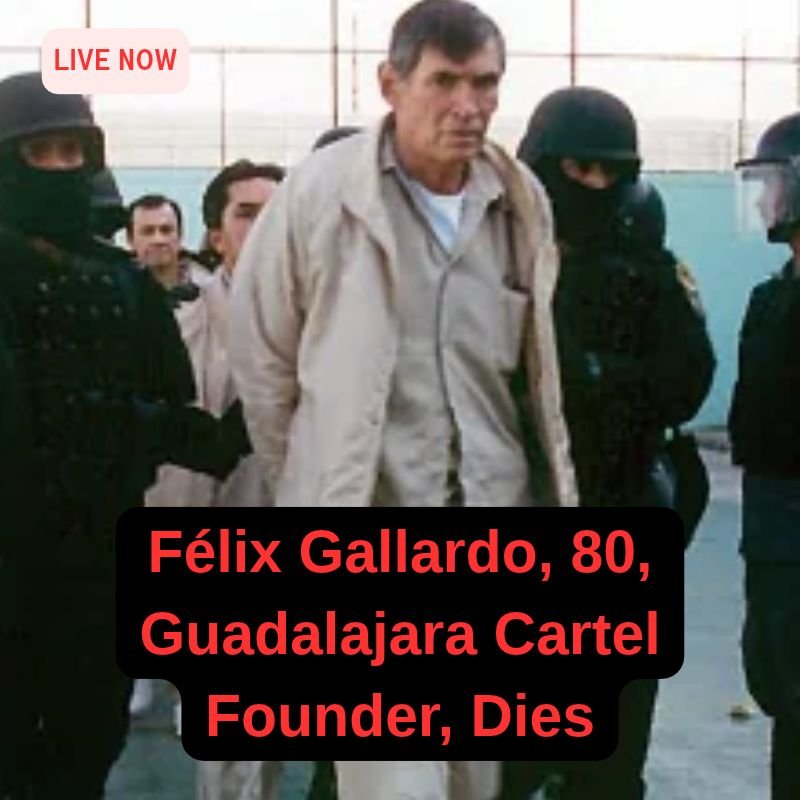
Miguel Ángel Félix Gallardo, the notorious Mexican drug lord known as the “Jefe de Jefes” (Boss of Bosses), has died at the age of 80. The founder of the Guadalajara Cartel passed away on Sunday, November 15, 2026, at a private hospital in Guadalajara, Mexico, after suffering multiple organ failure.
His death was confirmed by authorities in the Mexican state of Jalisco. Félix Gallardo had been transferred from Puente Grande prison to the hospital on Friday, November 13, after his health deteriorated.
The former cartel leader had remained in Mexican custody since his arrest in April 1989. He was serving consecutive prison sentences connected to drug trafficking, weapons offenses, and the kidnapping and murder of U.S. Drug Enforcement Administration (DEA) agent Enrique “Kiki” Camarena and Mexican pilot Alfredo Zavala.
His death marks the end of the life of one of the most influential figures in the history of organized drug trafficking in Mexico. His criminal organization helped establish trafficking networks between Colombia, Mexico, and the United States that shaped the country’s illegal drug trade for decades.
Miguel Ángel Félix Gallardo Death: What Happened in His Final Hours?
According to the Jalisco Security Secretariat, Félix Gallardo was rushed from the Puente Grande prison complex to a private hospital in Guadalajara on November 13. Medical staff monitored his condition under a guarded security arrangement.
He remained hospitalized for approximately two days. His condition was described as serious, and doctors reportedly gave him a reserved prognosis.
On Sunday, November 15, medical personnel reported multiple organ failure, which resulted in his death at approximately 2 p.m. local time.
The hospital was identified as Country 2000, located in Guadalajara. Security personnel maintained a significant presence around the facility during his hospitalization.
His death was subsequently reported by Mexican media outlets and international news organizations, including Reuters. Jornada
Who Was Miguel Ángel Félix Gallardo?
Miguel Ángel Félix Gallardo was born on January 8, 1946, in Mexico. He became one of the most powerful figures in Mexico’s illegal drug trade during the 1970s and 1980s.
Before becoming a major criminal figure, he reportedly worked as a police officer and developed connections with influential individuals in Mexico’s security and political networks.
He eventually established the Guadalajara Cartel, which became one of the most influential criminal organizations in Mexico.
Known by the nicknames El Jefe de Jefes and El Padrino, Félix Gallardo built a powerful trafficking network through alliances with other criminal organizations and connections with Colombian cocaine suppliers.
His organization played an important role in transporting cocaine from South America through Mexico into the United States.
Unlike many later cartel leaders, Félix Gallardo operated through a network of regional partners, traffickers, intermediaries, and corrupt officials. This structure helped his organization expand its influence across several Mexican states.
His criminal network also included two well-known associates: Ernesto Fonseca Carrillo, known as Don Neto, and Rafael Caro Quintero.
Together, these figures became central to the Guadalajara Cartel’s operations during the height of its influence.
How the Guadalajara Cartel Became a Major Drug Trafficking Organization
During the 1970s and 1980s, Mexico became an increasingly important transit country for cocaine entering the United States.
Félix Gallardo helped establish relationships with Colombian drug traffickers, including organizations associated with the Medellín Cartel.
These connections allowed criminal networks to move large quantities of cocaine through Mexican territory.
The Guadalajara Cartel also became involved in marijuana and heroin trafficking. Its influence extended across important transportation routes and border regions.
Félix Gallardo’s business model relied on cooperation between different criminal groups rather than direct control over every trafficking operation.
However, the cartel’s growing influence also depended on corruption, intimidation, and violence.
Authorities and investigative accounts have described extensive relationships between cartel members and corrupt law enforcement officials.
As the organization expanded, disagreements over trafficking routes and control of criminal territories contributed to the development of rival groups.
Following the arrest of its major leaders, the Guadalajara Cartel eventually fragmented. Former associates and regional networks became connected to several organizations that later emerged as powerful forces in Mexico’s drug trade.
The Murder of DEA Agent Kiki Camarena Changed Everything
One of the most significant events associated with Félix Gallardo’s criminal history was the 1985 kidnapping and murder of DEA agent Enrique “Kiki” Camarena.
Camarena was investigating drug trafficking operations connected to major Mexican criminal organizations.
In February 1985, he was kidnapped in Guadalajara. Mexican pilot Alfredo Zavala Avelar was also abducted.
Both men were subsequently murdered.
The killings triggered a major investigation and intensified pressure from the United States on Mexican authorities to identify and arrest those responsible.
The case became a defining moment in U.S.-Mexico cooperation against organized drug trafficking.
Félix Gallardo’s associates, including Don Neto and Rafael Caro Quintero, were arrested in connection with the case before authorities captured the cartel leader himself.
The investigation eventually contributed to the collapse of the Guadalajara Cartel’s centralized leadership.
The Camarena case also became one of the most widely recognized examples of the dangers faced by law enforcement officers investigating powerful international criminal organizations.
Miguel Ángel Félix Gallardo Arrest: Why Was He Imprisoned in 1989?
Félix Gallardo’s criminal network continued to attract attention from Mexican and U.S. authorities following the arrests of his associates.
On April 8, 1989, Mexican authorities arrested him at a residence on Cosmos Street in Guadalajara.
His arrest came after an investigation that reportedly involved surveillance and intelligence gathering.
At the time, he was considered one of the most wanted drug traffickers in the world.
According to accounts published by Mexican media, investigators had spent weeks trying to locate him. Authorities eventually identified his location through information gathered during surveillance.
His arrest took place without a major shootout.
He was subsequently transferred to Mexico City for questioning and prosecution.
In the years that followed, Félix Gallardo remained behind bars while facing multiple criminal proceedings.
His Prison Sentences Totaled 77 Years
Félix Gallardo received a 40-year prison sentence in 2000 for crimes involving drug trafficking, weapons possession, and related offenses.
In 2017, he received another 37-year sentence connected to the kidnapping and murder of DEA agent Enrique Camarena and pilot Alfredo Zavala.
Together, the sentences totaled 77 years.
Mexican courts determined that the sentences would be served consecutively rather than simultaneously.
This meant that even after completing his first sentence, he would have faced another lengthy period of imprisonment.
Based on the consecutive sentencing arrangement, his projected release date would have been decades into the future.
He ultimately died while serving his sentences in Mexican custody.
Reuters and Mexican newspaper La Jornada reported the details of his imprisonment and criminal convictions. Reuters
Health Problems and His Request for House Arrest
Félix Gallardo experienced serious health problems during his later years in prison.
Reports described significant physical deterioration, including the loss of vision in one eye, hearing impairment, gastrointestinal problems, and mobility difficulties.
By 2021, prison officials in Jalisco had publicly discussed his medical condition and the possibility of transferring him to house arrest.
Officials noted that his age and medical problems raised questions about whether he could continue receiving appropriate care inside the prison system.
In 2022, a federal judge in Mexico City granted a request allowing him to serve his sentence under house arrest.
The decision attracted attention because of his criminal history and the seriousness of the convictions against him.
Former Mexican President Andrés Manuel López Obrador also commented on the issue, acknowledging that Félix Gallardo had significant health problems and needed medical attention.
However, the transfer never happened.
Mexico’s Attorney General’s Office raised objections to the proposed arrangements, including concerns involving electronic monitoring.
As a result, Félix Gallardo remained at Puente Grande prison until his emergency hospitalization in November 2026.
His deteriorating health eventually led to his final transfer to Country 2000 hospital, where he died.
What Happened to the Guadalajara Cartel After His Arrest?
The arrest of Félix Gallardo significantly weakened the Guadalajara Cartel’s centralized leadership.
Before his imprisonment, the organization had operated through an extensive network of trafficking partners and regional connections.
After his arrest, those networks became increasingly fragmented.
Different criminal figures gained control of separate territories and trafficking routes.
The developments contributed to the emergence and expansion of several major Mexican criminal organizations, including networks associated with the Sinaloa, Tijuana, and Juárez cartels.
One important figure connected to the Guadalajara Cartel’s former network was Joaquín “El Chapo” Guzmán, who later became a leading figure in the Sinaloa Cartel.
The fragmentation of the Guadalajara Cartel also contributed to competition between criminal organizations.
Over subsequent decades, territorial disputes, trafficking conflicts, and organized criminal violence became major security challenges for Mexico.
Félix Gallardo’s influence therefore extended beyond the years when he personally controlled the Guadalajara Cartel.
His Story Reached International Audiences Through Narcos: Mexico
The story of Félix Gallardo also reached international audiences through the Netflix television series Narcos: Mexico.
The series portrayed the development of the Guadalajara Cartel, its relationships with other criminal organizations, and the investigation into the murder of DEA agent Kiki Camarena.
Actor Diego Luna portrayed Félix Gallardo in the series.
Although the production introduced viewers to important events in Mexico’s drug-trafficking history, it was a dramatized television production rather than a documentary.
His real-life criminal history involved decades of investigations, court proceedings, corruption allegations, and violence.
His death has renewed public interest in the history of the Guadalajara Cartel and the criminal networks that developed during his leadership.
What Miguel Ángel Félix Gallardo’s Death Means for Mexico
The death of Félix Gallardo closes another chapter in the history of Mexico’s organized drug trade.
He was among the early figures who helped establish the trafficking structures that connected Mexican criminal organizations with international cocaine suppliers.
His organization demonstrated how criminal networks could expand through international partnerships, corruption, and control of transportation routes.
His arrest in 1989 did not end drug trafficking in Mexico. Instead, the fragmentation of his organization contributed to a changing criminal landscape in which regional groups competed for influence.
His death also brings renewed attention to the unresolved consequences of the Guadalajara Cartel’s activities, particularly the violence surrounding the murder of Kiki Camarena.
For decades, Félix Gallardo remained a controversial and notorious figure in Mexico’s criminal history. He denied involvement in the Camarena murder and rejected allegations about his participation in drug trafficking during interviews.
Nevertheless, Mexican courts convicted him in connection with the crimes for which he received his prison sentences.
Frequently Asked Questions (FAQs)
1. Did Miguel Ángel Félix Gallardo die?
Yes. Miguel Ángel Félix Gallardo died on November 15, 2026, at the age of 80 in a private hospital in Guadalajara, Mexico.
2. What was Miguel Ángel Félix Gallardo’s cause of death?
Authorities in Jalisco reported that he died from multiple organ failure following a deterioration in his health.
3. How old was Miguel Ángel Félix Gallardo when he died?
He was 80 years old when he died.
4. Why was Miguel Ángel Félix Gallardo in prison?
He was serving consecutive sentences for drug trafficking, weapons-related offenses, and crimes connected to the kidnapping and murder of DEA agent Enrique Kiki Camarena and Mexican pilot Alfredo Zavala.
5. When was Miguel Ángel Félix Gallardo arrested?
Mexican authorities arrested him on April 8, 1989, in Guadalajara, Jalisco.
6. What cartel did Miguel Ángel Félix Gallardo establish?
He founded and led the Guadalajara Cartel, one of Mexico’s most influential criminal organizations during the 1970s and 1980s.
7. Was Miguel Ángel Félix Gallardo released from prison?
No. Although a judge granted a house-arrest arrangement in 2022, the transfer was never implemented. He remained in custody until his death.
8. Who were Félix Gallardo’s associates?
His prominent associates included Rafael Caro Quintero and Ernesto Fonseca Carrillo, also known as Don Neto.
Final Takeaway
Miguel Ángel Félix Gallardo’s death at 80 ends the life of a major figure in the history of Mexican organized crime. From building the Guadalajara Cartel to his 1989 arrest and decades behind bars, his criminal history remained closely connected to the evolution of international drug trafficking.
His death does not erase the consequences of the criminal networks associated with his leadership. Instead, it marks the passing of a figure whose influence helped shape Mexico’s drug-trafficking history for generations.