

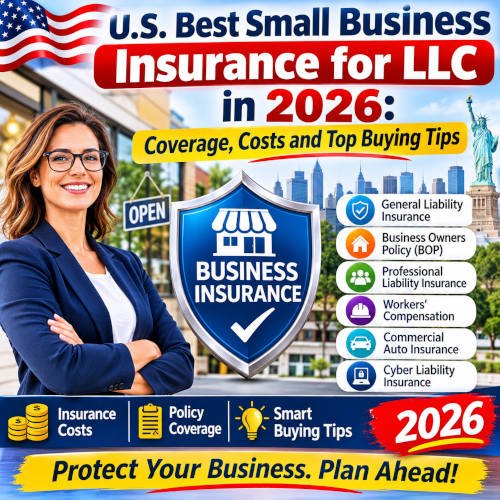
Insurance News US. Know all about the best small business insurance companies, information, and quotes, and also what people ask about this on the internet. Starting an LLC is an important step toward protecting your business, but forming a limited liability company does not eliminate every financial risk. A customer could suffer an injury at your workplace, a client could accuse you of professional negligence, or a cyberattack could expose sensitive business information.
That is why finding the best small business insurance for LLC owners matters in 2026. The right policy can help cover legal expenses, property damage, employee injuries, and other unexpected losses.
However, there is no single insurance package that works for every LLC. A freelance consultant, construction contractor, online retailer, and restaurant face very different risks.
This guide explains the essential types of business insurance, average costs, coverage options, and what US business owners should compare before requesting a quote.
What Is the Best Small Business Insurance for an LLC?
For many small LLCs, a combination of general liability insurance and a Business Owners Policy (BOP) provides a practical starting point.
General liability insurance protects against certain third-party claims involving bodily injury, property damage, and advertising injury. A BOP generally combines general liability coverage with commercial property insurance, helping protect eligible businesses against covered property losses and liability claims.
Your business activities should determine the final combination.
Consider these starting points:
- Freelancers and consultants: General liability and professional liability insurance.
- Retail stores: A BOP, product liability coverage where appropriate, and cyber insurance.
- Contractors: General liability, workers’ compensation when required, commercial auto, and tools and equipment coverage.
- Online businesses: General liability, cyber liability, and product liability where applicable.
- Professional service companies: Professional liability or errors and omissions (E&O) insurance, alongside general liability.
- Businesses with employees: Workers’ compensation according to applicable state law.
An LLC’s legal structure does not automatically provide insurance protection. Limited liability and commercial insurance serve different purposes: the former concerns legal responsibility, while insurance can help pay covered claims and losses.
Best Types of LLC Business Insurance to Consider
1. General Liability Insurance
General liability insurance is one of the most common policies for small businesses. It can help cover eligible claims involving customer injuries, accidental property damage, and certain advertising-related injuries.
For example, if a customer slips inside your rented business premises and files a claim, general liability coverage may help pay covered medical expenses and legal defense costs.
Many commercial landlords and clients also require proof of general liability insurance before signing contracts.
2. Business Owners Policy (BOP)
A Business Owners Policy combines general liability and commercial property insurance into one package for eligible businesses.
It can be useful for LLC owners who operate from an office, shop, studio, or other physical location. Depending on the policy, covered property may include furniture, computers, inventory, and business equipment.
Some insurers allow businesses to add endorsements for extra protection. Always review exclusions, deductibles, property limits, and business interruption coverage before purchasing.
3. Professional Liability Insurance
Professional liability insurance, also known as errors and omissions insurance, is important for consultants, accountants, designers, technology providers, and other professionals who sell advice or services.
It can help cover eligible claims alleging negligence, professional mistakes, missed deadlines, or inadequate work that causes a client financial loss.
General liability insurance does not replace professional liability coverage. A business may need both policies.
4. Workers’ Compensation Insurance
Workers’ compensation generally helps cover eligible medical expenses and lost wages when employees suffer work-related injuries or illnesses.
Most states require employers to carry workers’ compensation, although rules, exemptions, and thresholds differ. Requirements may also depend on the industry and employee classification.
LLC owners should check their state’s workers’ compensation agency before hiring employees. Do not assume that a small workforce automatically qualifies for an exemption.
5. Commercial Auto Insurance
Personal auto insurance may not cover every business-related driving activity. An LLC using vehicles for deliveries, transporting equipment, visiting clients, or other commercial operations may need commercial auto insurance.
Coverage requirements and minimum liability limits vary by state and vehicle use.
6. Cyber Liability Insurance
Cyber liability insurance has become increasingly relevant for businesses that collect customer information, accept online payments, store employee records, or operate digital platforms.
Depending on the policy, it may help cover expenses associated with data breaches, cyber incidents, forensic investigations, customer notifications, and certain recovery services.
Read the policy carefully because cyber coverage can contain important exclusions, security requirements, and incident-response conditions.
Best Small Business Insurance Companies for LLC Owners
The best insurer depends on your industry, location, coverage limits, budget, and claims-service expectations. There is no universal winner for every LLC.
Here are several providers and options worth comparing in 2026:
- ERGO NEXT: Worth comparing for small businesses seeking online quotes and convenient proof-of-insurance documents.
- The Hartford: Offers a broad range of commercial insurance options that may suit growing businesses with multiple coverage needs.
- biBERK: An option for small businesses looking for direct-to-business insurance purchasing.
- Thimble: Offers flexible insurance options that may appeal to contractors, freelancers, and businesses with changing coverage needs.
- Hiscox: Worth considering for professional service businesses seeking tailored professional liability coverage.
- Independent insurance brokers: Can help compare policies from multiple insurers, particularly when your business has complex risks.
These are comparison starting points, not guarantees of the lowest price or the best claims outcome. Check insurer licensing, financial strength, policy exclusions, customer complaint information, and coverage availability in your state.
How Much Does Small Business Insurance Cost for an LLC in 2026?
Insurance premiums depend on the business’s industry, location, annual revenue, payroll, claims history, coverage limits, deductibles, and number of employees or vehicles.
MoneyGeek’s September 2026 report provides the following average monthly estimates for small businesses with one to four employees:
| Insurance type | Average monthly cost |
|---|---|
| General liability | $123 |
| Professional liability | $56 |
| Workers’ compensation | $113 per employee |
| Commercial auto | $163 per vehicle |
| Commercial property | $125 |
| Cyber insurance | $83 |
These are research averages, not guaranteed quotes. Actual premiums can be significantly different depending on the business and policy terms.
For example, a home-based consultant may have different insurance costs from a contractor operating commercial vehicles and employing several workers.
To find affordable small business insurance, request multiple quotes using consistent coverage limits. Compare deductibles, exclusions, additional insured requirements, and annual premiums rather than choosing a policy based only on its advertised starting price.
How to Choose and Buy the Right LLC Insurance Policy
Before purchasing business insurance, identify the risks your LLC actually faces.
Start with these steps:
- Describe your business accurately: Explain your services, products, location, revenue, and employee count.
- Identify legal requirements: Review your state’s workers’ compensation and commercial auto rules, plus any industry-specific requirements.
- Check contracts: Commercial landlords, clients, and vendors may require specific liability limits or additional insured endorsements.
- Compare coverage limits: A $1 million per-occurrence and $2 million aggregate general liability limit is a common starting point, but it may not suit every business.
- Review exclusions: Understand what the policy does not cover, including professional mistakes, intentional acts, certain cyber incidents, or specific property losses.
- Request multiple quotes: Compare direct insurers and independent brokers.
- Check the certificate of insurance: Confirm that the certificate accurately reflects the coverage and limits required by your contract.
Do not overlook umbrella insurance. A commercial umbrella policy can provide additional liability limits above certain underlying policies when a covered claim exceeds their limits.
Also consider employment practices liability insurance (EPLI) if your LLC has employees. Depending on the policy, EPLI can help cover certain claims involving wrongful termination, discrimination, or harassment.
Frequently Asked Questions
Is business insurance required for an LLC in the USA?
Not every LLC is legally required to carry every type of business insurance. However, state laws may require workers’ compensation or commercial auto coverage. Landlords, clients, lenders, and licensing authorities may also impose insurance requirements.
What is the cheapest business insurance for an LLC?
There is no fixed cheapest option for every LLC. General liability may be a relatively affordable starting policy for some low-risk businesses, but the final premium depends on industry, location, coverage limits, and other underwriting factors.
Does an LLC need general liability insurance?
General liability insurance is not universally mandatory, but it can protect an LLC against certain third-party injury, property damage, and advertising injury claims. Many clients and commercial landlords require it.
Can I get small business insurance online?
Yes. Many insurers and online brokers allow eligible LLC owners to request quotes, compare coverage, purchase policies, and obtain certificates of insurance online. More complex businesses may benefit from an independent agent or specialist broker.
Does LLC insurance protect personal assets?
Business insurance primarily protects against covered business risks and claims. An LLC’s legal liability protections are separate. Neither should be treated as a complete guarantee against personal liability in every situation.
Final Takeaway
The best small business insurance for an LLC is the combination that matches its real risks, legal obligations, and contractual requirements. General liability and a BOP can provide a starting point, while professional liability, workers’ compensation, commercial auto, cyber insurance, and umbrella coverage may be necessary depending on the business.
Before choosing a policy in 2026, compare multiple small business insurance quotes and read the exclusions carefully. A lower premium is not a good deal if the coverage does not protect your LLC when a serious claim occurs.
Important Insurance Questions Every Small Business Owner Should Understand
Choosing the best small business insurance for an LLC involves more than comparing monthly premiums. Business owners should understand policy duration, coverage requirements, liability protection, and the risks their companies face.
What Is the 3-Year Rule in Insurance?
The three-year rule in insurance does not refer to one universal requirement across all US business insurance policies. Its meaning depends on the insurance product, policy wording, and state regulations.
In business insurance discussions, the term may refer to a three-year extended reporting period, sometimes called tail coverage, on certain claims-made policies.
Here is how it works:
- A claims-made policy generally responds when a covered claim is first made and reported during the policy period, subject to its terms and retroactive date.
- If the policy expires or is canceled, eligible claims may no longer be reported under the original policy.
- An extended reporting period can provide additional time to report qualifying claims arising from incidents that occurred on or after the applicable retroactive date.
- Some policies offer a three-year reporting extension, while others offer different periods or options.
For example, an LLC providing consulting services carries professional liability insurance on a claims-made basis. The company later closes its business and cancels the policy. If it purchases three-year tail coverage, it may have additional time to report eligible claims arising from covered past work.
However, tail coverage does not automatically insure new professional services performed after the original policy ends. The exact protection depends on the policy wording.
Important: Do not assume every business insurance policy has a three-year rule. General liability, commercial property, workers’ compensation, and professional liability insurance follow different coverage structures. Ask your insurer whether a three-year reporting period applies to your specific policy.
Reference: The Hartford’s explanation of extended reporting periods and tail coverage: https://www.thehartford.com/business-insurance/tail-coverage
Read Also
Which Insurance Is Best for Business?
There is no single best business insurance policy for every company. The right choice depends on the industry, number of employees, physical assets, customer interactions, and potential financial risks.
For many eligible small businesses, a Business Owners Policy (BOP) is a useful starting point because it generally combines general liability and commercial property coverage. It may also include business interruption protection, depending on the policy.
Here is a practical comparison:
| Business type | Insurance worth considering |
|---|---|
| Consulting company | General liability and professional liability |
| Retail business | BOP, product liability, and cyber insurance |
| Construction company | General liability, workers’ compensation, and commercial auto |
| Online business | General liability and cyber liability |
| Restaurant | BOP, workers’ compensation, and food-related liability coverage |
| Accounting or legal services | Professional liability and general liability |
| Home-based business | Home-business coverage or a suitable BOP |
Businesses with employees should also review workers’ compensation requirements in their state. Companies that use vehicles for commercial activities should check whether commercial auto insurance is necessary.
The best policy is the one that addresses the risks your business cannot comfortably afford to absorb. Compare coverage limits, deductibles, exclusions, and insurer financial strength before choosing.
What Type of Insurance Should I Get for My Small Business?
Start by identifying what could financially damage your company. A small business with no employees and no physical premises may need a different insurance package from a contractor with workers, vehicles, and expensive equipment.
For many USA small businesses, consider the following coverage:
1. General Liability Insurance: Helps protect against certain third-party bodily injury, property damage, and advertising injury claims. It is a common starting point for businesses that interact with customers.
2. Commercial Property Insurance: Helps cover eligible damage to business buildings, equipment, furniture, inventory, and other insured property.
3. Professional Liability Insurance: Also known as errors and omissions insurance, it can help cover eligible claims involving professional mistakes, negligence, or inadequate services.
4. Workers’ Compensation Insurance: Generally covers eligible medical expenses and a portion of lost wages for employees with work-related injuries or illnesses. State requirements vary.
5. Cyber Liability Insurance: Helps businesses manage certain financial losses and expenses associated with covered cyber incidents and data breaches.
6. Commercial Auto Insurance: Important for businesses that own or use vehicles for covered commercial activities.
7. Business Interruption Insurance: Can help replace lost business income following certain covered disruptions, subject to policy conditions and exclusions.
8. Commercial Umbrella Insurance: Provides additional liability limits above certain underlying insurance policies when a covered claim exceeds those limits.
A practical buying approach is to obtain general liability quotes first, then ask insurers
