

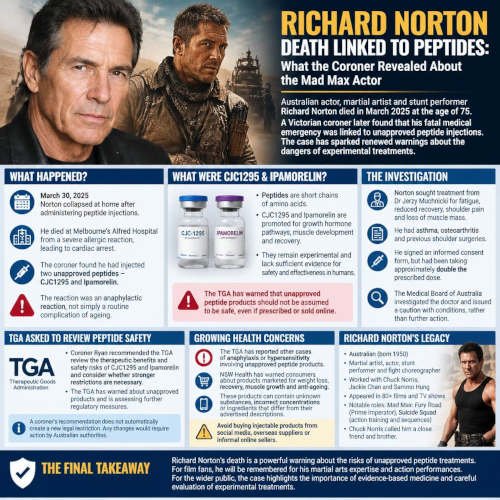
USA Latest news on Richard Norton: The death of Australian actor, martial artist and stunt performer Richard Norton has drawn renewed attention after a coroner linked his fatal medical emergency to unapproved peptide injections. Norton, best known for his work in action films and his contribution to Mad Max: Fury Road, died in March 2025 at the age of 75. The circumstances surrounding his death became public following the release of Victorian coroner David Ryan’s findings on October 28, 2026.
According to the findings, Norton suffered a severe allergic reaction after injecting two unapproved peptide products, CJC1295 and Ipamorelin. The reaction led to cardiac arrest. The coroner also recommended that Australia’s medicines regulator review the safety risks and consider whether tighter restrictions should apply to these substances.
The case has become an important warning about experimental treatments promoted for muscle growth, recovery and other health benefits.
Richard Norton Cause of Death: What Happened?
According to the Australian Broadcasting Corporation (ABC), Coroner David Ryan concluded that complications associated with Norton’s use of unapproved peptides triggered his fatal medical emergency.
Norton died at Melbourne’s Alfred Hospital on March 30, 2025. He had collapsed at home after administering peptide injections.
The coroner’s findings identified CJC1295 and Ipamorelin as the substances involved in the incident. These products had been prescribed by a medical practitioner, although they were not approved therapeutic goods in Australia.
The investigation also found that Norton had been taking more than the prescribed amount.
According to the coroner, Norton experienced an anaphylactic reaction following the injection, which resulted in cardiac arrest.
This distinction is important because the reported cause was not simply a routine complication of ageing. The investigation identified a serious reaction following the use of experimental, unapproved substances.
What Were CJC1295 and Ipamorelin?
CJC1295 and Ipamorelin are peptides that have attracted attention in fitness and performance-enhancement communities.
Peptides are short chains of amino acids. Some have established medical applications, but others remain experimental and lack sufficient evidence supporting their safety and effectiveness in humans.
CJC1295 and Ipamorelin are promoted in some online communities for potential effects involving growth hormone pathways, muscle development and recovery.
However, marketing claims should not be confused with established medical evidence.
The Therapeutic Goods Administration (TGA), Australia’s medicines regulator, has warned consumers about unapproved peptide products. Products that have not been evaluated for safety, quality and effectiveness should not be assumed to be safe simply because they are prescribed, professionally packaged or sold through online services.
Coroner’s Investigation Reveals Norton’s Peptide Use
The investigation examined Norton’s medical history and his decision to pursue peptide therapy.
According to the ABC report, Norton approached medical practitioner Jerzy Muchnicki because he was interested in peptide treatment. His reported concerns included fatigue, reduced physical recovery, shoulder pain and loss of lean muscle mass.
Norton also had a history of asthma, osteoarthritis and previous shoulder reconstruction surgeries.
The doctor reviewed his medical history, discussed the experimental nature of the treatment and arranged blood tests before prescribing the injections.
Norton reportedly signed an informed consent form acknowledging the treatment’s potential benefits and risks.
However, the investigation uncovered an important detail about his dosage.
In the days before his death, Norton informed a nurse at the clinic that he had been administering approximately double the prescribed dose. The nurse advised him to return to the prescribed amount.
The coroner also examined the circumstances surrounding replacement medication and the doctor’s record-keeping practices.
The medical practitioner was subsequently investigated by the Medical Board of Australia. The investigation identified shortcomings in clinical documentation and aspects of the doctor’s practice. The board issued a caution and imposed conditions rather than taking further regulatory action.
TGA Asked to Review Peptide Safety Restrictions
One of the most significant outcomes of the investigation was the coroner’s recommendation to the Therapeutic Goods Administration.
Coroner Ryan recommended that the regulator review the therapeutic benefits and safety risks of CJC1295 and Ipamorelin and consider whether stronger restrictions were necessary.
The recommendation reflects wider concerns about the growing popularity of unapproved substances promoted through fitness influencers, social media accounts and online sellers.
The TGA has repeatedly warned that unapproved therapeutic products have not undergone the same assessment of quality, safety and effectiveness required for registered medicines.
The regulator also stated that it continues to assess risks associated with these products and is considering whether additional regulatory measures may be appropriate.
Importantly, a coroner’s recommendation does not automatically create a new legal restriction. Any regulatory changes would require action by the relevant Australian authorities.
Growing Health Concerns About Unapproved Peptides
Norton’s death has highlighted the potential dangers of using experimental substances without sufficient safety evidence.
According to 7NEWS, the TGA had also reported other cases of anaphylaxis or hypersensitivity involving several unapproved peptide products.
NSW Health has separately warned consumers about products marketed online for weight loss, injury recovery, muscle growth and anti-ageing purposes.
These products can contain unknown substances, incorrect concentrations or ingredients that differ from their advertised descriptions.
Consumers should therefore be cautious about purchasing injectable products from social media promotions, overseas suppliers or informal online sellers.
Richard Norton’s Hollywood Career and Mad Max Legacy
Beyond the medical investigation, Norton’s death represents a significant loss for the international action-film community.
Born in Australia in 1950, Norton developed his reputation through martial arts, acting, stunt performance and fight choreography.
His career included work with major action stars, including Chuck Norris, Jackie Chan and Sammo Hung.
He appeared in more than 80 films and television productions throughout his career.
One of his notable Hollywood contributions came through Mad Max: Fury Road (2015), where he appeared as the Prime Imperator and contributed to the film’s action production.
He also worked on Suicide Squad (2016), helping train performers and develop action sequences.
His experience in martial arts made him a respected figure behind the scenes as well as on screen.
Chuck Norris publicly paid tribute to Norton after his death, describing him as a close friend and brother.
Why Richard Norton’s Death Matters Beyond Hollywood
The coroner’s findings have moved the discussion beyond celebrity news and into a broader public-health debate.
Unapproved peptides are increasingly discussed online as possible solutions for muscle growth, physical recovery and ageing-related concerns.
However, the evidence supporting many of these claims remains limited.
Norton’s case demonstrates why consumers should not assume that experimental treatments are harmless. Medical supervision and informed consent are important, but they cannot eliminate risks when a product’s safety profile remains uncertain.
Anyone considering an unapproved injectable treatment should discuss the potential risks with a qualified healthcare professional and avoid relying on fitness influencers or online testimonials for medical decisions.
Final Takeaway
Richard Norton’s death has become a major warning about the risks associated with unapproved peptide treatments. The Victorian coroner linked his fatal allergic reaction and cardiac arrest to CJC1295 and Ipamorelin injections and urged Australia’s medicines regulator to review their safety and restrictions.
For film fans, Norton will be remembered for his martial arts expertise, action performances and contributions to productions such as Mad Max: Fury Road. For the wider public, the investigation highlights the importance of evidence-based medicine and careful evaluation of experimental treatments.
