

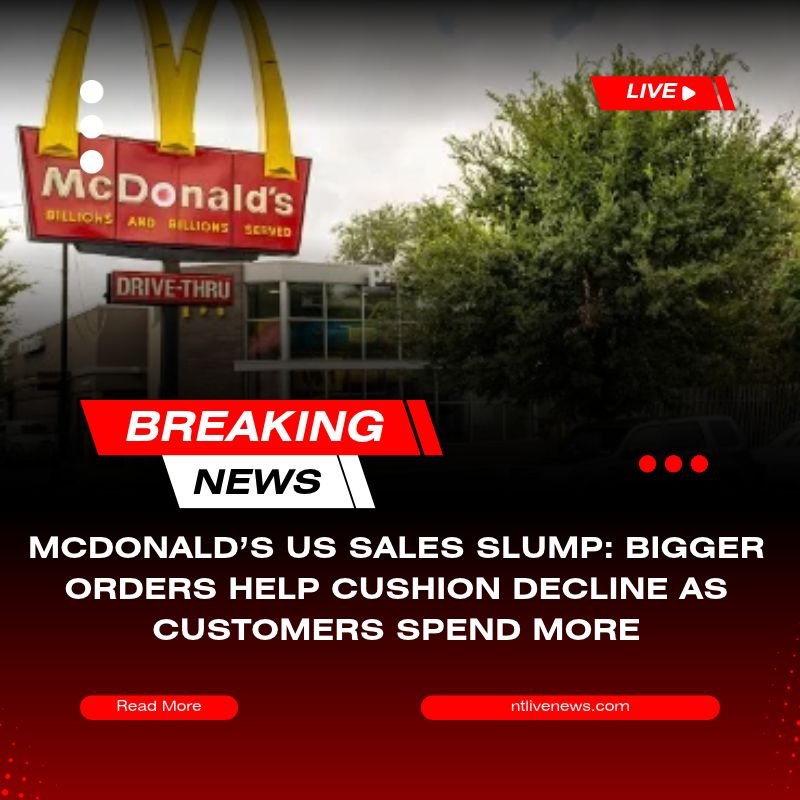
McDonald’s US sales came under pressure in the third quarter of 2026 as fewer customers visited its restaurants. However, larger orders and higher spending per visit helped the fast-food giant limit the damage, giving investors a more balanced picture of its performance.
The company reported a 0.2% decline in US comparable sales for the three months ended September 30. Although sales moved into negative territory, the result was better than the average analyst estimate compiled by Bloomberg, according to the November 4 report that highlighted the increase in customer spending.
The figures reveal an important challenge for McDonald’s: attracting more customers remains difficult, even as the company works to make its menu more affordable.
For consumers, the results also offer a glimpse into changing restaurant spending habits. Some customers may be visiting less frequently, while those who do visit are spending more on each order.
McDonald’s US Comparable Sales Fall 0.2% in Third Quarter
McDonald’s reported a 0.2% decline in US comparable sales during the July-September quarter. Comparable sales measure performance at restaurants that have been open for at least 13 months, helping investors compare established locations over time.
The decline marked a setback after several quarters of growth. It also showed that the company’s value-focused promotions had not fully reversed the pressure on customer visits.
McDonald’s had already warned in late September that it expected slightly negative US comparable sales for the quarter. The company pointed to weaker-than-expected customer response to some value menu offerings introduced earlier in the year.
Despite the decline, the final result was less severe than the Bloomberg analyst estimate cited in the original report. That offered some relief, although the underlying sales trend remained a concern.
The distinction matters because comparable sales can move in different directions depending on customer traffic, menu prices and the amount people spend during each visit.
Bigger Orders Help Offset Fewer Restaurant Visits
The main support for McDonald’s US sales came from higher spending per visit.
In simple terms, the company generated more money from customers who placed orders, helping offset the impact of fewer visits. Customers may spend more by purchasing additional items, choosing larger meals or selecting products with higher prices.
However, higher average spending does not automatically mean customer demand is improving.
If fewer people enter restaurants, the company must generate more revenue from each remaining transaction to protect its overall sales performance. That approach can help in the short term, but it may become harder to sustain if customers continue reducing restaurant visits.
Reuters reported that visits to McDonald’s US restaurants declined 4.6% year over year during the third quarter, based on data from Placer.ai. The traffic figures highlight the difference between the number of customers visiting and the amount they spend once they arrive.
This gap is particularly important for a brand that has traditionally promoted affordable meals as a major reason to choose its restaurants.
Why McDonald’s Value Menu Has Not Fully Reversed the Slowdown
Affordability has become a central part of McDonald’s strategy as consumers face pressure from everyday expenses.
Over the past two years, the company has introduced several promotions, including an under-$3 menu and a $4 breakfast meal. These offers aim to attract customers who are becoming more careful about discretionary spending.
However, value promotions alone have not been enough to restore consistent traffic growth.
McDonald’s warned in September that its earlier value menu initiatives were not generating the customer response it had hoped to achieve. That suggested a gap between the company’s promotional strategy and what consumers actually wanted.
Price is only one part of the decision. Customers also consider portion sizes, food quality, convenience, service and the total cost of feeding a family.
A discounted sandwich may attract attention, but consumers may still decide that eating at home or choosing another restaurant offers better value.
Higher Living Costs Continue to Influence Dining Decisions
The broader economic environment remains a major factor behind the restaurant slowdown.
Higher living costs, including housing, groceries, transportation and fuel, can leave households with less money for restaurant meals. When budgets become tight, eating out is often one of the expenses consumers reduce.
The Associated Press reported that higher gas prices and the cost of living were weighing on customers visiting McDonald’s locations.
The pressure is not limited to one restaurant chain. Revenue Management Solutions, a restaurant industry consultant, reported that US fast-food traffic declined 2.6% across the sector during the third quarter.
That broader trend suggests McDonald’s is facing an industry-wide challenge rather than an isolated problem.
Consumers may continue buying fast food, but they can become more selective about how often they visit and how much they spend.
Global Sales Growth Offers Some Support
Although the US market weakened, McDonald’s international business delivered positive comparable sales growth.
The company’s global comparable sales increased 1.3% according to the Associated Press report. Stronger performance in Germany and Australia helped offset weakness in France.
This international performance provides an important counterbalance to the pressure in the United States.
McDonald’s operates in markets with different consumer conditions, competitive environments and spending patterns. As a result, weakness in one country does not necessarily translate into a decline across its entire global business.
Still, the US remains a particularly important market for the company. Sustained weakness there could affect its broader growth outlook, especially if customer traffic does not recover.
The contrast between international growth and declining US comparable sales also shows why investors examine regional performance rather than relying only on worldwide figures.
Revenue Rises, but Quarterly Earnings Beat Expectations
McDonald’s financial results presented a mixed picture.
According to the Associated Press, quarterly revenue increased 1% to approximately $7.16 billion. However, that figure came in below Wall Street expectations of $7.28 billion.
Net income increased 9% to $2.49 billion.
The company reported adjusted earnings of $3.57 per share, beating the analyst forecast of $3.38 per share cited by AP. Reuters also reported adjusted earnings of $3.57 per share, compared with $3.22 a year earlier.
The earnings performance offered investors a positive signal despite weaker US sales.
Reuters reported that operating costs and expenses declined by approximately 4%, helping the company exceed profit expectations. Shares rose 2.4% in premarket trading following the results, according to the report.
However, stronger earnings do not erase the concern about customer traffic. Investors will continue watching whether McDonald’s can improve sales without depending too heavily on higher spending from fewer customers.
McDonald’s Focuses on Value, Promotions and Its NEXT Strategy
McDonald’s is working on several initiatives to improve its performance in the US market.
Its strategy includes more targeted value offers, promotional campaigns and operational improvements. The company has also been working to simplify restaurant operations and modernize its locations.
In June 2026, McDonald’s announced its NEXT turnaround strategy. Reuters reported that the plan focuses on simplifying operations, updating restaurant designs and investing in employee training.
The company aims to improve restaurant-level efficiency by 250 basis points, which it expects could generate approximately $100,000 in additional annual cash flow for the average US restaurant.
These improvements are designed to strengthen restaurant operations and support longer-term growth.
However, the success of the strategy will depend on execution. Restaurant upgrades and technology investments can improve the customer experience, but they must also deliver financial benefits for the company and its franchise operators.
Promotions Could Shape the Next Stage of Growth
Promotions remain an important part of McDonald’s effort to bring customers back.
Reuters reported that the company continued using offers and seasonal campaigns, including its Monopoly promotion and Halloween-themed Boo Buckets, during October.
Even with those promotions, restaurant traffic remained below year-ago levels in October, according to the Placer.ai data cited by Reuters.
That suggests McDonald’s may need more than short-term discounts to restore customer momentum.
A successful strategy could require a combination of competitive pricing, popular menu items, reliable service and a stronger customer experience.
The company must also balance affordability with profitability. Deep discounts can attract customers, but they may put pressure on restaurant margins if they do not generate enough additional orders.
What Customers and Investors Should Watch Next
The next few quarters will help determine whether McDonald’s US sales weakness represents a temporary setback or a longer-lasting change in consumer behavior.
Investors will likely focus on several indicators:
- Comparable sales: Whether US sales return to positive growth.
- Customer traffic: Whether more people begin visiting restaurants again.
- Average spending: Whether larger orders continue supporting revenue.
- Value promotions: Whether discounts attract repeat customers.
- Profit margins: Whether the company can maintain earnings while offering affordable meals.
- International performance: Whether overseas growth continues to offset weakness in the US.
These indicators will provide a clearer picture than revenue alone.
A company can report higher earnings while still facing a demand problem. For McDonald’s, restoring customer visits is likely to remain just as important as encouraging existing customers to spend more.
Final Outlook: Bigger Orders Provide Relief, but Traffic Remains the Key Challenge
McDonald’s third-quarter 2026 results show how higher customer spending can cushion a sales decline when restaurant traffic weakens.
The 0.2% fall in US comparable sales was less severe than the Bloomberg analyst estimate cited in the original report. However, the decline, combined with lower restaurant visits, highlights the pressure facing the fast-food business.
International growth and stronger adjusted earnings provided some positive news. Yet the company still needs to demonstrate that its value strategy can attract more customers rather than simply increase spending among those who continue to visit.
For McDonald’s, the next major test is clear: turn bigger orders into stronger overall demand.
The Golden Arches can continue relying on promotions and operational improvements, but a sustained recovery will depend on convincing more Americans that eating at McDonald’s offers good value for their money.
News update: November 4, 2026
