

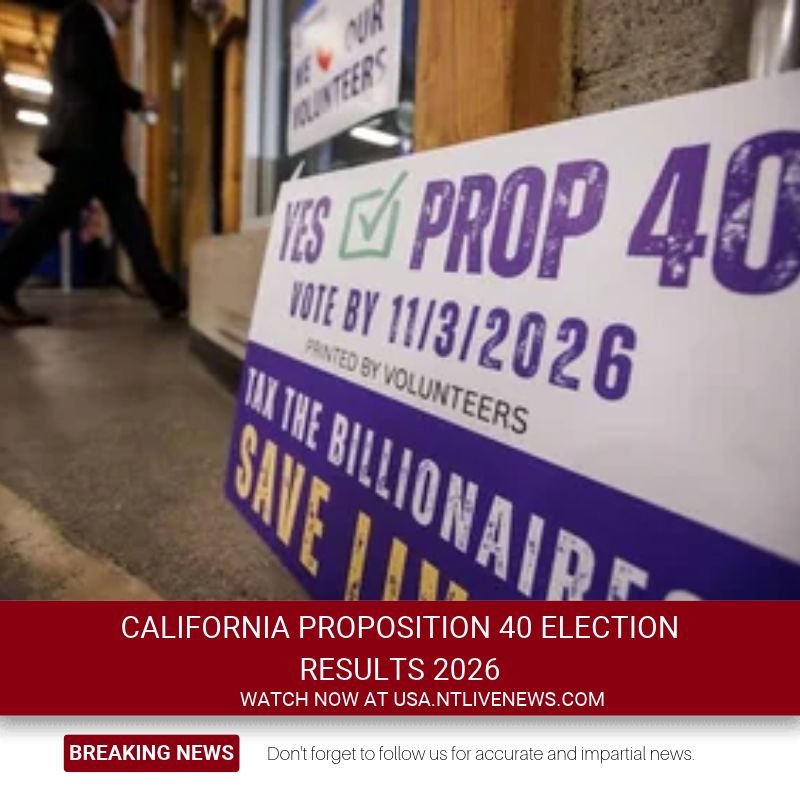
California’s controversial Proposition 40 billionaire wealth tax is facing resistance in the 2026 election, with early results showing more voters opposing the proposed tax than supporting it. The measure would impose a one-time tax of up to 5% on the covered wealth of certain California residents worth more than $1 billion, directing most of the revenue toward healthcare and other public programs.
In the Associated Press results snapshot reported at 52% of votes counted, No received 56.5% (3,760,014 votes), while Yes received 43.5% (2,891,196 votes). That left the proposal trailing by 13 percentage points at that stage of counting.
Subsequent election reporting also showed No maintaining a lead, although ballots remained outstanding. The result is not final until election officials complete the count and certification process. California’s extensive mail-in voting system means additional ballots can change the totals after Election Day.
The closely watched vote has national significance because Proposition 40 could establish a new model for taxing billionaire wealth while directing billions of dollars toward healthcare, food assistance and education. It has also intensified debate over California’s business climate, tax policy and the possibility of wealthy residents moving elsewhere.
Proposition 40 Election Results: What California Voters Are Deciding
Proposition 40, also known as the 2026 Billionaire Tax Act, asks California voters whether the state should impose a one-time wealth tax on certain taxpayers whose covered assets exceed $1 billion.
The proposal would apply to qualifying individuals who were California residents on January 1, 2026. Unlike a conventional income tax, which applies to money earned during a particular period, the proposed wealth tax would be calculated using covered assets and net worth.
Under the measure, the tax could reach 5% of the taxable wealth of qualifying billionaires. The proposal generally excludes real estate, pensions and certain retirement accounts from its covered assets.
The official California voter guide explains that covered assets include businesses, securities, art, collectibles and intellectual property. The proposal would allocate 90% of the revenue to healthcare and 10% to food assistance or education-related programs.
For voters, the central question is whether a one-time tax on billionaire wealth would provide meaningful support for public services without creating wider economic and budgetary risks.
What Does the 5% Billionaire Wealth Tax Actually Mean?
The proposed tax is different from the federal income tax and California’s existing state income tax.
An income tax generally applies to earnings, such as wages, business income, dividends and other taxable income. A wealth tax instead considers the value of assets owned by an individual, after accounting for relevant liabilities and exclusions.
Under Proposition 40, qualifying billionaires who were California residents on the specified January 1, 2026 date would face a one-time tax calculated at 5% of their covered net worth.
The Legislative Analyst’s Office explains that the tax would be due in 2027. Taxpayers could also spread payments over five years, although doing so would increase the total amount paid.
The proposal is designed to raise substantial temporary revenue rather than establish an annual wealth tax.
Who Would Be Affected?
The measure targets a relatively small group of extremely wealthy taxpayers rather than ordinary California households.
People with assets below the $1 billion threshold would not be subject to the proposed billionaire wealth tax.
The covered assets include certain financial investments, business interests and valuable personal property. Real estate, pensions and retirement accounts generally would be excluded under the proposal.
The January 1, 2026 residency requirement is especially important because it determines which individuals would fall within the measure’s coverage.
Supporters argue that people who accumulated substantial wealth while living in California should contribute toward public services. Opponents question whether a tax based on wealth could encourage wealthy individuals and businesses to relocate.
How Much Money Could Proposition 40 Raise?
California’s nonpartisan Legislative Analyst’s Office estimates that the measure could generate tens of billions of dollars in additional state revenue over several years.
However, the exact amount would depend on the value of covered assets, market conditions, taxpayer responses and the state’s ability to determine and collect the tax.
The Legislative Analyst’s Office also warns that California could experience an ongoing reduction of less than $1 billion annually in state income tax revenue from billionaires if some respond to the new tax by changing their financial or residency arrangements.
These estimates are important because the measure’s potential revenue must be considered alongside its possible long-term effects on the state’s existing tax base.
How Proposition 40 Revenue Would Support Healthcare and Public Services
Healthcare is the biggest proposed beneficiary of Proposition 40.
Under the official measure, 90% of the tax revenue would be directed toward healthcare services. The remaining 10% would support food assistance, education-related programs and administration of the tax.
The proposal comes amid debate over federal healthcare spending and the financial pressure facing California’s public health programs.
Medi-Cal, California’s Medicaid program, provides healthcare coverage to eligible low-income residents. State healthcare spending also supports public health services, mental health programs and other essential services.
Supporters say the billionaire tax could help protect these programs from funding reductions and provide additional resources for vulnerable communities.
The proposal also aims to support food assistance and education programs, which affect families, children and lower-income households across California.
However, the money would be temporary rather than a permanent annual source of revenue. That distinction matters when state officials plan long-term healthcare budgets and public services.
The Economic Debate: Billionaire Tax Versus California’s Business Climate
Proposition 40 has divided political leaders, business interests, unions and wealthy technology investors.
Supporters argue that California’s wealthiest residents should contribute more toward public services, particularly when healthcare and social assistance programs face financial pressure.
Opponents argue that a wealth tax could encourage billionaires to relocate, potentially reducing future income tax collections and weakening California’s business environment.
California depends heavily on high-income taxpayers for a significant portion of its income tax revenue. Changes in the location or financial activity of wealthy residents could therefore affect state finances.
The debate also involves technology companies and Silicon Valley investors, many of whom hold substantial wealth in stocks, private businesses and other assets.
A major concern is that the value of those assets can change quickly. A company’s stock price may rise or fall substantially within a short period, making wealth calculations and tax assessments more complicated.
The Legislative Analyst’s Office notes that these uncertainties make it difficult to predict exactly how much money the proposal would generate.
Proposition 41 and Proposition 42 Could Affect Proposition 40
One of the most important complications in the California Proposition 40 election results involves two other ballot measures: Proposition 41 and Proposition 42.
These competing proposals could affect whether the billionaire wealth tax takes effect, even if Proposition 40 receives majority support.
Proposition 41 includes restrictions involving state spending limits and requirements for audits of certain tax-funded programs.
Proposition 42 seeks to restrict new state taxes on personal property and certain retroactive taxes. Those provisions could conflict with important parts of Proposition 40.
California’s Legislative Analyst’s Office warns that if Proposition 41 or Proposition 42 receives more Yes votes than Proposition 40, a court could determine that the competing measure prevents the billionaire tax from becoming law.
This means voters are not simply deciding whether to approve a billionaire tax. They are also deciding among competing proposals that could change California’s tax rules.
Why the Competing Measures Matter
The interaction between the three propositions makes the election unusually complicated.
If Proposition 40 fails, the proposed billionaire tax would not take effect.
If Proposition 40 passes and the competing measures do not block it, the tax could proceed under the terms of the law.
If Proposition 40 passes but a conflicting measure receives more Yes votes, legal questions could arise over which provisions take effect.
The outcome therefore depends on more than the Yes and No percentages for Proposition 40 alone. The number of affirmative votes received by the competing measures also matters.
California Proposition 40 Results by County
The early results supplied in the election snapshot show different voting patterns across major California counties.
Los Angeles County was almost evenly divided, with 50% voting No and 50% voting Yes in the reported figures.
San Diego County recorded 58% No and 42% Yes. Orange County showed 62% No and 38% Yes, while Riverside and San Bernardino counties each reported 61% No and 39% Yes.
These figures offer an early picture of regional voting patterns, but they should not be treated as final county outcomes.
County results can change as additional mail ballots and other eligible votes are processed. California’s large population and extensive use of vote-by-mail make the counting process particularly important.
The statewide result also cannot be determined by looking at a handful of counties. Votes from across California must be counted before officials certify the final outcome.
Why California Election Results Can Take Days or Weeks
California does not necessarily finish counting every ballot on Election Night.
Many voters cast ballots by mail, and election officials must process, verify and count eligible ballots according to state procedures.
The California Secretary of State’s office explains that counties continue reporting results after Election Day. The counting process can take several days or longer, depending on the number of outstanding ballots and local election workloads.
This is why early election-night figures should be understood as a snapshot rather than a final result.
The Associated Press percentage of votes counted is an estimate of the portion of the expected vote reported. It can change as more information becomes available.
For readers following Proposition 40 election results, the most reliable approach is to check updated results from election authorities and distinguish unofficial returns from certified totals.
Frequently Asked Questions About California Proposition 40
What is California Proposition 40?
Proposition 40 is a 2026 California ballot measure proposing a one-time tax of up to 5% on the covered wealth of certain taxpayers with assets exceeding $1 billion.
Is Proposition 40 a billionaire wealth tax?
Yes. The measure is commonly called the billionaire tax because it targets qualifying California residents with covered assets above $1 billion.
What were the early Proposition 40 election results?
In the supplied Associated Press snapshot, with 52% of votes counted, No received 56.5% and Yes received 43.5%. Later reporting also showed No leading, but the result remained subject to further counting.
Will Proposition 40 affect ordinary California residents?
The proposed tax targets qualifying billionaires, not ordinary households with assets below the $1 billion threshold. However, its potential effects on state revenue and public programs could have broader consequences.
Where would Proposition 40 tax revenue go?
The proposal directs 90% of revenue toward healthcare and 10% toward food assistance or education-related programs, including the administration of the tax.
When would billionaires pay the proposed tax?
Under the Legislative Analyst’s Office analysis, the tax would be due in 2027, with an option to spread payments over five years at a higher total cost.
What Happens Next in the Proposition 40 Election?
The next stage is continued vote counting, followed by official certification.
California voters and taxpayers will be watching the final Yes and No totals, county-level results and the outcomes of Propositions 41 and 42.
If Proposition 40 fails, the proposed one-time billionaire wealth tax will not be implemented. If it passes, the competing ballot measures and any resulting legal questions could still affect its future.
The election also raises broader questions about how states should fund healthcare, education and social assistance while maintaining a competitive business environment.
For now, the early California Proposition 40 election results show opposition leading. The final decision will depend on the completed vote count, the interaction between the ballot measures and the state’s official certification process.
