
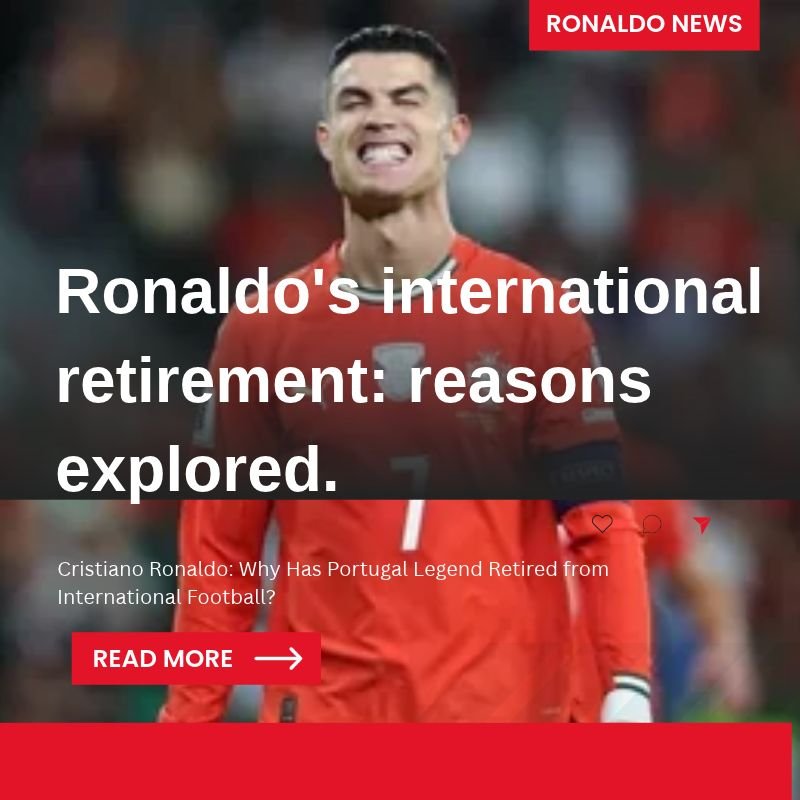
Cristiano Ronaldo has announced his retirement from international football, bringing an extraordinary 23-year career with Portugal to an end. The 41-year-old forward confirmed on November 5, 2026, that he would hand back the national team’s famous No. 7 shirt after the November international break.
Ronaldo leaves Portugal with a record of 146 international goals in 234 appearances. He also captained his country to its first major international trophy at Euro 2016 and helped Portugal win two UEFA Nations League titles.
However, the timing of his announcement has raised questions about how one of football’s greatest international careers reached its conclusion. A public disagreement with Portugal head coach Jorge Jesus, uncertainty over his starting position and the demands of international football have all become part of the discussion.
The retirement marks the end of an important chapter for Portuguese football. Ronaldo will continue playing club football with Saudi Arabian side Al-Nassr, but his journey with the national team is over.
Why Has Cristiano Ronaldo Retired from International Football?
Ronaldo’s announcement came after a difficult period involving Portugal coach Jorge Jesus. The disagreement developed during the September 2026 international break, when Ronaldo was left out of the starting line-up and subsequently left the national team’s training camp without permission.
The forward had been an unused substitute during Portugal’s match against Norway. He later claimed that the coach had broken promises about his expected involvement and the way the situation would be explained publicly.
Jesus disputed aspects of Ronaldo’s account and said the player would be welcome to return. The disagreement nevertheless created uncertainty about Ronaldo’s role in the squad.
According to reports, the Portuguese Football Federation imposed a 30-day suspension and a fine of 255 euros after Ronaldo left the camp. The suspension had already been served by the time the retirement announcement was made.
The dispute was an important part of the background, but Ronaldo’s announcement did not establish that the disagreement was the only reason for his decision.
The player described the retirement as an emotional choice. In his announcement, he reflected on the responsibility of representing Portugal and said the time had come to pass the No. 7 shirt to the next generation.
Ronaldo’s Retirement Announcement: What Did He Say?
Ronaldo announced his decision through a video message shared on social media. He addressed the Portuguese people and described wearing the national team’s shirt for 23 years as a privilege and responsibility.
He said the No. 7 shirt never belonged to him alone. Instead, he viewed himself as someone entrusted with carrying it for his country.
The forward also acknowledged that retirement was not an easy decision. He reflected on the journey that began in August 2003 and the experiences that changed his life.
His message focused on more than goals, records and trophies. Ronaldo said the lasting connection between a player and supporters was more important than statistics that could eventually be broken.
He thanked his family, teammates, coaches, staff and Portuguese supporters for their support throughout his international career. His message ended with a declaration that Portugal would always remain part of him.
Cristiano Ronaldo’s Portugal Career in Numbers
Ronaldo’s international record places him among the most successful players in football history.
| Career achievement | Ronaldo’s record |
|---|---|
| Portugal appearances | 234 |
| Portugal goals | 146 |
| International career | 2003–2026 |
| European Championship titles | 1 |
| UEFA Nations League titles | 2 |
| FIFA World Cup appearances | 6 |
| World Cup goals | 11 |
Ronaldo holds the men’s international records for both appearances and goals. His 146 goals for Portugal put him ahead of Lionel Messi, who has scored 126 international goals for Argentina, according to UEFA’s published statistics.
These figures demonstrate the extraordinary consistency of his international career. He represented Portugal across different generations of players, several coaching eras and six World Cup tournaments.
From a Teenage Debut to Portugal’s Greatest Football Icon
Ronaldo made his senior international debut in August 2003. At that stage, he was a promising young player beginning to attract attention for his speed, technical ability and confidence.
His first major tournament came at Euro 2004, which Portugal hosted. The teenager helped his country reach the final, where Greece produced a surprise 1-0 victory.
The defeat was painful for Portugal, particularly because the team had hoped to win the European Championship on home soil. Ronaldo was visibly emotional after the final whistle.
That tournament introduced him to the pressure of representing a nation with enormous expectations. It also marked the beginning of a long international journey.
As established players such as Luis Figo moved towards the end of their international careers, Ronaldo became increasingly important to Portugal. He eventually took over the captaincy and developed into the team’s central figure.
His influence extended beyond his performances. He became the public face of Portuguese football and one of the most recognisable athletes in the world.
Euro 2016: The Trophy That Defined His Portugal Legacy
One of the most important moments in Ronaldo’s international career came at the 2016 European Championship in France.
Portugal entered the tournament with considerable expectations but faced difficult opponents throughout the competition. The team advanced through the group stage and knockout rounds before reaching the final against France.
Ronaldo suffered a knee injury during the final and had to leave the pitch in the first half. Although he could not complete the match, he remained involved from the sidelines, encouraging his teammates.
Portugal eventually won 1-0 after extra time, with Éder scoring the decisive goal.
The victory gave Portugal its first major international football trophy. It also transformed Ronaldo’s legacy with the national team.
He had experienced the disappointment of losing the Euro 2004 final as a teenager. Twelve years later, he finally celebrated a European Championship title as captain.
Nations League Success Added to His International Legacy
Ronaldo’s achievements did not end with Euro 2016.
Portugal won the inaugural UEFA Nations League in 2019, defeating the Netherlands in the final. Ronaldo played an important role during the tournament and scored a hat-trick against Switzerland in the semi-finals.
Portugal later won another Nations League title in 2025, adding another major achievement to Ronaldo’s international record.
These victories helped establish Portugal as a major force in international football. They also gave Ronaldo a collection of trophies that reflected his long service to the national team.
Six World Cups and a Record-Breaking International Career
Ronaldo’s international career included appearances at six FIFA World Cups, beginning in Germany in 2006 and continuing through the 2026 tournament in North America.
He became the first men’s player to score at five different World Cups and extended that achievement by scoring at a sixth tournament in 2026.
His World Cup career included memorable goals, difficult defeats and repeated attempts to help Portugal reach the final stages of the competition.
Portugal’s 2026 campaign ended with a 1-0 defeat against Spain in the round of 16, according to Reuters. Ronaldo’s final appearance for his country came earlier, against Wales on September 24, 2026.
Although he never won the World Cup, his six tournament appearances and 11 goals created another significant record.
Did the Disagreement With Jorge Jesus Influence Ronaldo’s Decision?
The relationship between Ronaldo and Jorge Jesus became a major talking point before the retirement announcement.
The disagreement followed decisions about Ronaldo’s playing time during the Nations League campaign. Ronaldo said he had an understanding with the coach about his participation in the matches against Norway and Denmark.
He claimed the agreement was not followed and that a subsequent discussion about explaining the situation publicly also broke down.
Jesus gave a different account and left the door open for Ronaldo to return to the squad. The Portuguese Football Federation then imposed a disciplinary punishment after the forward left the training camp.
The situation highlighted a difficult question facing elite players near the end of their careers: how should a legendary footballer respond when he is no longer guaranteed a starting position?
Ronaldo has spent much of his career as one of the first names on the team sheet. Adjusting to a reduced role may have been difficult, particularly for a player whose ambition and competitiveness have shaped his public identity.
However, it would be inaccurate to describe the retirement as simply the result of a disagreement. Ronaldo’s announcement presented the decision as an emotional conclusion to a journey lasting more than two decades.
What Happens to Cristiano Ronaldo After Portugal Retirement?
Ronaldo’s international retirement does not mean he is ending his professional football career.
He is expected to continue playing for Al-Nassr in Saudi Arabia. The club has been an important part of the later stage of his career, and he remains focused on scoring goals and competing at club level.
Reuters reported that Ronaldo was approaching the milestone of 1,000 career goals, with 985 credited to him at the time of the retirement announcement.
His next chapter will therefore involve club football rather than international tournaments.
The retirement also creates an opportunity for Portugal’s younger players to take greater responsibility. The national team must now prepare for future competitions without the player who has led its attack for much of the past two decades.
Portugal Says Thank You to Its Greatest Modern Football Star
The Portuguese Football Federation expressed deep gratitude and admiration for Ronaldo’s contribution to the national team.
The federation praised his role in raising Portugal’s international profile and inspiring younger generations. It also indicated that it intends to organise a tribute so supporters can celebrate his achievements.
The response reflects the scale of Ronaldo’s influence. He became more than a successful striker: he was a symbol of Portuguese football for supporters around the world.
His career included major victories, painful defeats, individual records and moments that brought millions of fans together.
The disagreement surrounding his final months may influence how some people remember the ending. Yet it does not erase the achievements that came before it.
Frequently Asked Questions About Cristiano Ronaldo’s Retirement
Has Cristiano Ronaldo retired from international football?
Yes. Ronaldo announced on November 5, 2026, that he would end his international career with Portugal after the November international break.
How many goals did Ronaldo score for Portugal?
He scored a record 146 goals in 234 appearances for Portugal.
Why did Cristiano Ronaldo leave Portugal’s training camp?
He left during the September 2026 international break after a disagreement with coach Jorge Jesus over his playing time and how the situation would be explained.
Who was Portugal’s coach when Ronaldo retired?
Jorge Jesus was Portugal’s head coach at the time of Ronaldo’s retirement announcement.
Did Ronaldo win the European Championship with Portugal?
Yes. He captained Portugal to victory at Euro 2016, when the team defeated France 1-0 after extra time.
Will Cristiano Ronaldo continue playing football?
Yes. His international retirement does not end his club career. He is expected to continue playing for Al-Nassr in Saudi Arabia.
What was Ronaldo’s final match for Portugal?
His last appearance came against Wales on September 24, 2026.
The End of an Era for Portuguese Football
Cristiano Ronaldo’s retirement closes one of the most remarkable chapters in international football. From an emotional teenager at Euro 2004 to a record-breaking captain who lifted the European Championship trophy, his journey transformed Portugal’s place in the global game.
The disagreement with Jorge Jesus made the ending more complicated than many supporters might have expected. Nevertheless, his 146 goals, 234 appearances and major international trophies remain central to his legacy.
Portugal must now move forward without its most recognisable football figure. For Ronaldo, the next challenge is at club level. For millions of supporters, however, the No. 7 shirt will always be associated with the player who wore it for 23 years.
