
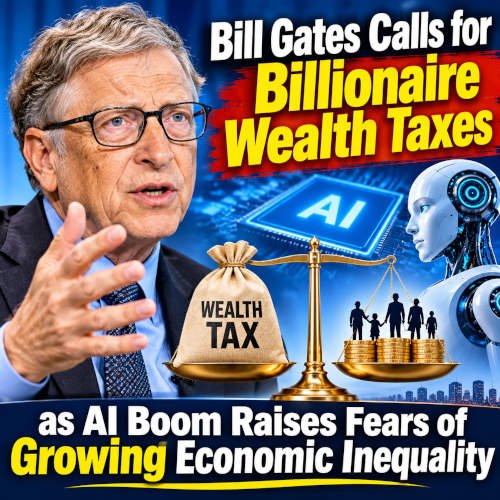
Microsoft co-founder Bill Gates is urging governments to rethink wealth taxation as artificial intelligence threatens to widen the financial gap between billionaires and ordinary workers.
The rapid expansion of artificial intelligence is creating enormous business opportunities, increasing company valuations, and transforming industries. However, one of the world’s richest technology entrepreneurs believes the economic benefits of this revolution could become concentrated among people who already control significant wealth.
Microsoft co-founder Bill Gates is backing stronger wealth taxes, including higher taxes on billionaires, to ensure that AI-driven economic growth benefits society more broadly.
In a recent interview with the Financial Times, Gates argued that governments must take primary responsibility for addressing economic inequality. He warned that charitable donations alone cannot replace public policies designed to support workers and families.
His comments arrive as businesses increasingly invest in artificial intelligence, automation, robotics, and advanced computing systems. While these technologies could improve productivity and generate substantial profits, they could also disrupt traditional employment and concentrate financial gains among investors and technology companies.
The debate over billionaire taxes, capital gains taxation, corporate tax policy, and AI-driven unemployment is therefore becoming increasingly important for the future of the American economy.
Why Bill Gates Wants Governments to Introduce Wealth Taxes
Bill Gates believes that artificial intelligence could create extraordinary wealth over the coming years. However, he is concerned about who will receive the largest share of those financial gains.
Companies developing AI technologies are attracting significant investments. Their founders, shareholders, executives, and early investors could benefit from rising company valuations and growing business revenues.
Meanwhile, workers whose jobs become automated may face employment uncertainty, lower bargaining power, or the need to develop entirely new professional skills.
Gates believes governments must address this imbalance through changes to taxation systems.
During his Financial Times interview, he emphasized that the responsibility for reducing inequality belongs primarily to governments.
He explained that philanthropy is voluntary and cannot serve as a replacement for a reliable social safety net.
Gates also argued that taxation systems must evolve as artificial intelligence changes how companies generate profits and how workers earn their incomes.
His position supports a broader discussion about progressive taxation, billionaire wealth taxes, and policies designed to distribute the economic benefits of technological development more fairly.
AI Wealth Creation Could Increase the Gap Between Rich and Poor
Artificial intelligence is becoming an important driver of economic growth.
Technology companies are investing billions of dollars in data centers, advanced processors, cloud computing infrastructure, and AI software. These investments are creating opportunities for businesses involved in semiconductor manufacturing, automation, cybersecurity, and enterprise technology.
However, the financial benefits may not be distributed equally.
People who own substantial shares in successful technology companies could see their investments increase in value. Workers who depend primarily on salaries may not experience the same financial growth.
According to the Federal Reserve’s Distributional Financial Accounts, the wealthiest 1% of American households owned approximately 50.2% of corporate equities and mutual fund shares in the first quarter of 2026.
This figure highlights the concentration of stock-market ownership in the United States. It also helps explain why rising technology valuations could disproportionately benefit wealthy investors.
The Federal Reserve data do not establish how much future AI profits will be distributed, but they illustrate the existing financial imbalance that concerns Gates.
If AI companies continue expanding and their valuations rise, shareholders with significant existing investments could receive substantial financial benefits.
For ordinary households, the outcome may depend more heavily on wages, employment opportunities, education, and access to affordable services.
Bill Gates Says Billionaires Should Pay More Taxes
Gates has specifically raised the possibility of increasing taxes on individuals with extremely large fortunes.
He believes governments should have the ability to tax substantial accumulated wealth rather than relying entirely on traditional income-tax systems.
His comments come amid growing discussions in the United States about billionaire wealth taxes, higher taxes on wealthy households, and changes to capital gains taxation.
A wealth tax generally applies to the value of a person’s assets, potentially including stocks, investments, real estate, and other financial holdings, depending on how a particular proposal is designed.
This differs from income tax, which generally applies to money earned through salaries, business activities, and other taxable income.
Supporters argue that wealth taxes could help governments collect revenue from individuals whose fortunes grow substantially through investments rather than traditional employment income.
Critics, however, raise concerns about asset valuation, capital movement, tax avoidance, investment incentives, and the practical difficulties of implementing such policies.
There is also an important distinction between taxing income from investments and taxing accumulated wealth itself.
Gates’ comments do not represent an enacted federal tax policy. They reflect his view that governments should reconsider how wealthy individuals contribute to public finances as AI transforms the economy.
Why Bill Gates Also Wants Robots and AI Systems Taxed
One of Gates’ most interesting proposals involves taxation on robots and artificial intelligence systems.
He has previously argued that companies hiring human workers face payroll-tax obligations, while businesses purchasing machines can often deduct qualifying equipment expenses under existing tax rules.
This difference could make automation financially attractive, particularly when companies are trying to reduce operating costs.
Gates believes tax policies should account for the economic consequences of replacing human labor with machines.
In his discussion of the issue, he suggested that governments consider taxing AI tokens and robots.
AI tokens are units used to measure the processing and usage of artificial intelligence models. Businesses may pay for these units when accessing commercial AI services.
A tax on AI usage or robotic systems could potentially generate public revenue while helping governments finance worker retraining and social protection programs.
However, implementing such a policy would require careful consideration.
A broad tax on artificial intelligence could also affect businesses using AI to improve healthcare, education, scientific research, and public services.
Gates has acknowledged that any proposed tax should be designed carefully so it does not discourage beneficial technological applications.
The Employment Challenge Behind AI Automation
Artificial intelligence is changing the nature of work across multiple industries.
Businesses are using AI tools to automate customer service, process documents, analyze financial information, generate software code, and perform administrative tasks.
Some occupations may experience significant changes as companies introduce more advanced systems.
However, automation does not automatically mean that every affected job will disappear. Some roles may evolve, while new employment opportunities could emerge in AI development, cybersecurity, technology maintenance, and other industries.
The major challenge is ensuring that workers can adapt to these changes.
Gates believes governments should consider stronger social safety nets, employment support, and professional retraining programs.
These measures could become particularly important if AI increases productivity while reducing demand for certain categories of human labor.
Bill Gates’ $100 Billion Philanthropic Commitment
Gates’ support for wealth taxation is particularly interesting because he has already committed most of his personal fortune to philanthropy.
In May 2025, he announced that he intended to give away virtually all his remaining wealth through the Gates Foundation over the following 20 years.
The foundation plans to spend more than $200 billion between 2025 and 2045, including its existing endowment and future contributions.
It also announced plans to close permanently on December 31, 2045.
The foundation focuses on major global challenges, including maternal and child health, infectious diseases, poverty reduction, and education.
However, Gates believes private charitable giving cannot replace government responsibility.
His argument is that philanthropy depends on voluntary decisions made by individuals and organizations. Government programs, by contrast, can establish broader public systems funded through taxation.
This distinction is central to his position on AI-driven inequality.
Even substantial charitable contributions cannot independently guarantee income protection, employment support, healthcare access, and economic opportunities for every affected household.
What Gates’ Wealth Tax Proposal Could Mean for the US Economy
The debate over billionaire wealth taxes could influence future discussions about American tax policy.
If governments introduce new taxes on substantial fortunes or AI-related economic activity, the additional revenue could potentially support public services and social programs.
Possible areas of investment include:
- Worker retraining: Helping employees develop skills required in AI-powered industries.
- Education: Expanding access to technology education and professional training.
- Healthcare: Supporting affordable medical services and AI-assisted healthcare programs.
- Unemployment support: Providing financial assistance to workers affected by automation.
- Public infrastructure: Funding research, digital infrastructure, and economic development.
However, policymakers would need to balance revenue generation with economic competitiveness.
A poorly designed wealth tax could create administrative difficulties or encourage wealthy individuals to move assets or investments elsewhere.
Economists also disagree about the best way to tax wealth and automation without discouraging innovation.
Some favor higher taxes on capital gains and investment income, while others support stronger inheritance taxes, corporate taxation, or targeted taxes on automated activities.
Gates’ comments add another influential voice to this ongoing economic debate.
What the AI Tax Debate Means for Investors and Businesses
The discussion also has implications for investors following the technology sector.
Companies developing AI systems, semiconductor manufacturers, cloud computing providers, and robotics businesses could experience significant growth as demand for automation increases.
However, changing tax policies could affect corporate profitability, investment decisions, and the long-term economics of automation.
Investors should distinguish between Gates’ policy recommendations and actual legislative developments. His comments do not mean that a federal billionaire wealth tax or robot tax has been approved.
Businesses should also pay attention to how governments approach workforce development, AI regulation, and corporate tax incentives.
The long-term economic impact of artificial intelligence will depend not only on technological progress but also on how societies manage the resulting changes.
Can Wealth Taxes Prevent AI From Increasing Inequality?
Bill Gates’ proposal raises a fundamental question about the future of capitalism: Should people who benefit most from technological progress contribute more toward supporting those who face its economic consequences?
Supporters of progressive taxation argue that governments need additional resources to address inequality and provide essential services.
Opponents worry that excessive taxation could discourage investment, reduce innovation, and create difficulties for businesses.
There is also uncertainty about how quickly artificial intelligence will replace existing jobs and how many new occupations it will create.
No single tax policy can solve every challenge associated with automation.
A broader approach could combine responsible taxation, education, workforce development, investment in public services, and policies that encourage innovation.
The Bottom Line: Gates Wants AI Wealth to Benefit More People
Bill Gates’ support for billionaire wealth taxes highlights a growing concern about who will benefit financially from the artificial intelligence revolution.
AI could create enormous opportunities for businesses and investors, but its economic benefits may not automatically reach ordinary workers and families.
His proposal is not simply about collecting more money from billionaires. It is about ensuring that governments have the resources to support people as technology changes employment, business operations, and economic opportunities.
Whether policymakers adopt wealth taxes, robot taxes, or alternative financial reforms remains uncertain.
But one message from Gates is clear: The future of artificial intelligence should not be measured only by how much wealth it creates, but also by how widely that wealth benefits society.