
USA News Today Live Breaking America upd…
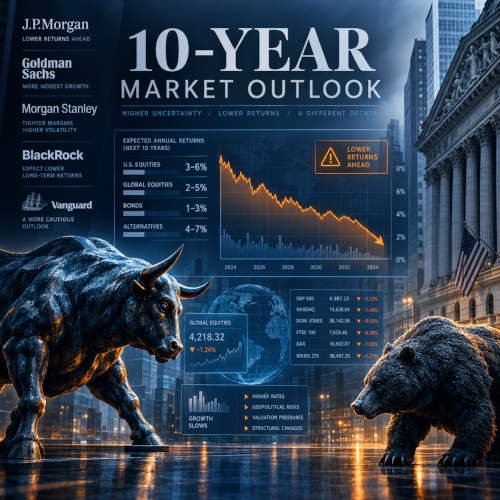
The stock market outlook for the next decade is raising questions for American investors. Two of the biggest names in investment management, Fidelity and Vanguard, expect U.S. stocks to deliver lower long-term returns than investors have enjoyed during some recent periods. Their projections highlight the impact of elevated stock valuations, changing interest rates, economic uncertainty, and the growing importance of portfolio diversification.
According to Vanguard’s October 2026 outlook, U.S. equities could generate annualized returns of approximately 4.8% to 6.8% over the next 10 years. Fidelity’s longer-term capital market assumptions have also pointed to more moderate U.S. stock returns, with a 5.8% annualized projection over a 20-year period in its previously published assumptions.
These estimates do not mean that a stock market crash is coming or that investors should immediately sell their investments. Instead, they suggest that people planning for retirement may need to reconsider expectations about future portfolio growth.
For investors using Vanguard or Fidelity funds, the central question is no longer simply whether stocks will rise. It is whether their investment plans can withstand a decade of potentially slower growth.
Why Fidelity and Vanguard Expect Lower Stock Market Returns
The latest forecasts from Fidelity and Vanguard reflect concerns about the prices investors are paying for U.S. stocks and the potential growth companies can deliver from current valuation levels.
Vanguard’s October 21, 2026, Capital Markets Model update places its expected annualized return for U.S. equities at 4.8% to 6.8% over the next decade. The forecast increased from its previous range of 4.2% to 6.2%, following stronger corporate earnings and some improvement in market valuations. corporate.vanguard.com
Fidelity’s October 13, 2026, capital market assumptions also point to below-average long-term returns for U.S. equities. The firm identifies elevated starting valuations and lower growth potential as important factors behind its outlook. It expects stocks to outperform bonds over the next 20 years, but by a smaller margin than investors have historically experienced. clearingcustody.fidelity.com
The two companies use different forecasting periods and investment models. Therefore, their projections should not be treated as identical predictions.
Nevertheless, their broader message is similar: investors should avoid assuming that the exceptional performance of the previous decade will automatically continue.
How Much Could a $500,000 Investment Grow Over 10 Years?
The difference between historical stock market returns and more conservative future expectations becomes clearer when applied to an investment portfolio.
Consider an investor with $500,000 who leaves the money invested for 10 years without making additional contributions or withdrawals.
The following examples illustrate how different annual growth rates could affect the portfolio:
| Annual Return | Investment After 10 Years |
|---|---|
| 4% | $740,122 |
| 5% | $814,447 |
| 5.8% | $873,500 |
| 6% | $895,424 |
| 6.8% | $966,000 |
| 8% | $1,079,462 |
| 10% | $1,296,871 |
These figures assume annual compounding and exclude taxes, investment fees, and inflation.
At a 10% annual return, the original $500,000 would grow to approximately $1.3 million. At 5.8%, it would reach approximately $873,500.
That represents a difference of more than $423,000.
This example explains why lower stock market return forecasts matter to people building retirement savings. Even when markets continue rising, a slower growth rate can significantly change the amount available for future expenses.
However, these calculations are illustrations, not predictions that any particular investor will earn these returns.
What Is Driving the Lower Stock Market Return Forecast?
Several economic and financial factors are influencing the long-term outlook from major investment firms.
1. High Stock Market Valuations
One of the biggest concerns is the price investors are paying for publicly traded companies.
Stock valuations measure how much investors are willing to pay relative to corporate earnings, sales, or other financial measures.
When valuations become elevated, companies may need to deliver substantial earnings growth to justify their share prices.
This does not mean expensive stocks must fall immediately. However, if earnings fail to meet expectations, investors may become less willing to pay premium prices.
Vanguard’s latest outlook acknowledges that U.S. equities remain highly valued, although valuations improved during the third quarter of 2026. The company also reported that stronger earnings and profit margins helped improve its return expectations. corporate.vanguard.com
2. Artificial Intelligence Expectations
Artificial intelligence has become a major influence on U.S. stock market performance.
Technology companies involved in AI development, semiconductor manufacturing, cloud computing, and data center infrastructure have attracted significant investor attention.
The AI investment boom has supported earnings expectations and stock valuations across several major companies.
However, investors must consider whether the revenue and productivity improvements expected from AI will eventually justify the substantial investments being made.
If companies fail to deliver the anticipated financial benefits, some highly valued stocks could experience pressure.
Vanguard’s October assessment noted that AI-linked technology, growth, and large-cap U.S. stocks continued to outperform several other market segments during the third quarter. corporate.vanguard.com
3. Interest Rates and Bond Yields
Interest rates also influence stock market valuations.
When bond yields rise, investors have more opportunities to earn income without taking the same level of equity risk.
Higher interest rates can also increase borrowing costs for businesses and reduce the present value of their expected future earnings.
This can create pressure on companies whose valuations depend heavily on profits expected many years into the future.
Vanguard’s latest forecast also shows why bonds are receiving renewed attention. Its projected 10-year annualized return range for U.S. aggregate bonds increased to 5.1% to 6.1% in its September 2026 model. corporate.vanguard.com
That range is relatively close to its U.S. equity forecast, although stocks and bonds have different risks and may perform differently.
4. Slower Long-Term Earnings Growth
Corporate earnings are a major driver of stock market performance.
Companies can increase profits through higher sales, improved productivity, cost reductions, international expansion, and new products.
However, investors may already be pricing in substantial future growth.
If actual earnings increase more slowly than expected, share prices may struggle even when businesses remain profitable.
Fidelity identifies lower growth potential and elevated starting valuations as important reasons for its below-average long-term U.S. equity return expectations. clearingcustody.fidelity.com
What Does This Mean for Vanguard and Fidelity Investors?
Investors who own mutual funds, exchange-traded funds (ETFs), or retirement accounts through Vanguard and Fidelity may wonder whether these forecasts should change their investment strategies.
The important distinction is between the investment company and the investments held inside an account.
Vanguard and Fidelity provide investment products and financial services. Their funds can hold different combinations of U.S. stocks, international equities, bonds, and other assets.
A Vanguard S&P 500 index fund, for example, provides exposure to large U.S. companies. A diversified international stock fund follows a different group of investments.
Therefore, a lower forecast for U.S. equities does not mean every Vanguard or Fidelity investment will deliver the same return.
Is Right Now a Good Time to Invest in Vanguard?
There is no universal answer because investment decisions depend on an individual’s financial goals, investment horizon, and ability to tolerate losses.
Vanguard’s latest forecast does not say investors should avoid stocks. Its October 2026 projections still anticipate positive annualized returns for U.S. equities over the next decade.
However, investors should recognize that positive returns do not necessarily mean strong returns every year.
Someone investing for retirement several decades away may have more time to recover from temporary market declines than someone who expects to withdraw money within the next few years.
Investors considering Vanguard funds may want to examine:
- Their current exposure to U.S. stocks.
- The concentration of their portfolios in large technology companies.
- Their allocation to international equities.
- Their exposure to bonds and cash.
- Their investment costs and tax considerations.
- Their expected retirement or withdrawal dates.
A long-term investment strategy should reflect personal financial circumstances rather than a single market forecast.
What Is the Difference Between Vanguard and Fidelity?
Both companies offer investment products, retirement services, and portfolio solutions, but their investment platforms and fund offerings are not identical.
| Feature | Vanguard | Fidelity |
|---|---|---|
| Main offerings | Mutual funds, ETFs and retirement services | Mutual funds, ETFs, brokerage and retirement services |
| Investment approach | Strong emphasis on index investing and low-cost funds | Index investing and actively managed funds |
| Retirement products | IRAs and workplace retirement plans | IRAs and workplace retirement plans |
| Research | Economic and market research | Asset allocation and capital market research |
| Investment choices | Stocks, bonds and diversified funds | Stocks, bonds and diversified funds |
Neither company is automatically the better choice for every investor.
Fund expenses, available investment options, account services, trading requirements, and individual financial goals all matter when comparing the two platforms.
Could Bonds Become More Attractive Than Stocks?
One important development in the latest forecasts is the improved outlook for fixed-income investments.
For much of the previous decade, low interest rates made bonds less attractive to some investors seeking higher returns.
However, higher bond yields have changed the investment environment.
Vanguard’s October 2026 projections place expected annualized returns for U.S. aggregate bonds at 5.1% to 6.1% over the next decade. Its corresponding U.S. equity forecast is 4.8% to 6.8%. corporate.vanguard.com
The ranges overlap considerably.
This means investors may have more reasons to consider bonds as part of a diversified portfolio rather than relying exclusively on stocks for growth.
Bonds can provide interest income and may help reduce portfolio volatility. However, they are not risk-free.
Bond prices can fall when interest rates increase. Corporate bonds also carry credit risk, while inflation can reduce the purchasing power of fixed interest payments.
Investors therefore need to consider the type, maturity, credit quality, and tax treatment of bonds before making decisions.
Why International Stocks Are Getting More Attention
Another important aspect of Vanguard’s latest forecast is its outlook for international equities.
The company increased its expected annualized return range for developed-market equities outside the United States to 5.3% to 7.3%.
Its emerging-market equity forecast increased to 3.7% to 5.7%. corporate.vanguard.com
These projections suggest that international markets could offer additional diversification opportunities.
U.S. investors who hold portfolios concentrated in American technology and large-cap companies may want to understand how international exposure could affect their overall risk.
However, international investments also involve currency movements, political developments, economic differences, and market-specific risks.
Diversification does not guarantee profits or prevent losses. Its purpose is to avoid depending entirely on the performance of one market or investment category.
How Lower Stock Returns Could Affect Retirement Planning
The biggest concern surrounding a decade of lower stock market returns may be its impact on people approaching retirement.
Workers who are still accumulating savings may be able to continue investing through different market conditions.
Retirees face a different challenge because they may need to withdraw money regularly to cover living expenses.
A market decline during the early years of retirement can have a lasting effect on portfolio sustainability.
This problem is commonly known as sequence-of-returns risk.
Consider two retirees who begin with identical investment portfolios and withdraw the same amount every year.
One experiences strong investment returns during the first few years of retirement. The other experiences a significant market decline during that period.
Even if both portfolios eventually achieve similar long-term average returns, the second retiree may have less money remaining because withdrawals during the downturn reduce the capital available for recovery.
This is why retirement planning involves more than estimating an average annual return.
Investors also need to consider inflation, withdrawal rates, healthcare costs, taxes, emergency savings, and the possibility of living longer than expected.
Is the 4% Retirement Withdrawal Rule Still Reliable?
The traditional 4% withdrawal rule is frequently discussed in retirement planning.
It generally refers to withdrawing approximately 4% of an initial retirement portfolio during the first year, then adjusting the dollar amount for inflation in subsequent years.
The rule became popular because historical market data suggested that this approach could support retirement withdrawals over a 30-year period under certain assumptions.
However, it is not a guarantee.
Lower future returns, higher inflation, changing bond yields, and an unfavorable sequence of market performance could affect how long a portfolio lasts.
Retirees should not assume that the historical 4% guideline will work equally well under every future market environment.
A flexible withdrawal strategy, appropriate cash reserves, and periodic portfolio reviews may help people manage changing financial conditions.
What Did Warren Buffett Say About Vanguard?
Warren Buffett has frequently emphasized the importance of low-cost index investing for ordinary investors.
His longstanding investment philosophy favors simple, diversified investments rather than trying to predict every movement in the stock market.
Buffett has also discussed the advantages of low-cost S&P 500 index funds for investors who do not have the time or expertise to evaluate individual businesses.
Vanguard’s founder, Jack Bogle, helped popularize this approach by making low-cost index investing widely available.
However, investors should distinguish Buffett’s longstanding views about index investing from the latest forecasts issued by Vanguard and Fidelity.
There is no reason to interpret the two companies’ lower-return projections as a new prediction from Buffett about an imminent market crash.
The broader lesson from the index-investing philosophy is that long-term investors should pay attention to diversification, investment costs, and discipline rather than making decisions based on short-term market excitement.
What Should Investors Do If Stock Market Returns Slow Down?
Lower return forecasts do not automatically require investors to change their portfolios.
Instead, they highlight the importance of building an investment strategy that can handle different economic conditions.
Here are several considerations for long-term investors.
1. Review portfolio diversification
Investors should understand how much of their money is concentrated in U.S. stocks, technology companies, international markets, and fixed-income investments.
2. Avoid relying on historical returns
The stock market’s previous performance does not guarantee similar results in the future. Retirement projections should include more conservative return assumptions.
3. Consider investment expenses
Management fees, fund expense ratios, and trading costs can reduce long-term investment gains.
4. Maintain an appropriate emergency reserve
Investors approaching retirement may benefit from keeping sufficient liquid savings to cover near-term expenses without being forced to sell stocks during a market downturn.
5. Review retirement goals regularly
Changes in income, inflation, healthcare expenses, and retirement dates can affect how much money an investor needs.
6. Avoid emotional investment decisions
Selling investments simply because a financial company lowers its long-term forecast can create unnecessary problems. Investors should evaluate their complete financial situation before making significant changes.
Conclusion: Fidelity and Vanguard See a More Challenging Decade for Stock Investors
The latest market outlooks from Fidelity and Vanguard suggest that U.S. stock investors should prepare for potentially more moderate returns over the coming decade and beyond.
Vanguard’s October 2026 forecast places expected annualized U.S. equity returns between 4.8% and 6.8% over 10 years. Fidelity also expects below-average long-term returns, citing elevated valuations and lower growth potential.
Neither company is predicting that the stock market will stop growing or that a major crash is inevitable.
Instead, their forecasts highlight the importance of realistic retirement planning, diversification, and careful investment decisions.
For people investing through Vanguard or Fidelity, the message is straightforward: past market gains should not become automatic assumptions about future wealth.
A well-diversified portfolio, reasonable return expectations, and a long-term financial plan may become increasingly important if the next decade delivers lower stock market returns.
Frequently Asked Questions (FAQs)
1. Is right now a good time to invest in Vanguard?
Vanguard’s October 2026 forecast still anticipates positive long-term U.S. equity returns. Whether investing is appropriate depends on your financial goals, risk tolerance, investment horizon, and portfolio allocation.
2. What did Warren Buffett say about Vanguard?
Warren Buffett has repeatedly supported low-cost index investing as a practical strategy for ordinary investors. He has particularly highlighted the advantages of low-cost S&P 500 index funds.
3. What is Warren Buffett saying about the stock market right now?
Buffett’s established investment philosophy emphasizes business quality, reasonable valuations, and long-term investing. His general philosophy should not be confused with a specific new prediction about the November 2026 stock market.
4. Is a $300,000 investment better in Vanguard or Fidelity?
Neither platform is automatically better. Investors should compare fund expenses, investment choices, account services, diversification, and their financial objectives before deciding.
5. What is Vanguard predicting for U.S. stocks over the next 10 years?
Vanguard’s October 21, 2026, forecast projects annualized U.S. equity returns of 4.8% to 6.8% over the next decade.
6. Why are Fidelity and Vanguard expecting lower stock returns?
Both firms identify factors such as elevated stock valuations and more moderate long-term growth expectations. These factors can limit future investment returns.
7. Does a lower stock market forecast mean a crash is coming?
No. Lower expected returns do not automatically indicate an approaching crash. They suggest that future gains could be more moderate than investors have experienced in recent periods.
8. Are bonds a better investment than stocks in 2026?
Not necessarily. Bonds may offer competitive expected returns and portfolio diversification, while stocks provide potential long-term capital appreciation. The appropriate balance depends on individual circumstances.
9. Could lower stock returns affect retirement savings?
Yes. Lower annual returns can reduce the amount accumulated over time, particularly for people who are approaching retirement or withdrawing money from their portfolios.
10. Should investors sell their Vanguard or Fidelity funds?
Not solely because of a lower return forecast. Investors should review their financial objectives, risk tolerance, investment horizon, and portfolio diversification before making changes.