
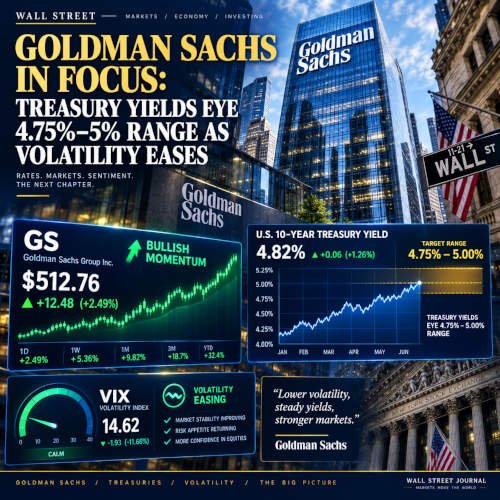
Business Updates USA : Goldman Sachs stock is attracting investor attention after the bank’s strategists outlined a potentially more stable outlook for U.S. Treasury yields. The latest assessment suggests that government bond yields could settle into a clearer trading range if financial-market volatility continues to decline and energy prices remain under control.
The November 9, 2026, market report said Goldman Sachs sees the 10-year U.S. Treasury yield potentially trading between 4.75% and 5.0% under more stable market conditions. The bank also expects Treasury-market volatility to moderate if uncertainty across financial markets and energy markets continues to ease.
This outlook matters for investors because Treasury yields influence borrowing costs, financial-market valuations and the trading environment for major investment banks. However, renewed energy-price pressure could increase inflation concerns and complicate the Federal Reserve’s interest-rate outlook.
For shareholders of The Goldman Sachs Group, the bond-market assessment provides an important view of the financial environment facing banks and institutional investors. It is a market outlook from Goldman Sachs strategists, not a new earnings forecast or an official recommendation to buy or sell the company’s stock.
Goldman Sachs Sees a Potential Trading Range for Treasury Yields
Goldman Sachs strategists believe the conditions are developing for major government bond yields to move into more predictable ranges. According to the November 9 report, the bank’s assessment came from a note led by strategist William Marshall and written late the previous Friday.
The 10-year U.S. Treasury yield was around 4.87% on Monday, compared with levels above 5.25% in early October. The decline suggests that some of the pressure that affected the bond market earlier in the autumn has eased.
Goldman Sachs identified improving conditions in risk assets and lower energy prices as important factors behind the more stable outlook. If these conditions continue, the bank sees the 10-year Treasury yield potentially settling between 4.75% and 5.0%.
That range is a conditional outlook rather than a guaranteed forecast. Treasury yields can move outside it if inflation data, economic growth, government borrowing or Federal Reserve policy expectations change.
The assessment also highlights the importance of the MOVE Index, which measures expected volatility in the U.S. Treasury market. The index was near 93 after exceeding 113 earlier in October, according to the report.
A declining MOVE Index generally indicates that investors expect smaller movements in Treasury yields. Lower volatility can make it easier for financial institutions and companies to plan borrowing, lending and investment activity.
Why the MOVE Index Matters to Financial Markets
The MOVE Index is closely watched by bond traders because it measures expected volatility in U.S. Treasury options. It serves a similar purpose in the bond market to the VIX Index in the stock market.
When Treasury volatility increases, investors may become more cautious about holding bonds and taking interest-rate risks. Financial institutions can also face greater uncertainty when pricing loans, managing portfolios and trading fixed-income securities.
A decline in the index can indicate improving confidence in the bond market. However, lower volatility does not necessarily mean that Treasury yields will fall.
For Goldman Sachs, a more stable interest-rate environment could support more predictable trading conditions and client activity. The bank operates across investment banking, global markets, asset management and wealth management, all of which can be affected by changing financial conditions.
Strong U.S. Jobs Data Keeps Federal Reserve Rate Expectations in Focus
The latest Treasury outlook comes after an important U.S. employment report changed expectations about the Federal Reserve’s next policy decision.
According to Reuters, U.S. employers added 165,000 jobs in October 2026, considerably more than the 65,000 increase economists had expected. The unemployment rate also declined to 4.1% from 4.2% in September.
The stronger employment figures suggested that the U.S. labor market remained more resilient than many investors had anticipated. The report also contributed to increased market expectations of another Federal Reserve rate increase in December.
That development creates a complicated environment for Treasury investors.
Stronger employment can support economic growth and business activity. However, if the labor market remains strong while inflation stays elevated, policymakers may have less room to reduce interest rates.
Higher expected interest rates can put pressure on Treasury bond prices. Because bond prices and yields generally move in opposite directions, declining bond prices can push yields higher.
Reuters reported that the 10-year Treasury yield increased to 4.878% following the November 6 employment report, while the 30-year yield advanced to 5.277%.
This recent movement shows why Goldman Sachs’ more stable yield outlook depends on economic conditions. A positive employment report can support the economy but may also increase concerns about inflation and future monetary policy.
Energy Prices Remain a Major Risk for Treasury Yields
Energy prices are another important factor in Goldman Sachs’ assessment.
Oil and natural gas prices can influence inflation because energy costs affect transportation, manufacturing, electricity generation and household spending. When energy prices rise sharply, businesses may face higher operating expenses and pass some of those costs to consumers.
That can make it harder for central banks to bring inflation under control.
The November 9 market report said lower energy prices had helped improve the outlook for government bond yields. However, Goldman Sachs warned that renewed energy-market pressure could bring inflation concerns back into focus.
Reuters also reported that global markets were watching developments related to the Iran conflict as oil prices declined on November 9. Falling crude prices helped ease some inflation concerns, although investors remained cautious ahead of important U.S. economic releases.
If energy prices continue to decline, investors may become more comfortable with the inflation outlook. That could support government bonds and reduce pressure on long-term yields.
However, an unexpected increase in oil or natural gas prices could reverse some of that improvement. Investors would likely reassess inflation expectations, interest-rate forecasts and the outlook for government borrowing costs.
What Higher Treasury Yields Mean for Goldman Sachs
Treasury yields influence several parts of the financial system, making them particularly important for large investment banks.
Goldman Sachs provides services to corporations, governments, financial institutions and individual investors. Its Global Banking & Markets business participates in trading, financing, investment banking and other financial activities.
A more predictable bond market can help financial institutions manage interest-rate exposure and price financial products. It may also support client confidence when companies consider debt issuance, mergers, acquisitions and capital-market transactions.
However, the relationship between Treasury yields and Goldman Sachs stock is not straightforward.
Higher yields can create opportunities for fixed-income trading and certain lending activities. At the same time, rapidly rising yields can reduce bond valuations, increase financing costs and discourage some investment activity.
Lower yields may support financial-market valuations and borrowing demand, but they can also change the profitability of certain banking activities.
For that reason, investors should examine Goldman Sachs’ earnings, revenue mix, trading performance and operating expenses rather than assuming that a particular Treasury yield level will automatically benefit the stock.
Goldman Sachs Stock: What Investors Should Watch
The Goldman Sachs Group, Inc. trades on the New York Stock Exchange under the ticker symbol GS. Its performance is influenced by company-specific developments and broader financial-market conditions.
The November 9 report listed a Lang & Schwarz quote of €787.40 at 13:32 CET. That was a specific trading-platform snapshot, not a universal real-time price or the official New York Stock Exchange closing price.
Investors following Goldman Sachs stock should pay attention to several important factors.
Fixed-income trading activity: Changes in Treasury yields and volatility can influence client demand for bond trading, hedging and risk-management services.
Investment banking revenue: A more stable market environment may encourage companies to consider acquisitions, debt offerings and other capital-market transactions. However, actual revenue depends on completed deals and client activity.
Asset management performance: Changes in bond prices, equity valuations and investor allocations can affect assets under management and related fee income.
Federal Reserve policy: Interest-rate decisions can influence financial conditions, borrowing demand and the value of financial assets.
Quarterly earnings: Revenue, expenses, compensation costs and profitability remain essential indicators when assessing Goldman Sachs stock.
Investors should also distinguish between a strategist’s market outlook and a formal change in the company’s financial guidance. The November 9 assessment focused on interest rates and bond-market conditions, not a new earnings target for Goldman Sachs.
Europe, the United Kingdom and Canada Face Different Bond-Market Risks
Goldman Sachs’ outlook also covered government bond markets outside the United States. The bank highlighted different conditions across Europe, the United Kingdom and Canada.
In Europe, markets had removed approximately 40 basis points of European Central Bank rate-hike expectations through the end of 2027 since the late-September peak in yields.
Goldman Sachs viewed this adjustment as consistent with improving geopolitical sentiment and a lower oil and natural gas risk premium. However, the bank saw limits to further easing expectations without clearer evidence about energy supplies and winter weather.
The United Kingdom presented a different picture. Goldman Sachs maintained a medium-term steepening bias across the British government bond yield curve, commonly known as the gilt market.
A steepening yield curve occurs when the difference between longer-term and shorter-term yields increases. The bank also warned that renewed energy concerns could bring interest-rate hike risks forward.
In Canada, Goldman Sachs said a hawkish repricing driven by higher U.S. yields could create an opportunity to rebuild positions in shorter-maturity bonds.
These regional differences show that government bond markets do not always move together. Central-bank policy, inflation, energy dependence and domestic economic conditions can produce different yield movements across countries.
What Comes Next for Treasury Yields and Goldman Sachs Stock?
Investors will continue watching U.S. inflation data, employment figures, energy prices and Federal Reserve communications for clues about the direction of interest rates.
The November 9 market environment reflected competing forces. Strong employment data increased expectations of tighter monetary policy, while falling oil prices helped ease some inflation concerns.
The upcoming consumer price index report was another important event for investors. Inflation figures can influence expectations for future Federal Reserve decisions and cause changes in Treasury yields across different maturities.
Goldman Sachs’ proposed 4.75% to 5.0% range for the 10-year Treasury yield therefore depends on whether the current improvement in market conditions continues.
If energy prices remain contained and financial-market volatility declines further, Treasury yields could trade within a narrower range. That environment may offer greater predictability for financial institutions and corporate borrowers.
However, renewed inflation pressure, geopolitical uncertainty or stronger-than-expected economic data could push yields higher again.
For Goldman Sachs shareholders, the main question is whether improving financial-market conditions translate into stronger business activity and sustainable earnings. Treasury yields are an important part of that picture, but they are only one factor affecting the company’s stock performance.
Conclusion
Goldman Sachs stock is in focus as the bank’s strategists see the possibility of a more stable Treasury-market environment. The November 9 assessment identified a potential 4.75% to 5.0% range for the 10-year U.S. Treasury yield if financial-market volatility continues to ease and energy prices remain under control.
The decline in the MOVE Index and the recent retreat in Treasury yields support the view that some market pressure has moderated. Nevertheless, strong U.S. employment data and uncertainty surrounding inflation and Federal Reserve policy remain important risks.
For investors, the outlook offers a useful perspective on the financial conditions facing Goldman Sachs and the wider banking sector. It does not guarantee a particular direction for GS shares.
The next major signals will come from inflation data, energy-market developments, Federal Reserve expectations and the company’s own financial results.
Frequently Asked Questions
1. Why is Goldman Sachs stock in focus on November 9, 2026?
Goldman Sachs attracted attention after strategists outlined a potentially more stable outlook for government bond yields and Treasury-market volatility.
2. What Treasury yield range does Goldman Sachs expect?
The bank sees a potential range of 4.75% to 5.0% for the 10-year U.S. Treasury yield if financial-market volatility eases and energy prices remain contained.
3. What is the MOVE Index?
The MOVE Index measures expected volatility in the U.S. Treasury market using options prices. It helps investors assess uncertainty around bond yields.
4. How do Treasury yields affect Goldman Sachs?
Treasury yields can influence fixed-income trading, financing activity, asset valuations and client demand for financial services.
5. Can lower Treasury yields automatically increase Goldman Sachs stock?
No. Goldman Sachs shares are affected by earnings, trading revenue, investment banking activity, expenses, economic conditions and investor sentiment, among other factors.
6. Why are energy prices important for Treasury yields?
Higher energy prices can increase inflation pressure and influence expectations for Federal Reserve interest rates. Lower energy prices can ease some inflation concerns.
7. Is Goldman Sachs recommending investors buy its stock?
No. The reported Treasury-yield outlook is a strategist assessment of financial markets, not a formal recommendation to buy or sell Goldman Sachs shares.
Reference Sources:
- CNBC coverage of Goldman Sachs strategists’ Treasury outlook, as summarized in the November 9 report.
- Reuters – U.S. employment report and Treasury-market reaction, November 6, 2026.
- Goldman Sachs – Why Global Bond Yields Are Expected to Stay Elevated.
- Reuters – Global market developments, November 9, 2026.
For more such helpful, up-to-date U.S. business updates, keep reading news articles and subscribe to us at zero cost.