
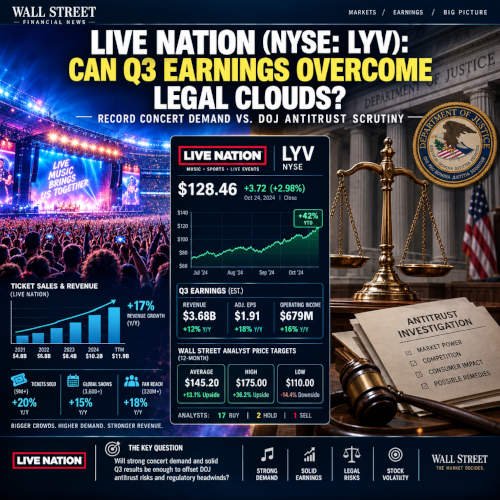
Business updates today USA: Live Nation Entertainment (NYSE: LYV) delivered strong revenue growth in the third quarter of 2026, supported by concert demand, ticket sales and international expansion. However, the company’s latest financial results arrived against a challenging legal backdrop, with unresolved antitrust litigation involving the U.S. government and several states continuing to create uncertainty for investors.
The company reported third-quarter revenue of approximately $10.1 billion, up 19% from $8.5 billion in the same period last year. Operating income increased 13% to $892 million, while adjusted operating income rose 14% to approximately $1.18 billion. These figures show that the live entertainment business continued to grow despite regulatory pressure.
Nevertheless, investors are looking beyond headline revenue growth. The Justice Department settlement, an April jury verdict in the remaining states’ case and a $450 million litigation-related expense recognized during the first nine months of 2026 could influence Live Nation’s future financial performance.
Live Nation shares closed at $175.25 on November 6, down 3.31% for the session. The stock’s movement reflects a market in which strong operating performance must be weighed against legal, regulatory and financial risks.
Live Nation Q3 2026 Earnings Show Strong Revenue Growth
Live Nation released its third-quarter financial results on November 5, 2026. The results showed that demand for concerts and live entertainment remained a major growth driver.
Total quarterly revenue reached $10.105 billion, compared with $8.499 billion in the third quarter of 2025. That represented an increase of approximately 19%.
The company’s three main operating segments all reported higher revenue.
Concerts generated approximately $8.75 billion, increasing 20% year over year. Ticketing revenue reached $870.3 million, up 9%, while sponsorship and advertising revenue climbed 14% to approximately $505.7 million.
Consolidated operating income increased from $792.5 million to $892 million. Adjusted operating income, a company-reported measure that helps investors assess operating performance, reached $1.179 billion, compared with $1.033 billion a year earlier.
The results suggest that Live Nation continues to benefit from strong demand for live events. Concert attendance, ticket transactions and sponsorship activity remain important contributors to its business.
However, revenue growth alone does not determine whether the stock is attractive. Investors must also consider profitability, cash generation, legal expenses and the potential effect of regulatory changes on Ticketmaster.
Concert Demand and Ticketmaster Support Business Performance
Live Nation’s concert business remains its largest source of revenue. During the third quarter, concert revenue increased 20% to $8.746 billion.
The company’s ticketing segment also delivered positive results. Revenue reached $870.3 million, while adjusted operating income increased 10% to $315.7 million.
Live Nation reported a record 98 million fee-bearing ticket transactions during the quarter, representing a 10% increase from the previous year. International markets contributed 75% of the growth in fee-bearing ticket volume, highlighting the importance of overseas expansion.
Sponsorship and advertising also performed well. Revenue increased 14% to $505.7 million, and adjusted operating income rose 12% to $350.2 million.
These figures are important because ticketing and sponsorship contribute a substantial share of the company’s operating profitability, even though concerts generate most of its total revenue.
The company also reported that Venue Nation hosted 26 million fans during the quarter, an increase of 17%. It expects the venue business to host more than 75 million fans during 2026. International venues are becoming increasingly important to its growth strategy.
International Expansion Could Create New Growth Opportunities
Live Nation is investing in venues, promoters and festivals across international markets. The company expects international attendance to remain an important part of its long-term growth strategy.
Its latest results show that overseas markets are contributing significantly to ticketing and sponsorship growth. International markets accounted for 75% of the increase in fee-bearing ticket volume during the third quarter.
This expansion can help Live Nation reduce its dependence on the U.S. concert market. It also gives the company opportunities to work with more artists, promoters and venue operators.
However, international growth carries risks. Currency movements, local regulations, operating costs and differences in consumer spending can affect profitability.
Investors will therefore want to see whether the company can turn rising international attendance into sustainable earnings and cash flow.
Live Nation’s Antitrust Legal Challenges Remain a Major Risk
Despite strong financial results, the biggest uncertainty surrounding Live Nation remains its antitrust litigation.
The U.S. Department of Justice and a coalition of states filed an antitrust lawsuit against Live Nation and Ticketmaster in 2024. The case raised concerns about competition in concert promotion, major concert venues and primary ticketing services.
The legal proceedings changed significantly in 2026. During the trial, Live Nation reached a settlement with the federal government and certain states. The proposed agreement includes structural and business-practice changes intended to address competition concerns.
The settlement framework includes changes to ticketing contracts, opportunities for alternative ticket marketplaces, restrictions involving exclusive arrangements and measures affecting certain amphitheater operations. It also includes a settlement fund initially valued at approximately $280 million for damages and civil penalty claims by participating states.
The agreement was formalized in a proposed final judgment filed in June 2026. However, the company’s latest SEC filing explains that the settlement remains subject to court approval under the Tunney Act process.
The settlement is important because it could require changes to how Live Nation and Ticketmaster operate. Those changes may affect ticket distribution, venue agreements and the company’s competitive position.
States’ Jury Verdict Adds Further Financial Uncertainty
The federal settlement did not end the entire legal dispute.
Several states continued their case against Live Nation and Ticketmaster. On April 15, 2026, a jury returned a verdict for the remaining litigants.
Helpful to read? Stay tuned with us for more USA, Texas, Washington, California, etc. business news articles online.