


USA Business news today: Read on this news portal the latest news on China’s secret spaceplane, how image was captured, capabilities, and other activity updates.
In the news we have ,China’s secretive spaceplane has attracted renewed attention after a rare satellite image appeared in a new Pentagon intelligence report. The photograph provides a clearer view of Beijing’s reusable spacecraft and highlights the country’s growing space capabilities.
The image was captured in 2024 by a commercial satellite operated by Maxar Technologies, now known as Vantor. It was included in the Defense Intelligence Agency’s (DIA) report on emerging threats in space.
The findings come as the United States and China continue developing advanced space technologies. Both countries are investing in reusable spacecraft and systems that could influence future military operations in orbit.
China’s Spaceplane Captured in Rare Satellite Image
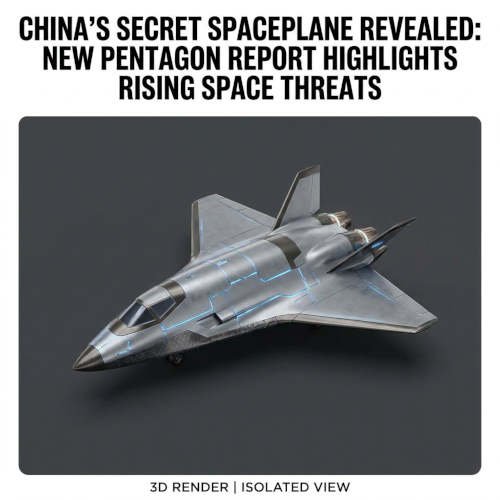
The newly released photograph offers a detailed look at China’s experimental reusable spaceplane. The spacecraft appears with a service module and an extended solar-panel array.
The image provides valuable information about a vehicle that China has kept largely secret. However, it does not reveal the spacecraft’s complete capabilities or intended mission.
Western analysts commonly associate China’s reusable spaceplane with Shenlong, a vehicle designed to operate in orbit before returning to Earth.
China has disclosed limited technical information about the spacecraft. Its payload, operating systems, and specific mission objectives remain largely unknown.
What Is China’s Shenlong Spaceplane?
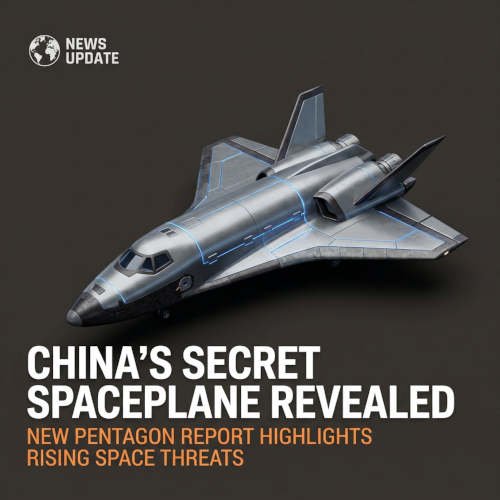
Shenlong is the commonly used name for China’s experimental reusable spaceplane. It launches aboard a rocket and can remain in orbit for extended periods.
China’s first publicly known reusable spaceplane mission began in September 2020. The spacecraft returned to Earth after approximately two days.
Later missions lasted significantly longer. The second mission remained in orbit for approximately 276 days, while the third lasted about 268 days before ending in September 2024.
China launched another reusable spaceplane mission on February 7, 2026, continuing its experiments with orbital technology.
These extended missions demonstrate China’s ability to operate experimental spacecraft for months. However, Beijing has not publicly explained all the activities performed during these flights.
Why Is the Pentagon Monitoring China’s Spaceplane?
The Pentagon is concerned about the growing importance of space in national security. Satellites support military communications, navigation, intelligence gathering, and weather forecasting.
Countries that can interfere with these systems could gain significant advantages during a conflict.
Counterspace technologies can interfere with, damage, or potentially destroy satellites. They include electronic warfare systems, directed-energy weapons, cyber capabilities, and technologies designed to disrupt orbital operations.
However, the report’s broader concerns about China’s space capabilities do not establish that its reusable spaceplane carries weapons.
China’s Growing Counterspace Capabilities
According to the DIA, China has developed ground-based laser systems capable of disrupting, degrading, or damaging satellites in low Earth orbit.
The agency also assesses that China could develop more advanced directed-energy systems capable of threatening satellites in higher orbits later this decade.
These assessments describe the agency’s understanding of China’s capabilities and potential future developments. They should not be interpreted as confirmation that every projected system is already operational.
Electronic warfare presents another potential challenge. Interference with satellite communications and navigation systems could affect both military operations and civilian services.
As countries become increasingly dependent on satellite infrastructure, these technologies are receiving greater attention from defense planners.
Could China’s Spaceplane Perform Military Missions?
Reusable spaceplanes can potentially support a range of activities, including scientific experiments, equipment testing, satellite deployment, and the recovery of selected payloads.
Their ability to remain in orbit for extended periods also makes them useful for testing technologies that conventional satellites may not easily accommodate.
Spacecraft capable of maneuvering near other objects can perform rendezvous and proximity operations. These techniques have legitimate applications, including satellite inspection and servicing.
However, similar capabilities could also be relevant to military operations involving other spacecraft.
Publicly available information does not establish that China’s spaceplane has conducted hostile operations against foreign satellites.
Its precise capabilities and operational purpose remain uncertain.
China’s Spaceplane Compared With America’s X-37B
China’s reusable spaceplane has attracted comparisons with the American X-37B, an uncrewed spacecraft operated by the U.S. Space Force.
Both vehicles demonstrate how reusable spacecraft can support long-duration orbital missions and technology experiments.
Their winged designs also distinguish them from conventional satellites that remain in orbit throughout their operational lives.
However, visible similarities do not prove that the two spacecraft have identical capabilities or missions.
The United States has also kept some details of its X-37B operations classified. This makes direct comparisons difficult.
The broader competition reflects the growing strategic importance of reusable spacecraft and other advanced orbital technologies.
Commercial Satellites Are Changing Space Intelligence
The photograph also highlights the increasing role of commercial satellite companies in intelligence and security analysis.
The image was captured when Maxar Technologies operated the satellite imaging business now known as Vantor.
Commercial imaging systems can sometimes observe spacecraft in orbit, providing details that may otherwise remain unavailable to the public.
These observations can help researchers study spacecraft designs, solar arrays, attached modules, and other visible features.
However, photographs alone cannot reveal everything about a spacecraft. Internal equipment, software, payload contents, and mission objectives may remain unknown.
Analysts must therefore combine satellite imagery with orbital tracking and other evidence to understand what a spacecraft might be doing.
What Happens Next for China’s Space Program?
China is expected to continue developing reusable spacecraft and other advanced space technologies.
Future missions may provide additional information about the vehicle’s maneuvering capabilities, orbital activities, and potential applications.
However, the absence of detailed official disclosures means some questions may remain unanswered.
The DIA’s assessment also highlights a broader challenge facing the international community. The growing number of countries developing counterspace technologies could increase risks to satellites and other critical infrastructure.
Disruptions could affect communications, navigation, transportation, weather forecasting, and military coordination.
The newly released photograph offers an important glimpse into China’s space program. Nevertheless, the spacecraft’s precise mission and full capabilities remain matters of continuing analysis.
Frequently Asked Questions
1. What is China’s secretive spaceplane?
China’s reusable experimental spaceplane is commonly associated with the name Shenlong. It is designed to operate in orbit and return to Earth.
2. Who released the photograph?
The Defense Intelligence Agency included the image in its space-threat assessment. The photograph was captured in 2024 by commercial satellite technology operated by Maxar Technologies, now known as Vantor.
3. Does China’s spaceplane carry weapons?
There is no publicly established evidence that the spacecraft shown in the image carries weapons. Its payload and precise mission objectives remain undisclosed.
4. How long can China’s spaceplane remain in orbit?
Previous missions have lasted hundreds of days. China’s second publicly reported mission lasted approximately 276 days, while its third lasted about 268 days.
5. Why is China’s space program a concern for the United States?
The DIA has raised concerns about China’s expanding counterspace capabilities. Technologies that interfere with satellites could threaten military operations and essential civilian services.
6. Is China’s spaceplane similar to America’s X-37B?
Both are reusable, uncrewed spacecraft designed for orbital operations. However, their technical capabilities and mission objectives are not fully known.
Conclusion
China’s secretive spaceplane is drawing international attention following the release of a rare satellite image in a Pentagon intelligence report.
The photograph provides a clearer view of China’s reusable spacecraft, while the DIA’s assessment highlights broader concerns about counterspace technology and satellite security.
As China and the United States continue advancing their space programs, monitoring orbital activity will remain important for understanding emerging opportunities and potential risks.