

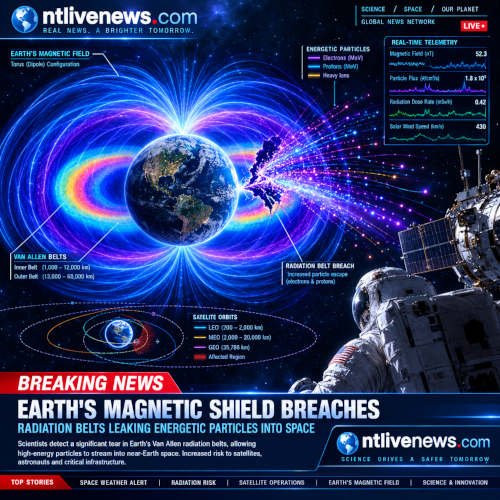
USA Business News: A region of space once described as an “impenetrable barrier” around Earth has proved less secure than scientists believed. New research published on October 31, 2026, reports that an extreme solar storm in May 2024 triggered the formation of highly energetic electrons deep inside Earth’s inner radiation belt.
The discovery challenges a long-standing understanding of how Earth’s radiation belts behave during powerful space-weather events. It also highlights why scientists closely monitor radiation around Earth when planning satellite operations and crewed space missions.
However, the finding does not mean Earth’s radiation shield has permanently failed or that astronauts cannot safely travel through the region. It shows that extreme space weather can create radiation conditions that scientists must understand and account for.
What Are the Van Allen Radiation Belts?
The Van Allen radiation belts are two large, doughnut-shaped regions surrounding Earth. Earth’s magnetic field traps energetic charged particles in these zones, creating areas of radiation that vary in intensity and shape.
The inner belt contains many energetic protons, while the outer belt is largely populated by high-energy electrons. These particles come from several sources, including the solar wind and interactions between cosmic rays and Earth’s atmosphere.
The belts are not solid barriers or physical walls. Instead, they are dynamic regions where charged particles move under the influence of Earth’s magnetic field and electromagnetic waves.
They matter because energetic particles can affect satellites, spacecraft electronics and astronauts. The amount of radiation present changes with solar activity and geomagnetic conditions.
Why Scientists Called It an Impenetrable Barrier
Scientists have studied the Van Allen radiation belts for decades. In 2014, observations from NASA’s Van Allen Probes revealed a surprisingly sharp boundary that limited the movement of ultra-relativistic electrons toward Earth.
Researchers described this feature as an “impenetrable barrier.” The boundary appeared around three Earth radii from the planet’s center, where the most energetic electrons rarely travelled farther inward.
Scientists proposed that electromagnetic waves and the surrounding cold plasma helped remove incoming energetic electrons from their trapped orbits. These particles could lose energy or be scattered into Earth’s atmosphere before moving deeper into the inner belt.
The finding suggested that Earth had a natural mechanism limiting the inward movement of some of the most dangerous electrons.
However, later research raised questions about whether this barrier was truly impenetrable. Scientists increasingly suspected that extreme geomagnetic storms could create conditions that allowed energetic electrons to move into regions where they were rarely detected.
What Happened During the May 2024 Solar Superstorm?
The major event behind the latest discovery occurred in May 2024, when a series of powerful solar eruptions sent coronal mass ejections toward Earth.
These eruptions carried huge amounts of magnetized plasma through space. When the material interacted with Earth’s magnetic environment, it triggered an intense geomagnetic storm.
NOAA recorded G5 conditions, the highest category on its geomagnetic storm scale. NASA described the May 2024 event as the strongest geomagnetic storm in more than two decades at that time. The storm also produced spectacular auroras across locations where such displays are uncommon.
The storm dramatically disturbed Earth’s magnetosphere and depleted cold plasma in the plasmasphere, a region of relatively cool charged particles surrounding the planet.
That change created an unusual environment in which electromagnetic waves known as chorus waves could become especially active.
How Chorus Waves Accelerated Dangerous Electrons
Chorus waves are electromagnetic waves that occur naturally in Earth’s magnetosphere. When converted into audio, their signals can resemble the sound of birds singing.
Despite their unusual name, these waves play an important role in space weather. They can interact with energetic electrons and transfer energy to them, accelerating particles to extremely high speeds.
During the May 2024 storm, the unusually depleted plasma environment supported intense chorus-wave activity. Researchers believe these waves helped accelerate electrons locally inside the inner magnetosphere.
The latest study, led by space physicist Yoshizumi Miyoshi of Nagoya University, used observations from Japan’s Arase satellite.
Published in Geophysical Research Letters, the research found that multi-megaelectronvolt electrons developed deep inside the region previously associated with the impenetrable barrier. The evidence indicated that the particles were accelerated locally rather than simply transported inward from farther away.
What the Arase Satellite Actually Detected
The research identified a significant increase in high-energy electrons during the recovery phase of the May 2024 storm.
At a location known as L* = 2.5, the measured flux of electrons at approximately 3.128 megaelectronvolts increased from around 1 to approximately 10,000 in the study’s reported flux units. At L* = 3.0, it increased to roughly 50,000 from around 1.
The researchers reported an increase of more than 5,000 times relative to pre-storm levels in parts of the inner region.
The timing also provided important clues. Lower-energy electrons increased first, followed by higher-energy populations. This sequence supported the interpretation that particles gained energy locally over time.
The findings do not mean the entire radiation belt disappeared or that Earth lost its magnetic protection. Instead, they show that an extreme event can create a population of highly energetic electrons inside a region where scientists previously expected them to be uncommon.
Conclusion: Earth’s Radiation Barrier Is Not Completely Impenetrable
The latest research changes how scientists understand the Van Allen radiation belts. The inner region once considered an effective barrier to ultra-relativistic electrons can experience significant changes during extreme space-weather events.
The May 2024 superstorm created unusual plasma conditions that supported chorus waves and local acceleration of multi-MeV electrons. Observations from the Arase satellite provided evidence that the supposedly impenetrable boundary could be breached under exceptional conditions.
The discovery does not mean Earth has lost its magnetic protection or that human spaceflight is unsafe. Instead, it highlights the need for better space-weather monitoring and more accurate radiation models as missions travel farther from Earth.
References
- Geophysical Research Letters – Original 2026 research paper
- NASA – Artemis II Mission and Crew Return
Editorial note: The research describes an exceptional event observed during the May 2024 superstorm. It does not establish that the barrier has permanently disappeared or that astronauts face a new, immediate danger.
