
Stock Market Today: Dow Jones Plunges 1,833 Points as Nasdaq Enters Correction in AI Stock Meltdown
The U.S. stock market experienced a massive sell-off on Thursday, November 5, 2026, as investors aggressively dumped artificial intelligence (AI) stocks, semiconductor companies and major technology shares. The sudden decline wiped out Wall Street’s previous session gains and pushed the Nasdaq Composite into correction territory.
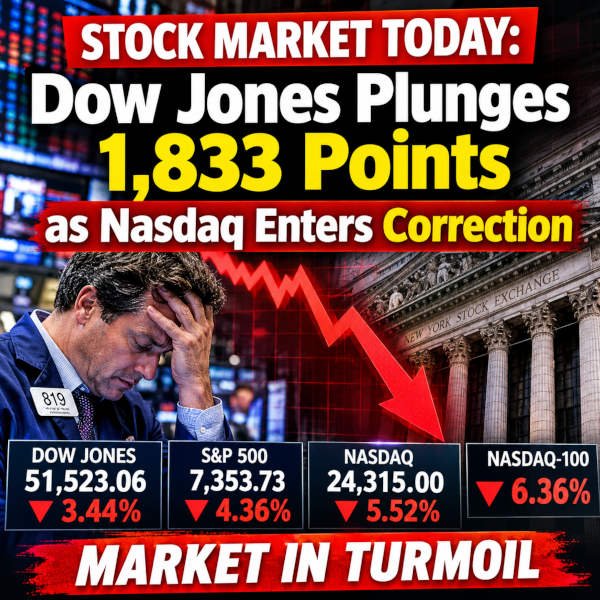
The Dow Jones Industrial Average plunged 1,833.06 points, or 3.44%, closing at 51,523.06. The S&P 500 dropped 4.36% to 7,353.73, while the Nasdaq Composite tumbled 5.52% to 24,315, according to Associated Press market data.
The Nasdaq-100 also suffered a significant decline, falling approximately 6.36%. Meanwhile, the Philadelphia Semiconductor Index collapsed 12.25%, highlighting the severity of the technology stock sell-off.
The market crash raised an important question for investors: What happened to the stock market today, and why are stocks down so sharply?
The main pressure came from concerns about expensive AI investments, semiconductor valuations, potential regulatory restrictions on data-center construction and changing political expectations following the 2026 midterm elections.
Dow Jones Today: Wall Street Loses Trillions in Market Value
The Dow Jones today experienced one of its most painful trading sessions in more than a year.
After Wednesday’s strong post-election rally, investors returned to the market with a very different attitude. Selling pressure spread across technology, industrial and consumer-related companies.
The Dow Jones Industrial Average lost 1,833.06 points, finishing at 51,523.06. Its 3.44% decline erased the previous session’s substantial gains.
The S&P 500 also suffered a major setback. The benchmark index dropped 334.89 points, or 4.36%, to close at 7,353.73.
The Nasdaq Composite experienced the biggest decline among the three major U.S. indexes, falling 1,421.52 points, or 5.52%, to 24,315.
According to Associated Press reporting, Thursday’s S&P 500 decline was its steepest since the April 2025 tariff-related market shock.
U.S. Stock Market Closing Figures: November 5, 2026
| Stock Market Index | Closing Level | Daily Change |
|---|---|---|
| Dow Jones Industrial Average | 51,523.06 | -3.44% |
| S&P 500 | 7,353.73 | -4.36% |
| Nasdaq Composite | 24,315 | -5.52% |
| Nasdaq-100 | — | -6.36% |
| Philadelphia Semiconductor Index | 9,011.14 | -12.25% |
The numbers demonstrate how quickly market sentiment changed following Wednesday’s election-related rally.
For investors following the Dow, Nasdaq and S&P 500 index, Thursday’s performance was a reminder that strong market rallies can reverse when economic and corporate uncertainties increase.
Why Is the Stock Market Down Today? AI Investment Concerns Trigger Selling
The biggest reason behind Thursday’s stock market decline was a sudden reversal in investor confidence toward artificial intelligence companies.
For much of 2026, AI-related businesses have attracted enormous investment. Companies developing advanced processors, memory chips, cloud-computing services and data-center infrastructure have benefited from expectations of increasing demand.
However, investors are now questioning whether the enormous spending on AI infrastructure will generate sufficient financial returns.
Building AI data centers requires billions of dollars in investment. Companies must purchase advanced processors, secure electricity supplies, construct cooling infrastructure and maintain expensive computing systems.
These investments can create significant opportunities, but they also introduce financial risks.
Investors want stronger evidence that AI spending will translate into sustainable revenue growth and higher corporate profits.
Concerns about expensive valuations have also increased. Some AI-related companies experienced substantial share-price gains earlier in the year, leaving their stocks vulnerable to profit-taking.
When institutional investors begin reducing positions in popular technology companies, selling pressure can quickly spread across the broader market.
That is precisely what happened during Thursday’s trading session.
Nvidia, AMD and Micron Lead the Semiconductor Stock Sell-Off
Semiconductor companies suffered particularly heavy losses as investors reduced exposure to AI-related investments.
Nvidia (NVDA), one of the most important companies in the artificial intelligence industry, declined approximately 9.3%.
Advanced Micro Devices (AMD) plunged approximately 17.3%, while Micron Technology (MU) dropped around 17.5%.
SanDisk also suffered substantial losses, falling more than 22%.
These companies play important roles in the global technology supply chain.
Nvidia manufactures advanced processors used in AI computing systems. AMD competes in the processor and AI accelerator markets, while Micron supplies memory products used in advanced computing infrastructure.
Their performance matters because semiconductor companies have become major contributors to technology-sector growth.
The Philadelphia Semiconductor Index’s 12.25% decline demonstrated that investors were selling across the industry rather than targeting only one company.
The sell-off also affected companies involved in data-center equipment and infrastructure.
For people monitoring the NVDA stock price, Thursday’s decline highlighted the risks associated with investing in highly valued technology companies.
Strong long-term business prospects do not guarantee that stock prices will rise every day.
Nasdaq Enters Correction Territory as Technology Stocks Collapse
The Nasdaq Composite entered correction territory after falling more than 10% from its October record high.
A stock market correction generally means an index or individual security has declined at least 10% from a recent peak.
A bear market is generally associated with a decline of 20% or more.
The Nasdaq’s correction is particularly important because the index contains many major technology companies, including businesses involved in AI, software, semiconductor manufacturing and cloud computing.
Thursday’s 5.52% decline represented one of the Nasdaq’s worst daily performances since April 2025.
The Nasdaq-100 also suffered a major setback as large technology companies experienced widespread selling.
Investors are now watching whether technology shares can stabilize or whether additional losses could follow.
The correction does not automatically mean that the U.S. economy is entering a recession.
However, it demonstrates that investors are becoming more cautious about valuations, earnings expectations and future technology spending.
Midterm Election Results Add Pressure to AI and Data-Center Stocks
The November 3, 2026, midterm elections created another source of uncertainty for the stock market.
Democrats secured sweeping victories, changing the political balance in Washington and raising questions about future economic and regulatory policies.
Wednesday’s market rally initially reflected optimism following the election results.
However, investors quickly shifted their attention toward the potential consequences of a change in congressional control.
One major concern involves the rapid expansion of AI data centers.
Democratic policymakers have raised concerns about electricity consumption, water usage, environmental effects and the impact of large data-center developments on local communities.
Some political leaders have supported stronger oversight or restrictions on new data-center construction.
Investors worry that additional regulatory requirements could delay projects and affect demand for semiconductor processors, electricity infrastructure and related technology services.
This is particularly important for companies that have invested heavily in the AI infrastructure boom.
However, proposed restrictions should not be confused with enacted national policies. The market reaction reflects investor expectations and uncertainty rather than confirmation that all planned data-center projects will be stopped.
Oil Prices Rise as Middle East Uncertainty Affects Financial Markets
Oil prices also attracted attention during Thursday’s market turmoil.
Brent crude traded near $98 per barrel, while the U.S. benchmark West Texas Intermediate approached $90.
The increase reflected uncertainty surrounding the Middle East conflict and the possibility of diplomatic negotiations involving Iran.
Higher oil prices can create additional challenges for the U.S. economy.
Expensive energy increases transportation and manufacturing costs. It can also affect household spending and contribute to inflation.
For the Federal Reserve, rising energy prices can complicate decisions about interest rates.
If inflation remains elevated, policymakers may have less flexibility to reduce borrowing costs.
Higher interest rates can create additional pressure on growth-oriented companies because investors place a lower present value on profits expected in the future.
This combination of geopolitical uncertainty, inflation concerns and technology-sector weakness added to the pressure on Wall Street.
What Investors Should Watch Next: Jobs Report, Federal Reserve and Corporate Earnings
Investors are now turning their attention to Friday’s October employment report for additional information about the U.S. economy.
Employment figures are important because they help policymakers and investors evaluate economic growth, household income and consumer spending.
A stronger labor market could support economic activity, although unexpectedly strong employment growth may also influence inflation and interest-rate expectations.
A weaker report could raise concerns about slowing economic growth.
Another important development came from Challenger, Gray & Christmas. Its October report showed announced layoff plans falling to their lowest level since 2023.
The report suggested that companies were increasingly focusing on retaining existing employees.
Investors will also monitor earnings from companies including Duke Energy, Airbnb and Lumentum.
Their financial results could provide useful information about consumer demand, energy infrastructure and technology spending.
Other important indicators include:
- Federal Reserve policy: Investors will monitor inflation and interest-rate expectations.
- AI company earnings: Nvidia, AMD and other semiconductor businesses remain important market indicators.
- Dow Jones futures: Futures trading may provide an indication of market sentiment before the next regular trading session.
- Nasdaq performance: Investors will watch whether technology shares recover after entering correction territory.
- Oil prices: Higher energy costs could create additional inflation concerns.
- S&P 500 performance: The benchmark index’s ability to stabilize could influence broader investor confidence.
Stock Market News: Is This the Beginning of a Bigger Market Crash?
Thursday’s dramatic decline has raised questions about whether the U.S. stock market could experience a deeper correction.
However, one difficult trading session does not automatically establish the beginning of a prolonged bear market.
The Dow Jones Industrial Average, Nasdaq Composite and S&P 500 remain important indicators of investor confidence and broader economic expectations.
Investors should examine corporate earnings, employment data, inflation and Federal Reserve policy before making decisions.
The current situation also highlights the importance of diversification and risk management.
Investors who concentrate too heavily on a single industry may face substantial losses when market sentiment changes.
For people following stocks today through Yahoo Finance and other financial platforms, comparing individual company performance with broader market indexes can help provide a clearer picture of market conditions.
The next several trading sessions will be important in determining whether Thursday’s sell-off represents temporary profit-taking or the beginning of a longer period of market weakness.
Frequently Asked Questions About the Stock Market Today
1. What happened to the stock market today?
On November 5, 2026, the Dow Jones plunged 1,833.06 points, the S&P 500 declined 4.36%, and the Nasdaq Composite dropped 5.52%. Technology and AI-related stocks led the sell-off.
2. Why is the market down today?
The market declined because investors sold AI stocks, semiconductor companies and technology shares amid concerns about expensive valuations, data-center spending and possible regulatory changes.
3. Why did the stock market crash today?
Thursday’s sell-off reflected heavy institutional selling, profit-taking in popular AI investments and uncertainty following the Democratic victories in the 2026 midterm elections.
4. How much did the Dow Jones fall today?
The Dow Jones Industrial Average lost 1,833.06 points, or 3.44%, closing at 51,523.06 on November 5, 2026.
5. Why is the Nasdaq down today?
The Nasdaq declined because major technology and semiconductor companies experienced heavy selling. Nvidia, AMD and Micron were among the significant losers.
6. Did the Nasdaq enter correction territory?
Yes. The Nasdaq Composite fell more than 10% from its October record high, meeting the standard definition of a market correction.
7. How much did the S&P 500 fall today?
The S&P 500 declined 334.89 points, or 4.36%, closing at 7,353.73.
8. Why are Nvidia and AI stocks falling?
Investors are reconsidering the valuations of AI companies and questioning whether massive investments in data centers and advanced computing infrastructure will generate sufficient returns.
9. Is the U.S. stock market entering a bear market?
Not necessarily. A correction generally involves a 10% decline from a recent high, while a bear market is commonly defined as a decline of 20% or more.
10. Where can investors follow Dow Jones and Nasdaq updates?
Investors can follow financial market information through Yahoo Finance, Reuters, Associated Press, major brokerage platforms and official exchange resources.
Final Outlook: Wall Street Faces a Major Test After the AI Stock Market Meltdown
Thursday’s stock market collapse delivered a serious warning to investors who had become increasingly confident in the artificial intelligence investment boom.
The Dow Jones lost more than 1,800 points, the S&P 500 experienced its steepest decline since April 2025, and the Nasdaq entered correction territory.
Semiconductor stocks suffered particularly heavy losses as investors questioned the financial returns from massive AI infrastructure investments.
Political uncertainty, rising oil prices and concerns about future economic conditions added further pressure.
The immediate focus will now shift to employment figures, corporate earnings, Federal Reserve expectations and the ability of major technology stocks to recover.
For investors following the US stock market, the November 5 sell-off is a reminder that even the strongest market trends can experience sudden reversals.
Whether the Dow, Nasdaq and S&P 500 recover or experience further declines will depend on the economic and corporate developments unfolding over the coming weeks.
