
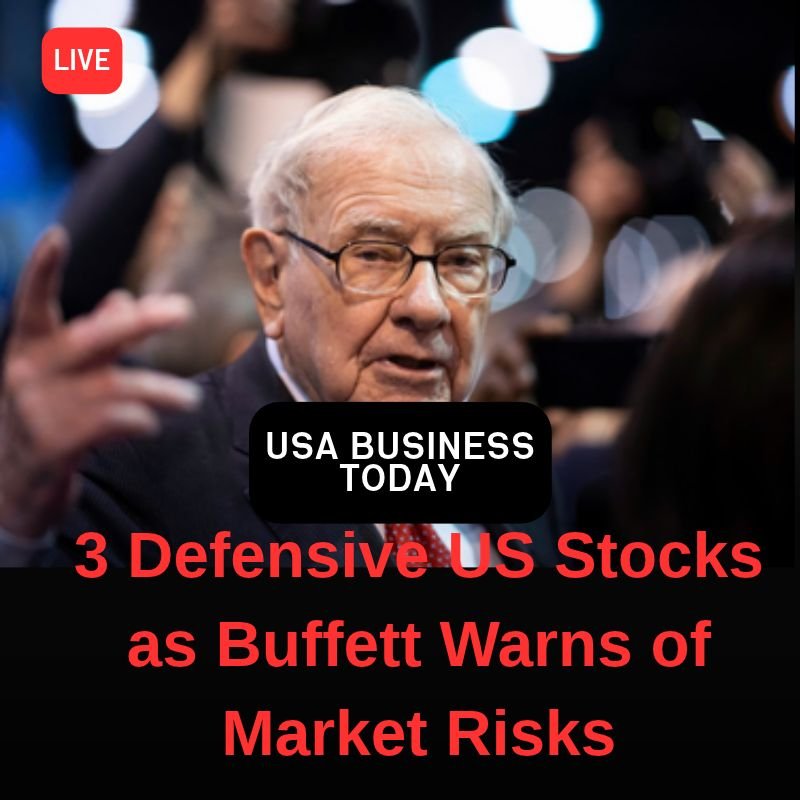
Warren Buffett’s warning about rising speculation in financial markets is drawing attention as investors search for more dependable businesses. With stock valuations elevated and short-term trading attracting growing interest, some market participants are looking beyond high-growth technology shares for companies with established operations, recurring demand and potential income.
Three US-listed healthcare stocks are attracting attention in this environment: Royalty Pharma (NASDAQ: RPRX), Zoetis (NYSE: ZTS) and Johnson & Johnson (NYSE: JNJ).
These companies operate in different parts of healthcare, from pharmaceutical royalty financing to animal medicines and medical technology. Their businesses may offer exposure to demand that is less directly connected to consumer spending cycles or technology market sentiment.
However, defensive does not mean risk-free. Each company faces its own financial, competitive and operational challenges. Investors should examine those risks alongside the potential benefits before making investment decisions.
Why Warren Buffett’s Market Warning Matters to Investors
Warren Buffett has repeatedly encouraged investors to distinguish long-term investing from short-term speculation. During remarks surrounding Berkshire Hathaway’s 2026 annual meeting, he compared financial markets to a church with a casino attached.
He expressed concern about the growing popularity of short-term trading, particularly one-day options. Buffett argued that this type of activity can resemble gambling rather than investing based on business fundamentals.
His comments are particularly relevant when investors are dealing with expensive stock valuations and strong market enthusiasm.
The Shiller CAPE ratio, which compares stock prices with average inflation-adjusted earnings over 10 years, is one measure investors use to assess long-term market valuations. The published October 2026 reading was approximately 40.71, placing the measure well above its historical average. A high CAPE ratio does not predict exactly when a market decline will happen, but it can indicate that investors are paying elevated prices relative to long-term earnings.
In this environment, some investors may consider businesses with established products, healthcare demand and recurring revenue.
1. Royalty Pharma (NASDAQ: RPRX): Healthcare Royalties and Long-Term Cash Flow
Royalty Pharma operates differently from a traditional pharmaceutical manufacturer. Instead of depending entirely on developing and selling its own medicines, the company acquires rights to royalty payments from approved therapies and funds research and development programs.
This business model provides exposure to pharmaceutical sales without requiring Royalty Pharma to manufacture and market every drug itself.
The company receives payments based on sales of medicines in its royalty portfolio. Its investments cover commercial products as well as treatments still moving through clinical development.
That structure can create recurring revenue opportunities, although the performance of individual therapies remains important.
Royalty Pharma’s Latest Financial Results
Royalty Pharma reported encouraging third-quarter 2026 results on November 4.
Its portfolio receipts increased 9% to $890 million compared with the same quarter in 2025. Royalty receipts also grew 9%, while net cash provided by operating activities reached $686 million.
The company raised its full-year 2026 portfolio receipts guidance to between $3.5 billion and $3.55 billion. It previously expected receipts of $3.4 billion to $3.5 billion.
Royalty Pharma also continued expanding its development funding activities. Its agreements include up to $500 million for Johnson & Johnson’s investigational autoimmune treatment JNJ-4804 and up to $500 million for Teva’s experimental treatment TEV-‘408, subject to the relevant agreement conditions.
These partnerships demonstrate how the company seeks to build future royalty opportunities by financing pharmaceutical research.
The dividend is another factor income-focused investors may examine. Royalty Pharma declared a fourth-quarter 2026 dividend of $0.235 per Class A ordinary share, payable on December 10 to shareholders of record on November 13.
However, investors should consider the company’s debt obligations, clinical development risks and dependence on the commercial success of medicines in its portfolio. Royalty Pharma reported total debt with a principal value of $8.8 billion at September 30, 2026.
2. Zoetis (NYSE: ZTS): Animal Healthcare Demand Offers a Different Defensive Story
Zoetis is one of the world’s leading animal-health companies. It develops medicines, vaccines, diagnostics and other products for pets and livestock.
Its business covers several areas, including parasite prevention, pain management, dermatology, livestock health and veterinary diagnostics.
Animal healthcare can offer a different demand profile from many consumer-facing industries. Pet owners and livestock businesses continue to require veterinary products even when broader economic conditions become uncertain.
That does not make the sector immune to economic pressure. Pet owners may delay certain treatments, choose lower-cost alternatives or reduce spending when household budgets become tighter.
Zoetis Faces Competition Despite Its Healthcare Position
Zoetis reported third-quarter 2026 revenue of approximately $2.39 billion, down 1% from the same period a year earlier. Net income declined 18% to $591 million, while adjusted diluted earnings per share increased 3% to $1.75.
The company’s US segment experienced a 6% revenue decline. Companion-animal revenue fell 5%, reflecting softer demand and increased competition.
Generic competition also affected certain products, including Convenia and Cerenia. The company reported that livestock revenue increased 7%, helping offset some of the weakness in companion-animal products.
These results show why investors should not assume that animal healthcare stocks always deliver steady growth.
Zoetis has a broad product portfolio and international operations, but its ability to maintain market share, introduce new treatments and manage competition will remain important.
Investors should also monitor management’s updated 2026 financial guidance and progress in the companion-animal business.
3. Johnson & Johnson (NYSE: JNJ): A Diversified Healthcare Business
Johnson & Johnson is a major global healthcare company with two principal business segments: Innovative Medicine and MedTech.
Its pharmaceutical portfolio includes treatments across oncology, immunology, cardiovascular disease and other medical areas. Its MedTech operations supply products and technologies used in surgery, orthopedics, cardiovascular care and vision treatment.
This diversification is one reason investors often consider J&J when researching defensive healthcare stocks.
Demand for essential medicines and medical procedures does not necessarily move in line with technology shares or consumer discretionary spending. However, pharmaceutical companies still face patent expirations, regulatory decisions, pricing pressure and competition.
Johnson & Johnson’s Revenue and Earnings Performance
Johnson & Johnson reported third-quarter 2026 sales of approximately $25.4 billion, representing growth of 5.9% compared with the same period in 2025.
Its adjusted earnings per share reached $2.59. The company also raised its full-year 2026 financial guidance, projecting reported sales of approximately $101.2 billion at the midpoint and adjusted earnings per share of $11.10 at the midpoint.
The company has continued investing in its product pipeline and medical technology business.
Recent developments include progress in its OTTAVA surgical robotic system and regulatory advances for medicines targeting serious medical conditions.
However, J&J also faces challenges. The loss of exclusivity for established medicines can create revenue pressure as competing products enter the market. Its ability to replace declining sales with new treatments and expand its MedTech business will be important for future growth.
Investors should also examine litigation exposure, acquisition costs and the company’s balance sheet before treating J&J as a low-risk investment.
How These Three Defensive Stocks Compare
| Company | Ticker | Main Business | Potential Defensive Feature | Key Risk |
|---|---|---|---|---|
| Royalty Pharma | RPRX | Pharmaceutical royalties | Revenue linked to medicine sales | Drug development and portfolio concentration |
| Zoetis | ZTS | Animal healthcare | Demand for veterinary medicines | Generic competition and weaker pet-care spending |
| Johnson & Johnson | JNJ | Pharmaceuticals and MedTech | Diversified healthcare operations | Patent expirations, litigation and competition |
The three companies offer different ways to approach defensive investing.
Royalty Pharma provides exposure to pharmaceutical royalty payments and development financing. Zoetis focuses on animal health, while Johnson & Johnson combines prescription medicines with medical technology.
Their differences matter because investors should not evaluate all healthcare stocks using the same financial assumptions.
What Investors Should Consider Before Buying Defensive Stocks
A defensive investment strategy does not eliminate market risk. Even established healthcare companies can experience sharp share-price declines when earnings disappoint, valuations become excessive or industry conditions change.
Investors should consider several factors before buying.
First, valuation matters. A high-quality company can still be an expensive investment if its share price already reflects optimistic growth expectations.
Second, dividend payments should be evaluated alongside cash flow, debt and future capital requirements. A dividend is not guaranteed simply because a company has paid one in the past.
Third, investors should examine the competitive position of each business. Pharmaceutical patents, generic medicines, clinical trial results and regulatory decisions can significantly influence future earnings.
Finally, diversification remains important. Holding several healthcare stocks does not necessarily provide complete protection against market losses, particularly when companies share exposure to similar industry risks.
Frequently Asked Questions
What are defensive stocks?
Defensive stocks are shares of companies whose products or services may experience relatively stable demand during economic slowdowns. Healthcare, utilities and consumer staples are common examples.
Why did Warren Buffett warn about market gambling?
Buffett criticized the growing popularity of speculative trading, especially short-term options activity. He encouraged investors to distinguish long-term business ownership from gambling-like market behavior.
Is Royalty Pharma a defensive stock?
Royalty Pharma has exposure to recurring pharmaceutical royalty payments, but its results depend on drug sales, development outcomes and its investment portfolio. It is not risk-free.
Why is Zoetis considered a healthcare stock to watch?
Zoetis supplies medicines, vaccines and diagnostics for pets and livestock. Its animal-health business provides exposure to veterinary demand, although competition and spending pressure can affect revenue.
Is Johnson & Johnson suitable for long-term investors?
J&J has diversified pharmaceutical and medical technology operations. However, investors should assess its valuation, patent risks, litigation exposure and financial performance before investing.
The Bottom Line: Defensive Investing Requires Discipline
Warren Buffett’s warning about speculative market behavior offers a reminder that investors should focus on business fundamentals rather than chasing short-term price movements.
Royalty Pharma, Zoetis and Johnson & Johnson each have characteristics that may appeal to investors researching defensive US stocks. Their healthcare exposure, established operations and potential income streams make them worth monitoring.
However, their recent financial results also reveal meaningful differences in growth, competition and financial risk.
For investors concerned about expensive market valuations, the better approach may be to examine company fundamentals, compare stock prices with business performance and maintain a long-term perspective. No defensive stock guarantees protection during a market correction.