
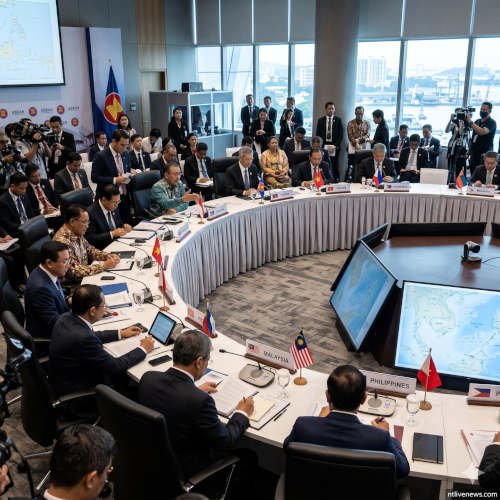
The Philippines’ Department of Foreign Affairs (DFA) says negotiations between China and the Association of Southeast Asian Nations (ASEAN) on a proposed South China Sea Code of Conduct have reached approximately 70% completion. However, several important provisions remain unresolved, raising questions about whether the agreement can be finalized before the Philippines completes its ASEAN chairmanship in December 2026.
DFA spokesperson for ASEAN Affairs Dominic Xavier Imperial described the progress as a significant achievement under the Philippines’ leadership. He explained that negotiators still need to clarify and refine important parts of the proposed agreement.
The announcement comes as regional governments prepare for the 49th ASEAN Summit in Manila. The South China Sea dispute is expected to remain an important regional security issue, particularly for countries with competing maritime claims.
Malaysia has also called for stronger political commitment from ASEAN and China to move the negotiations forward. Its involvement matters because Malaysia is both an ASEAN member and one of the countries with overlapping claims in the disputed waters.
What the DFA Says About the 70% Progress
Imperial said on November 13 that approximately 70% of the proposed Code of Conduct package had been agreed upon. He described the remaining 30% as containing significant issues that negotiators are still discussing.
He did not identify every unresolved provision, explaining that the discussions involve specific details within the draft agreement. He also cautioned against predicting whether the negotiations would finish before the end of the year.
The DFA has emphasized that the Philippines wants the final agreement to provide meaningful rules governing conduct in the South China Sea. Manila also wants the rights of countries outside the negotiations to remain protected.
According to the Philippine News Agency, Imperial said the proposed code should guide the behavior of all parties operating in the disputed waters. He added that the agreement should respect the rights of third parties, even if those countries are not directly involved in the negotiations.
The 70% figure represents progress in negotiations, not necessarily a guarantee that the remaining provisions will be easy to settle. The outstanding questions involve some of the most politically sensitive parts of the agreement.
Four Major Issues Still Complicate the Agreement
Foreign Secretary Ma. Theresa Lazaro previously identified four major issues that negotiators need to address. These questions concern the legal status of the proposed code, its geographic scope, its relationship with an earlier regional declaration and the terms used in the agreement.
1. Whether the Code Will Be Legally Binding
One of the biggest disagreements concerns whether the final Code of Conduct will create legally binding obligations for China and ASEAN members.
A legally binding agreement could establish stronger commitments and make it more difficult for participating countries to disregard agreed rules. However, reaching consensus on the precise obligations and enforcement arrangements remains challenging.
The distinction matters because a document that expresses political intentions without enforceable commitments may have limited influence during future maritime confrontations.
ASEAN countries have pushed for a meaningful agreement, while differences over the proposed legal framework have complicated negotiations with China. The final wording will help determine how much practical authority the code carries.
2. Geographic Scope of the South China Sea Code
The geographic scope is another sensitive issue. Negotiators must determine which areas of the South China Sea will fall under the agreement.
The question is important because China and several Southeast Asian countries have overlapping maritime claims. The Philippines, Malaysia, Vietnam and Brunei are among the countries involved in disputes with Beijing.
A clearly defined geographic scope could help establish where the agreed rules apply. However, disagreements over boundaries and competing claims make this provision politically difficult.
The code is not intended to replace the process of resolving sovereignty disputes. Instead, it is expected to provide rules for managing conduct and reducing the possibility of confrontations.
3. Relationship With the 2002 Declaration
Negotiators must also clarify how the proposed code will relate to the 2002 Declaration on the Conduct of Parties in the South China Sea.
The declaration, commonly known as the DOC, was designed to encourage restraint and peaceful management of disputes. However, it is not legally binding.
The proposed Code of Conduct is expected to build on that earlier framework while establishing more detailed rules for regional behavior.
The relationship between the two documents matters because governments need to understand whether the new agreement will strengthen existing commitments or introduce a separate set of obligations.
4. Terms of Reference and Definition of Key Words
The fourth issue involves the terms of reference and the precise meaning of important expressions in the draft.
Words such as “self-restraint” can have significant consequences in a maritime dispute. Governments may interpret the same language differently, particularly when it concerns military activities, patrols, construction or other operations.
Clear definitions could reduce misunderstandings and provide a more consistent framework for implementing the agreement.
These four issues remain central to the negotiations, although the DFA has not publicly identified every outstanding paragraph.
Malaysia Calls for Renewed Political Commitment
Malaysia is an important participant in the negotiations because it has overlapping maritime claims in the South China Sea and has helped coordinate discussions between ASEAN and China.
On November 14, Malaysian Foreign Minister Datuk Seri Mohamad Hasan called on ASEAN and China to demonstrate renewed political will and intensify efforts to finalize the proposed Code of Conduct.
According to Malaysia’s national news agency Bernama, Mohamad said negotiations had become more frequent during 2026, with monthly meetings taking place. However, he acknowledged that major questions, including the nature and geographic scope of the proposed agreement, remained unresolved.
Malaysia has co-chaired the negotiations since 2024 and has worked with other ASEAN members and China to move the draft toward an effective agreement.
Mohamad’s comments highlight the importance of regional cooperation. Malaysia wants the negotiations to produce a substantive framework rather than an agreement that simply announces broad political commitments without providing practical guidance.
The Malaysian position also demonstrates that the issue is not limited to the Philippines and China. Other Southeast Asian governments have direct interests in how maritime activities are regulated and how competing claims are managed.
Why the South China Sea Dispute Matters to the Region
The South China Sea is one of the world’s most important maritime trade routes. It connects major Asian economies with international markets and supports commercial shipping, fishing and offshore energy activities.
The waterway also contains important natural resources. Competing claims over islands, reefs and surrounding waters have created long-running disagreements between China and several Southeast Asian countries.
China claims extensive areas of the South China Sea, while the Philippines, Malaysia, Vietnam and Brunei have overlapping claims in parts of the region.
The disputes have contributed to repeated tensions involving coast guard vessels, fishing boats and other government or maritime assets.
For the Philippines, incidents involving Chinese vessels in areas claimed by Manila have made maritime security a major national concern. Malaysia also has an interest in protecting its maritime rights and maintaining stability around its claimed waters.
A regional Code of Conduct could help establish expectations for how governments and their vessels should behave. It could encourage communication, restraint and peaceful dispute management.
However, the agreement would not automatically resolve the underlying territorial and maritime claims.
Can ASEAN and China Meet the 2026 Deadline?
The Philippines has made completing the agreement a priority during its 2026 ASEAN chairmanship. President Ferdinand Marcos Jr. previously expressed his desire to see the Code of Conduct finalized during the country’s leadership of the regional bloc.
The target reflects an earlier commitment made by ASEAN and China in 2023 to accelerate negotiations and work toward completing the agreement within three years.
However, the November 13 DFA announcement showed that substantial work remains. Imperial said he could not guarantee that negotiators would finish the agreement before the Philippines’ chairmanship ends in December.
Reporting has also highlighted differences in how negotiating progress is being described. The DFA publicly cited approximately 70% completion, while an Associated Press report published around the same period cited diplomats who said roughly 80% of the draft text had been provisionally agreed after the latest negotiating round.
These figures should not be treated as identical measurements. They may reflect different assessments of negotiating progress and the status of draft provisions. Both accounts point to unresolved questions involving geographic scope, legal status and definitions of sensitive terms.
The Philippines is expected to continue discussing the issue with ASEAN partners and China during the Manila summit. Even if leaders express political support, negotiators will still need to settle the remaining language.
What Happens if the Agreement Remains Unfinished?
If ASEAN and China fail to finalize the code by the end of 2026, negotiations could continue under Singapore’s ASEAN chairmanship in 2027.
A delay would not necessarily mean the negotiations had failed. It would, however, represent another missed target for a framework that regional governments have discussed for years.
The challenge will be ensuring that additional negotiations produce meaningful progress rather than repeated political statements.
A weak agreement could also create concerns if its provisions are too vague to guide behavior during maritime incidents. Countries will want clear language about obligations, geographical coverage and the treatment of third-party rights.
For Malaysia and the Philippines, the final document must provide practical value while respecting the interests of other ASEAN members.
What the South China Sea Code Could Mean for Malaysia and Its Neighbors
The proposed agreement could become an important part of Southeast Asia’s regional security framework if governments reach a workable compromise.
For Malaysia, a substantive code could support maritime stability and provide clearer expectations for activities in disputed waters. For the Philippines, it could strengthen efforts to promote rules-based conduct and protect the rights of countries beyond the negotiating group.
China would also need to accept the final framework for it to operate as an ASEAN-China agreement.
Ultimately, the success of the negotiations will depend on whether governments can settle the most difficult provisions without weakening the purpose of the document.
Frequently Asked Questions
1. How much of the South China Sea Code of Conduct has been agreed?
The Philippine DFA reported on November 13, 2026, that approximately 70% of the proposed Code of Conduct package had been agreed. Some other reporting cited a higher provisional estimate for agreed draft text, reflecting differences in how progress is measured.
2. What are the main unresolved issues?
The four major issues include whether the code will be legally binding, its geographic scope, its relationship with the 2002 Declaration on the Conduct of Parties and the definitions of important terms.
3. Why is Malaysia involved in the negotiations?
Malaysia is an ASEAN member with overlapping maritime claims in the South China Sea. It has also co-chaired negotiations since 2024 and is urging ASEAN and China to demonstrate stronger political commitment.
4. Will the South China Sea Code of Conduct be finalized in 2026?
The Philippines wants negotiations completed before the end of its ASEAN chairmanship. However, the DFA has not guaranteed that the deadline will be met, and significant issues remain unresolved.
5. Will the agreement end territorial disputes?
No. The proposed code is intended to guide conduct and help manage tensions. It is not designed to settle every sovereignty or maritime boundary dispute in the South China Sea.
6. Why is the South China Sea important to Malaysia?
The waterway is important for trade, fishing, energy resources and regional security. Stability in the area is therefore a significant economic and diplomatic concern for Malaysia and other Southeast Asian countries.
Editorial takeaway: The reported 70% progress represents an important step, but the remaining issues are among the most difficult parts of the negotiations. Malaysia’s call for renewed political commitment reinforces the need for an agreement that provides clear rules, protects legitimate rights and helps prevent future maritime confrontations.