
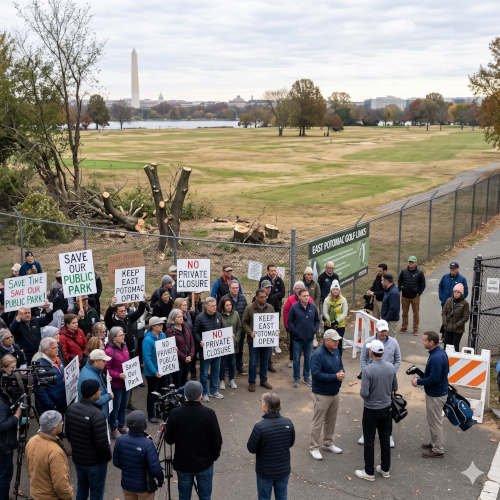
A major legal fight over a historic public golf course in Washington, D.C., is approaching a decisive moment. A federal judge is questioning the Trump administration’s reasons for closing East Potomac Golf Links, raising fresh uncertainty about the future of the popular recreational property.
U.S. District Judge Ana C. Reyes heard more than five hours of arguments on Friday, November 13, as preservation groups asked the court to stop the planned shutdown. The administration wants to close the course and surrounding parkland on November 15, while President Donald Trump has proposed replacing the existing facility with a championship-style golf course.
Reyes did not issue an immediate decision after the hearing. However, she repeatedly challenged government lawyers about the administration’s safety concerns, the departure of the current golf course operator and the relationship between the closure and Trump’s redevelopment plans.
The judge was expected to rule on Saturday, November 14, leaving golfers, preservation advocates and local residents waiting for an important decision.
Why East Potomac Golf Links Is Facing Closure
East Potomac Golf Links is a historic public golf facility located on Hains Point in Washington, D.C. The property offers views of the Potomac River and the city’s landmarks and has served local golfers and visitors for generations.
The facility includes an 18-hole course, two nine-hole layouts, a driving range and other public recreational amenities. Its location and relatively accessible public-golf experience have made it an important part of Washington’s municipal golf system.
The current dispute began after the Trump administration announced plans to transform the property into a larger championship-level golf course.
Trump has promoted a redesigned facility that could exceed 8,000 yards and potentially accommodate major golf tournaments. The proposed design is associated with golf architect Tom Fazio and would replace the current combination of courses with a single championship-style layout.
The administration has discussed closing the property for approximately 15 months to support the renovation.
However, preservation groups argue that the government should not shut down the existing public facility or make irreversible changes before completing the necessary environmental and historic-preservation reviews.
The disagreement has now developed into a significant federal court dispute involving public access, environmental protection and the government’s authority to manage historic parkland.
Judge Ana Reyes Questions the Government’s Reasons for Closing the Course
Friday’s hearing became contentious as Reyes pressed Justice Department lawyers to explain why the entire property needed to close immediately.
The administration has offered two principal reasons for the shutdown.
First, government officials have cited safety concerns involving a deteriorating seawall around the property. Second, they have pointed to the end of National Links Trust’s role as the longtime operator of East Potomac Golf Links.
Reyes questioned whether those issues justified closing the entire golf course and surrounding parkland.
The judge also examined whether the administration could address specific safety concerns without shutting down the whole facility. One possibility discussed during the hearing involved fencing off hazardous areas while allowing other parts of the property to remain accessible.
The government’s position faced another challenge when Reyes asked why the course needed to close immediately if officials had no current plans for major seawall repairs or golf course construction.
Government lawyers acknowledged that they knew of no work scheduled to begin immediately on the seawall or the golf course.
That exchange became important because the planned shutdown is scheduled to take place before the administration completes several reviews connected to the proposed redesign.
The National Links Trust Dispute
National Links Trust has operated East Potomac Golf Links as part of its involvement in Washington’s public golf system.
Under a new arrangement, the nonprofit will continue operating two other municipal golf courses but is expected to stop managing East Potomac by November 15.
The Trump administration has argued that the end of the organization’s operating role creates a practical reason to close the facility.
However, Reyes questioned whether the government could rely on an operator transition as justification when the administration’s own directive helped create that situation.
The judge explored whether the National Park Service could arrange temporary management rather than immediately shutting down the property.
That possibility matters because keeping the course open temporarily would not necessarily prevent the administration from continuing its long-term planning and review process.
It could, however, protect public access while the court considers the legal challenges.
Trump’s Championship Golf Course Plan Faces Legal Challenges
The proposed East Potomac renovation is part of Trump’s broader interest in changing the appearance and use of federal properties.
The president has publicly described plans for a world-class championship golf course that could host major tournaments, including the U.S. Open.
The proposed project has attracted attention because East Potomac is not simply a private golf facility. It is part of a public park area used by golfers, walkers, cyclists and other visitors.
The redesign could significantly change how the property operates.
The current layout includes multiple golf options, including shorter courses that provide opportunities for beginners and recreational players. A single championship-style course could change the property’s character and affect the range of activities available to the public.
Preservation groups argue that the government must follow environmental and historic-preservation requirements before proceeding with major changes.
The National Capital Planning Commission is expected to consider the proposed design at its December 3 meeting. That review is an important part of the broader planning process.
Government lawyers have maintained that the proposed closure and the eventual redesign are separate matters. They have also said environmental and historic-preservation reviews, including opportunities for public comment, will take place before a final decision on the redevelopment.
Reyes has questioned whether the administration’s explanations can be separated from the president’s publicly stated plans.
Why the Earlier Tree-Removal Dispute Matters
The latest hearing is part of a much larger legal battle that has already involved tree removal, government statements and questions about the administration’s redevelopment intentions.
Earlier in October, more than 500 trees were cut down at East Potomac, prompting preservation groups to seek emergency court intervention.
Reyes subsequently issued orders restricting further tree removal and other potentially irreversible changes without court approval.
On October 26, she granted a preliminary injunction that placed additional restrictions on the government’s activities at the property. The order also required advance notice before certain closures or irreversible changes.
The administration later asked the judge to pause the injunction while it appealed. Reyes refused to do so in a November 9 decision.
Her ruling emphasized that government planning documents connected the tree removal to the proposed championship course rather than merely routine maintenance.
The judge also expressed concern about the government’s earlier descriptions of its plans.
A Separate Investigation Into Government Lawyers
The dispute has also raised questions about the conduct of government officials and attorneys during earlier court proceedings.
On October 30, Reyes announced an inquiry into whether Justice Department and Interior Department lawyers had made misleading statements or violated professional responsibilities while defending the administration’s plans.
The judge indicated that former Washington, D.C., U.S. Attorney Jessie Liu would serve as a special master to examine the relevant conduct.
The inquiry does not establish that any lawyer committed misconduct. Its purpose is to investigate the conflicting accounts and determine whether professional obligations were violated.
The issue became particularly controversial after Trump publicly announced a November 15 closure date while government representatives had previously given the court different information about the administration’s plans.
The latest hearing therefore involved more than a disagreement about golf course management. It also reflected continuing tensions between the federal court and the executive branch over government transparency and compliance with judicial orders.
What Happens if the Judge Blocks the Closure?
A ruling against the planned shutdown could provide temporary relief for golfers and other visitors who use East Potomac.
The court could require the government to maintain public access while the legal dispute continues. It could also consider whether the golf course, surrounding parkland or Ohio Drive should remain open.
Such an order would not necessarily cancel Trump’s proposed championship golf course.
Instead, it could delay the immediate closure and require the administration to address the legal and operational questions raised by the plaintiffs.
The National Park Service could potentially arrange temporary operations if the existing operator leaves.
However, keeping the property open would require practical decisions about maintenance, safety responsibilities and management.
If Reyes allows the closure, the administration could proceed with its planned shutdown on November 15, subject to the existing court orders and other applicable legal requirements.
That outcome would not automatically mean that the full redevelopment plan had received final approval. Environmental reviews, historic-preservation requirements and planning commission proceedings would remain important.
The court’s decision could therefore determine the immediate future of public access without resolving every question surrounding the proposed renovation.
What the East Potomac Golf Course Fight Means for Washington Residents
The dispute has consequences beyond the local golf community.
East Potomac is a public recreational property that serves people with different interests and budgets. Golfers use the courses, while runners, cyclists and other visitors enjoy the surrounding parkland.
A lengthy closure could disrupt established routines and affect workers and businesses connected to the facility.
The proposed redesign could eventually create a high-profile championship venue, but it also raises questions about whether the property’s existing public amenities will be preserved.
Golf course renovation projects can involve major construction costs, environmental reviews, infrastructure improvements and long-term maintenance commitments. The East Potomac proposal is especially significant because it involves federally managed land and a historic public recreation area.
The controversy also highlights the importance of transparent government planning. Residents and public-interest organizations want clear information about how major changes to shared public spaces are approved and implemented.
For now, the legal process remains central to the property’s future.
East Potomac Golf Links: What to Watch Next
Several developments could shape the next stage of the dispute:
- Judge Reyes’s decision: The court’s expected November 14 ruling could determine whether the planned November 15 closure can proceed.
- November 15 deadline: The administration’s announced shutdown date is approaching, making the timing of the ruling particularly important.
- National Links Trust: The transition away from the current operator could affect whether temporary golf course operations are possible.
- Environmental reviews: The proposed redevelopment still faces environmental and historic-preservation review requirements.
- December 3 planning meeting: The National Capital Planning Commission is expected to consider the proposed design.
- Special master inquiry: The examination of possible ethical violations by government lawyers could add another dimension to the ongoing case.
Final Takeaway
The East Potomac Golf Links closure dispute has become one of Washington’s closely watched public-land controversies. What began as a disagreement over a golf course renovation has expanded into a legal battle involving federal property management, environmental protections, public access and presidential authority.
Judge Ana C. Reyes’s questions during Friday’s hearing suggest that the administration must explain why an immediate shutdown is necessary and whether less restrictive alternatives are available.
The immediate question is whether the historic public golf course will close on November 15. The larger issue is whether the proposed championship redevelopment can move forward while the legal challenges remain unresolved.
Frequently Asked Questions
1. Why is East Potomac Golf Links facing closure?
The Trump administration plans to close the historic public golf facility as part of a broader redevelopment proposal. Officials have cited seawall safety concerns and the departure of the current operator, National Links Trust.
2. Who is the judge handling the East Potomac golf course lawsuit?
U.S. District Judge Ana C. Reyes is overseeing the federal case involving the proposed closure and redevelopment.
3. When is East Potomac Golf Links scheduled to close?
The administration has announced November 15, 2026, as the planned closure date. The court’s consideration of an emergency request could affect whether that shutdown proceeds.
4. What does Trump want to build at East Potomac?
Trump has proposed replacing the existing golf facility with a championship-style course designed by Fazio Design, potentially capable of hosting major tournaments.
5. Why are preservation groups opposing the project?
Preservation advocates argue that the redevelopment could damage a historic public recreational property and that the government must complete the required environmental and historic-preservation reviews.
6. Will the golf course remain open?
The outcome depends on the court’s decision and any subsequent government action. As of the latest reporting available for this article, Judge Reyes had not issued a ruling following Friday’s hearing.
7. What is the role of National Links Trust?
National Links Trust has operated East Potomac Golf Links. Under a new arrangement, it is expected to continue managing two other Washington municipal courses but leave East Potomac by November 15.