

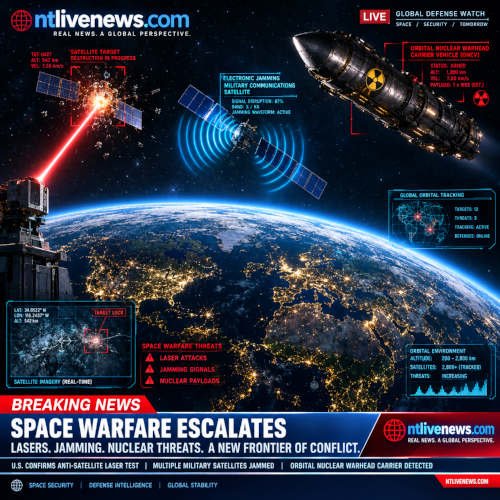
America Business Today News: The next major military conflict may not begin with missiles crossing borders or fighter jets entering enemy airspace. Some of its opening moves could take place hundreds of miles above Earth, where military and commercial satellites support communications, navigation, intelligence and national security.
A new intelligence assessment from the U.S. Defense Intelligence Agency (DIA), released on October 26, 2026, warns that China and Russia are developing increasingly sophisticated capabilities to disrupt, damage or destroy satellites. The reported threats include electronic jamming, powerful lasers, cyberattacks, anti-satellite weapons and a Russian program involving a satellite designed to carry a nuclear weapon into orbit.
The assessment highlights a growing challenge for the United States and its allies. Modern military operations depend heavily on space-based technology, and an attack against satellites could affect forces on land, at sea and in the air.
The warning does not mean a space war is inevitable or that every reported weapon is operational. However, it shows why military planners are treating outer space as an increasingly important part of national defense.
Why Space Is Becoming a Major Battlefield
Satellites have become essential to modern military operations. American forces use them to communicate across long distances, navigate ships and aircraft, monitor enemy movements, detect missile launches and support precision-guided weapons.
These systems also serve civilian needs. GPS supports transportation, logistics and emergency services, while satellite networks help deliver communications, weather information and data used by businesses and infrastructure operators.
That dependence creates a potential weakness. If an adversary can interrupt satellite services during a military crisis, the effects could reach far beyond the spacecraft themselves.
A disruption to military communications could make coordination more difficult. GPS interference could affect navigation, while attacks on surveillance satellites could reduce the ability to monitor developments on the battlefield.
Clayton Swope, deputy director of the Aerospace Security Project at the Center for Strategic and International Studies, previously told Fox News Digital that military operations today cannot function in the same way without satellites and other space systems.
The strategic concern is straightforward: a country that can deny an opponent access to important space services could gain an advantage without first defeating its forces in a conventional battle.
China and Russia Are Expanding Their Anti-Satellite Capabilities
The DIA assessment describes different approaches taken by Beijing and Moscow. Both countries view space as an important military domain, but their reported programs include a range of technologies designed to interfere with American and allied systems.
China is developing electronic warfare tools, ground-based lasers and potential space-based directed-energy weapons. Russia is pursuing capabilities that include satellite interference, close-approach operations and a reported nuclear anti-satellite program.
The threat is not limited to destroying satellites. Intelligence officials describe a range of possible actions, from temporarily disrupting a spacecraft to permanently damaging its equipment or destroying it.
This distinction matters because some attacks could happen without creating visible explosions or large amounts of orbital debris. A satellite might remain in orbit while its communications, sensors or other functions become unreliable.
China’s Satellite Jamming and Laser Weapons
China’s military has practiced disrupting satellite communications and GPS signals during exercises, according to the reported DIA findings.
Electronic jamming works by interfering with radio-frequency signals. If successful, it can prevent a receiver from obtaining reliable information from a satellite or disrupt communications between spacecraft and ground stations.
China also has ground-based laser systems that can interfere with or damage satellite sensors, particularly those operating in low Earth orbit.
The DIA assessment reportedly warns that Beijing could field space-based directed-energy systems and more powerful ground-based systems capable of threatening satellites in higher orbits by the late 2020s.
What the New Intelligence Warning Means for Future Wars
The DIA assessment points to a change in how governments think about military competition. Space is no longer simply a supporting environment for operations on Earth. It is also a domain where countries may attempt to gain an advantage by disrupting an opponent’s critical systems.
China’s reported progress in jamming and directed-energy technology, together with Russia’s nuclear anti-satellite program, raises questions about deterrence, international law and the long-term safety of Earth’s orbital environment.
The biggest danger may not be a single satellite being destroyed. A wider conflict could create debris, disrupt commercial services and damage systems used by countries that are not directly involved.
Why International Cooperation Still Matters
Space is shared by governments, private companies, research organizations and ordinary people around the world. A destructive attack could create consequences that extend well beyond the countries involved.
International agreements, communication between space agencies and stronger rules for responsible behavior could help reduce the risk of escalation.
The Outer Space Treaty remains a central part of this framework, although governments continue to debate how existing international law applies to newer military technologies.
The Bottom Line
America’s next major security challenge could involve more than aircraft, ships and missiles. Satellites are now essential to military operations and everyday services, making them potential targets during a future conflict.
The latest DIA warning describes China’s expanding counterspace capabilities and Russia’s reported effort to develop a nuclear anti-satellite system. These assessments deserve attention, but they should not be mistaken for proof that every weapon is ready for use.
Protecting satellites, strengthening backup systems and maintaining international cooperation will be critical to keeping space accessible and reducing the danger of a conflict that could affect the entire world.
Sources and Further Reading
- Fox News – America’s Enemies Prepare to Take the Next Major War Into Outer Space
- United Nations – Outer Space and the Principles of International Space Law
