
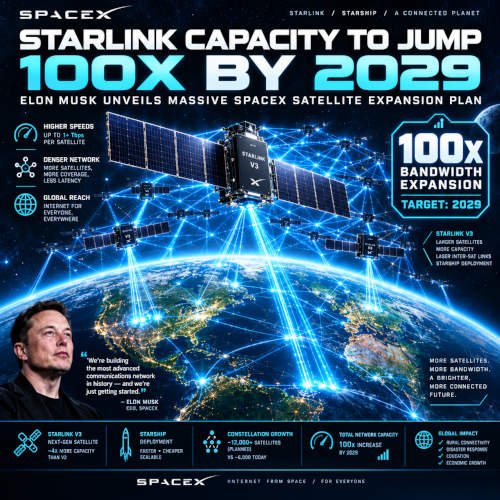
Elon Musk has made an ambitious prediction for the future of Starlink, saying SpaceX could increase the satellite internet network’s total bandwidth by approximately 100 times within the next two to three years. The expansion could significantly change global internet connectivity as demand for high-speed data continues to grow.
Speaking at the Baron Investment Conference on November 6, 2026, Musk explained that SpaceX plans to deploy more powerful next-generation satellites while dramatically increasing the size of its Starlink constellation. He said the combination of these improvements could deliver around 100 times more network bandwidth by 2028 or 2029.
The forecast highlights SpaceX’s growing ambitions in the satellite internet industry. The company is moving beyond its existing broadband services and preparing for a future in which artificial intelligence, connected devices, businesses and consumers require much greater communication capacity.
However, Musk’s prediction is a company target, not a guaranteed outcome. Launch schedules, satellite manufacturing, regulatory approvals and the availability of Starship will influence how quickly SpaceX can expand its network.
Elon Musk Explains How Starlink Could Deliver 100 Times More Bandwidth
During his conversation with investor Ron Baron, Musk explained that Starlink currently has approximately 11,000 satellites in orbit, with most belonging to the company’s second-generation network.
SpaceX has started deploying its third-generation Starlink satellites, known as V3. Musk said each V3 satellite has more than 10 times the capability of a V2 satellite.
He also described plans to launch approximately 10 times as many next-generation satellites. Combining greater capacity per satellite with a much larger constellation could produce the projected 100-fold increase in total network bandwidth.
The forecast is important because Starlink’s performance depends on more than the number of satellites in orbit. Each satellite must carry enough communications capacity to serve users, connect with other satellites and transfer data through the wider network.
By improving satellite capability and increasing the number of spacecraft, SpaceX wants to provide more total bandwidth to customers across its coverage areas.
Why Starlink V3 Satellites Matter
Starlink V3 represents a major step in SpaceX’s satellite internet development.
The new generation is designed to deliver substantially more data capacity than earlier models. SpaceX has also developed V3 satellites to work with its Starship launch system, which is expected to carry larger batches of satellites into orbit.
The company has said V3 satellites are designed to provide approximately one terabit per second of downlink capacity per satellite. This is a significant improvement over earlier satellite designs.
SpaceX also expects Starship to make satellite deployment more efficient. Its greater payload capacity could allow the company to place many more large satellites into orbit with fewer launches.
That matters because building a larger constellation requires both advanced spacecraft and an economical way to transport them into space.
SpaceX Wants to Expand Starlink Toward 100,000 Satellites
Musk’s 100-fold bandwidth prediction is connected to a much larger expansion plan.
During the November 6 discussion, Musk and Baron discussed the possibility of eventually expanding Starlink toward 100,000 satellites. Musk also described a strategy of replacing older satellites with newer models that offer significantly greater capacity.
The company’s longer-term vision is to create a much larger satellite network capable of handling growing global demand.
SpaceX has already disclosed plans to operate up to 100,000 Starlink satellites. Its official Starlink updates also reported that the company had more than 11,000 satellites in low Earth orbit and deployed its first 26 V3 satellites at the end of September 2026.
However, the 100,000-satellite figure should be understood as a longer-term plan. It does not mean SpaceX will necessarily have all those satellites operating by 2029.
Starship Could Accelerate the Satellite Deployment Process
Starship is central to SpaceX’s plans for expanding Starlink.
Traditional satellite launches can place only a limited number of spacecraft into orbit during each mission. Starship is designed to carry much larger payloads, potentially allowing SpaceX to deploy more satellites in a single flight.
If the launch system reaches its planned operational capability, it could reduce the time and cost required to expand the constellation.
This could also help SpaceX replace older satellites more quickly. Satellite networks require regular upgrades because spacecraft have limited operating lifetimes and technology continues to improve.
A faster replacement cycle would allow Starlink to introduce better communications equipment without relying entirely on additional satellites.
Nevertheless, the expansion depends on Starship’s development, launch reliability and regulatory permissions. Delays in any of these areas could affect Musk’s projected timeline.
Laser Technology Could Make Starlink Even Faster
Another important part of Musk’s plan involves laser communication links between satellites.
These links allow satellites to transfer data through space without depending on a ground station for every connection. They can help Starlink route information across long distances and improve network flexibility.
During the Baron conference, Musk discussed the possibility of increasing laser-link capacity substantially.
He said current Starlink laser links operate at approximately 100 gigabits per second, while the next generation could reach 10 terabits per second.
That would represent a major increase in the amount of information satellites could transfer between one another.
Musk also discussed future Starlink V4 satellites, which he expects could deliver another order-of-magnitude improvement over V3.
These figures describe ambitious technical targets. Their real-world performance will depend on engineering development, testing and deployment.
Why More Bandwidth Matters for Artificial Intelligence
Artificial intelligence is becoming an important reason for expanding global data infrastructure.
AI systems increasingly depend on communication between data centers, computing facilities, connected devices and software agents. As businesses use more AI tools, the amount of information moving across networks could rise significantly.
Musk argued that AI agents and robots could create far greater demand for communications bandwidth than traditional human internet use.
This is one reason SpaceX wants to expand Starlink beyond its current customer base.
A larger network could support enterprise connectivity, remote computing, industrial applications and communication services in locations where traditional infrastructure is limited.
However, increased satellite capacity alone will not solve every AI infrastructure challenge. Data centers also need electricity, computing hardware, cooling systems and reliable connections to users.
What a 100-Fold Capacity Increase Could Mean for Starlink Customers
If SpaceX achieves its target, Starlink could have significantly more total network capacity available to serve customers.
That could help the company support more subscribers without experiencing the same level of network congestion during busy periods.
Potential benefits include:
- More capacity for households and businesses using satellite broadband.
- Better support for customers in rural and remote locations.
- Greater network resources for enterprise and government services.
- More opportunities for satellite-to-mobile connectivity.
- Improved support for data-intensive applications and connected devices.
However, a 100-fold increase in total bandwidth does not automatically mean every customer will receive internet speeds that are 100 times faster.
Individual performance will continue to depend on the user’s location, equipment, service plan, network demand and available capacity in the surrounding area.
Starlink Faces Challenges Before Reaching Its 2029 Target
Despite the ambitious forecast, SpaceX faces several challenges before it can deliver a 100-fold increase in network bandwidth.
The first challenge is satellite deployment. SpaceX must manufacture thousands of advanced satellites and launch them reliably. Starship must also demonstrate the operational capability needed to support the planned expansion.
The second challenge is regulation. Satellite operators must follow international and national rules covering orbital operations, radio frequencies and interference with other communications systems.
Space traffic management is another major concern. A constellation containing tens of thousands of satellites will require careful coordination to reduce collision risks and manage orbital debris.
Competition will also remain important. Traditional broadband companies, mobile operators and other satellite internet providers are investing in their own networks.
SpaceX will need to maintain reliable service and competitive pricing while expanding its infrastructure.
There is also the question of customer demand. More network capacity creates opportunities, but the company must attract enough subscribers and business customers to justify the investment.
What Musk’s Starlink Prediction Means for the Satellite Internet Industry
Musk’s forecast could have implications beyond SpaceX.
A major increase in satellite internet capacity could strengthen competition with traditional broadband providers, especially in rural and underserved areas.
It could also encourage other satellite companies to invest in more advanced spacecraft, laser communication systems and larger constellations.
For businesses, greater satellite capacity could provide additional connectivity options for remote operations, transportation, energy projects and emergency communications.
The development may also become important for mobile services. SpaceX is expanding its Starlink Mobile ambitions and exploring ways to combine satellite connectivity with terrestrial wireless networks.
Still, the competitive impact will depend on actual service quality, pricing, coverage and regulatory access.
For consumers, the most important measure will not simply be how many satellites SpaceX launches. It will be whether those satellites deliver faster, more reliable and affordable internet access.