
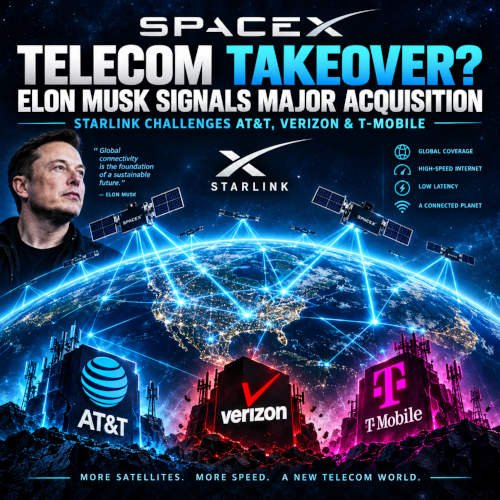
Elon Musk has opened the door to a potentially major telecommunications acquisition as SpaceX accelerates its plans to challenge America’s biggest wireless companies. The billionaire entrepreneur indicated that SpaceX could acquire an established telecom operator and use its wireless spectrum more efficiently as the company expands its Starlink Mobile business.
Musk made the comments during a video appearance at the Baron Investment Conference on November 6, 2026. His remarks attracted attention across the telecommunications industry because SpaceX has already been purchasing wireless spectrum, exploring access to cellular infrastructure and preparing a nationwide 5G network.
However, there is an important distinction: SpaceX has not announced a telecommunications acquisition, named a target company or disclosed a potential deal value. Musk’s comments signal strategic interest rather than a confirmed transaction.
Elon Musk’s SpaceX Telecom Acquisition Comments Put Wireless Giants on Alert
Musk suggested that SpaceX could make significant progress in the wireless market with its existing spectrum licenses. He also indicated that acquiring an established telecommunications company could be an option if the opportunity allowed SpaceX to use its licensed airwaves more effectively.
According to MarketWatch’s November 6 report, Musk told investor Ron Baron that SpaceX could get far in its effort to compete with major wireless providers using the spectrum licenses it has purchased.
The comments matter because wireless spectrum is one of the most valuable resources in the telecommunications business. Companies need permission to use specific radio frequencies to provide cellular connectivity. Acquiring a carrier could potentially give SpaceX access to additional spectrum, infrastructure, customers and operational capabilities.
Musk did not identify whether SpaceX would consider buying a smaller wireless operator, a prepaid mobile business or a major established carrier. He also did not provide a timeline for any potential acquisition.
Why SpaceX Wants to Enter the U.S. Wireless Market
SpaceX already operates Starlink, a satellite internet network designed to provide broadband connectivity in locations where traditional internet infrastructure can be limited or expensive.
The company now wants to expand beyond home and business internet services. Its Starlink Mobile ambitions combine satellite connectivity with conventional cellular infrastructure to deliver broader coverage to smartphone users.
The strategy could put SpaceX in direct competition with:
- AT&T
- Verizon
- T-Mobile
These companies have spent decades developing cellular networks, purchasing spectrum licenses, installing antennas and building relationships with millions of customers.
SpaceX believes its satellite network could provide a different approach. Instead of relying entirely on conventional cell towers, the company wants to combine satellite-to-phone technology with ground-based 5G infrastructure.
That combination could help extend connectivity into rural areas, remote locations and places where traditional networks struggle to provide consistent service.
SpaceX Has Already Made Major Moves to Secure Wireless Spectrum
Spectrum acquisition is central to SpaceX’s telecommunications strategy.
In October 2026, SpaceX agreed to acquire a nationwide portfolio of 800 MHz spectrum licenses from investment firm Grain Management. Reuters reported that the deal would help Starlink Mobile improve connectivity by using lower-frequency airwaves.
Low-band spectrum can travel longer distances and penetrate buildings more effectively than higher-frequency signals. That characteristic could help address one of the major limitations of satellite-to-phone connectivity: maintaining reliable connections when users are inside buildings or surrounded by obstacles.
Reuters reported that the financial terms were not disclosed by the companies. However, The Wall Street Journal, citing people familiar with the matter, reported that SpaceX would pay approximately $8 billion in cash for the assets.
The transaction remains subject to regulatory approval. Therefore, the agreement should not be treated as a completed acquisition until the required approvals and closing steps take place.
Qualcomm Deal Gives SpaceX Another Piece of Its 5G Strategy
SpaceX is also building the technology infrastructure needed to operate a nationwide wireless network.
On November 4, 2026, Qualcomm announced a multiyear agreement to supply radio equipment, baseband units and software for Starlink Mobile’s planned terrestrial 5G network.
The equipment is expected to be deployed across tens of thousands of cellular sites in the United States starting in 2027.
Qualcomm described the agreement as its biggest 5G deal yet, although the companies did not disclose its financial value.
The partnership is significant because SpaceX will need more than satellites and spectrum licenses to become a full-scale wireless carrier. It will also need radio equipment, antennas, network software, ground infrastructure and reliable connections between cellular sites.
Qualcomm’s technology is expected to help SpaceX develop a multiband network that can be deployed in stages. The system will also use advanced beamforming technology to direct wireless signals toward users and improve the efficiency of available spectrum.
The agreement suggests that SpaceX is moving ahead with a conventional terrestrial 5G network alongside its satellite-based connectivity plans.
Could SpaceX Buy T-Mobile, AT&T or Verizon?
Musk’s comments have naturally raised questions about which telecommunications company could become a potential acquisition target.
T-Mobile, AT&T and Verizon are the three major U.S. wireless carriers, and all could face increased competitive pressure if SpaceX becomes a nationwide mobile operator.
However, there is currently no confirmed evidence that SpaceX has agreed to acquire any of these companies.
T-Mobile has an existing relationship with SpaceX through satellite-to-phone connectivity services. That relationship has encouraged speculation about how the two companies might work together in the future.