

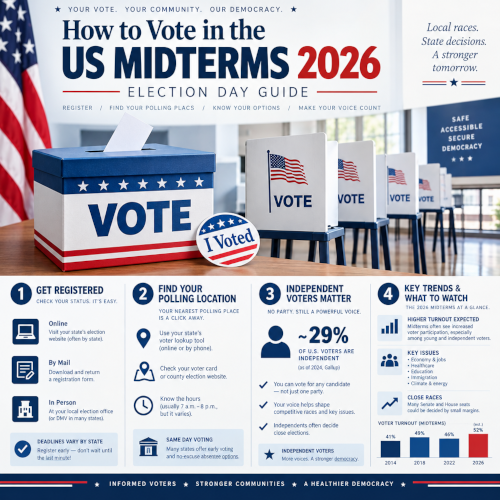
USA Politics : Millions of Americans are preparing to vote in the 2026 US midterm elections, with control of Congress, state legislatures and important local offices at stake. Election Day falls on Tuesday, November 3, 2026, and voters across the country will decide which candidates represent their communities and shape the next stage of national politics.
One major development this election cycle is the growing number of Americans who identify as politically independent. A record share of voters say they do not belong to either the Democratic or Republican Party. However, independent candidates continue to face significant obstacles in a political system dominated by the two major parties.
For eligible voters, understanding how to vote in the US midterms is particularly important. Registration status, polling locations, identification requirements and mail-in ballot rules can differ depending on the state.
Here is a practical voting guide, along with the latest information about independent voters, third-party candidates and the political competition surrounding the 2026 midterms.
When Are the 2026 US Midterm Elections?
The 2026 US midterm elections take place on Tuesday, November 3, 2026.
Midterm elections happen halfway through a president’s four-year term. Unlike presidential elections, voters do not choose a president during the midterms. Instead, they elect members of Congress and decide numerous state and local contests.
The elections will determine all 435 seats in the US House of Representatives and approximately one-third of the 100 seats in the US Senate. Voters will also participate in gubernatorial contests, state legislative elections and local races, depending on where they live.
The results could influence congressional control, federal legislation, government spending, healthcare policy, immigration policy, taxes and other major national issues.
How to Vote in the US Midterms: Step-by-Step Guide
The voting process is not identical in every state, but most eligible voters can follow these basic steps.
1. Check your voter registration
Before Election Day, confirm that your voter registration is active and that your registered address is correct.
Voters can use the official federal registration information at Vote.gov to locate their state’s election website and check registration details.
Most states require registration before Election Day. Some states allow same-day registration, but voters should not assume this option is available everywhere.
2. Find your assigned polling location
Your polling place generally depends on your residential address. It may be a school, community center, government building or another designated public facility.
Check your polling location through your state or local election office. Do not assume that the location used during the previous election will remain the same.
3. Check voter ID requirements
Identification requirements vary by state. Many states require voters to show identification when voting in person, while others accept alternative verification methods.
Depending on the state, acceptable identification may include a driver’s license, state-issued identification card, passport or another approved document.
Check the rules before leaving home. If you arrive without the required identification, ask election workers about the available procedures, including whether you can cast a provisional ballot.
4. Review your sample ballot
A sample ballot helps voters understand which candidates and measures will appear on their ballot.
Depending on the state and district, voters may see congressional races, governor contests, state legislative elections, judicial elections, local offices and ballot initiatives.
Reviewing candidates and ballot questions before arriving can make the process easier.
5. Vote at your assigned location
On Election Day, visit your designated polling location during its official operating hours.
Follow the instructions provided by election workers. Depending on the jurisdiction, voters may complete a paper ballot or use an electronic voting device.
Check your state election website for opening and closing times.
6. Consider early voting or mail voting where available
Many states offer early in-person voting, absentee voting or vote-by-mail options. However, deadlines and eligibility rules differ.
If you already received a mail ballot, follow the instructions carefully. Complete the required sections, sign the return envelope where requested and return it using an approved method.
Do not assume that placing a ballot in the mail on Election Day is sufficient. Some states require ballots to arrive by Election Day, while others use different postmark and receipt rules.
Can Independent Voters Vote in the 2026 Midterms?
Yes. Independent voters can participate in general elections in the United States, provided they meet their state’s eligibility and registration requirements.
An important distinction exists between primary elections and general elections.
In a general election, voters generally can support any candidate on the ballot, regardless of whether they registered as Democrats, Republicans or independents.
Primary election rules can be different. Some states have closed primaries, which restrict participation based on party registration. Other states allow unaffiliated voters to participate under specific rules.
For the November 3 general election, independent voters are not required to support a candidate from either major party.
Independent Voters Could Influence Control of Congress
Independent voters are becoming an increasingly important part of the American political landscape.
According to figures cited in the November 2 Al Jazeera report, 44 percent of US adults identify as politically independent, compared with 29 percent who identify as Democrats and 28 percent who identify as Republicans.
That figure does not mean that all independent voters reject both major parties when choosing candidates.
Many people who describe themselves as independent still lean toward Democrats or Republicans. The group that expresses no consistent preference for either party is considerably smaller, representing an estimated 7 to 10 percent of the electorate in the report.
These less-partisan voters can become especially important in closely contested congressional and statewide races.
A recent NPR/PBS News/Marist poll provides another indication of their potential influence. Among likely independent voters, 52 percent supported Democratic congressional candidates, while 39 percent favored Republican candidates.
The results suggest that independent voters could play an important role in determining which party gains or retains congressional seats.
Why Do Independent Candidates Struggle to Win Elections?
Despite the growing number of independent voters, independent candidates continue to face substantial challenges.
The United States does not legally restrict elections to two political parties. Candidates from smaller parties and independent candidates can compete for public office if they meet the relevant ballot-access requirements.
However, the country’s electoral structure generally favors Democrats and Republicans.
Most congressional elections use single-member districts, where the candidate receiving the most votes wins the seat. This winner-take-all arrangement can make it difficult for third-party candidates to convert nationwide support into congressional representation.
For example, a third-party candidate could receive a meaningful share of votes across the country but still fail to win individual districts.
Voters may also hesitate to support candidates they believe have little chance of winning. Some worry that their preferred independent or third-party candidate could take votes away from a major-party candidate they otherwise support.
Campaign Finance Creates Another Challenge
Money is another major obstacle for independent and third-party candidates.
The two major political parties have extensive fundraising networks, established campaign organizations, national recognition and access to experienced political consultants.
According to the November 2 report, the Democratic National Committee raised approximately $252.3 million during the 2026 campaign cycle, while the Republican National Committee raised about $341 million.
Political advertising spending is also expected to reach extraordinary levels. The report cited projections of as much as $11.6 billion in political advertising spending during the 2026 midterm cycle.
Smaller candidates often struggle to compete with these financial resources. Limited fundraising can affect advertising, campaign staffing, voter outreach and the ability to build name recognition.
As a result, independent candidates may face a difficult task even when public frustration with the two major parties creates opportunities for alternative political choices.
