
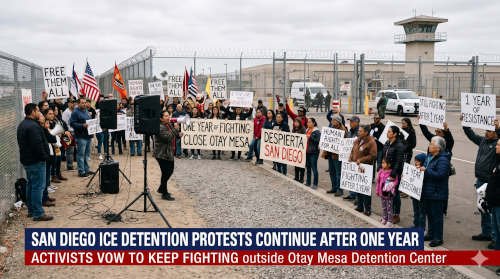
San Diego residents are continuing their weekly protests outside the Otay Mesa Detention Center, more than a year after the demonstrations began in October 2025. Despite growing political pressure over President Donald Trump’s immigration policies and the results of the November 2026 midterm elections, organizers say they have no plans to stop gathering outside the facility.
The demonstrations bring together local residents, immigrant-rights advocates, community organizations and families who want to show support for people held inside the Immigration and Customs Enforcement (ICE) detention center. Their activities include peaceful vigils, public speeches, music and fundraising for detainees.
The latest gathering took place on Sunday, November 8, 2026. Organizers and participants told inewsource that their commitment remains strong as immigration enforcement continues across Southern California.
Weekly Vigils Become a Community Movement
The weekly gatherings outside Otay Mesa have developed into an organized community event. According to inewsource, volunteers arrive early to place traffic cones along Calzada de la Fuente and help maintain safety near the protest area.
Participants bring folding chairs, signs, tables, canopies and speakers. Some bring their children and pets, while others help raise money for detainees’ commissary accounts. Organizers also play music in different languages, hoping people inside the facility can hear messages of encouragement.
The events are organized by the Otay Mesa Detention Collective, working alongside the Racial Justice Coalition of San Diego and other community members.
Johannes Ottensmeier, who helps organize the weekly events, made the group’s position clear during the November 8 gathering. He said the demonstrations would continue as long as ICE operates the facility.
The message reflects the organizers’ belief that public attention and community support remain important, even after months of repeated protests.
Why Protesters Are Focusing on Otay Mesa
The Otay Mesa Detention Center is one of California’s major immigration detention facilities. It is operated by private prison company CoreCivic under a contract with ICE and is located in San Diego.
The California Department of Justice’s 2026 report lists the facility’s capacity at 1,142 people. A separate review of the facility found that its average detained population was 1,433 during the department’s October 2025 inspection period, making it one of the state’s largest ICE detention populations at that time.
The figures are tied to specific reporting periods and should not be interpreted as a current daily head count. However, they illustrate the scale of immigration detention at the facility.
Protesters say they want detainees and their families to know they have not been forgotten. They also oppose the administration’s broader immigration crackdown and argue that people should have access to fair legal proceedings and appropriate treatment while in custody.
California Report Raises Questions About Detention Conditions
The protests are taking place amid wider scrutiny of immigration detention conditions across California.
In May 2026, California Attorney General Rob Bonta released the state Department of Justice’s fifth report examining conditions at seven immigration detention facilities. The report found that conditions had worsened in several areas following the increase in detainee populations, with concerns involving overcrowding, limited resources and access to medical care.
The department also reported six deaths of detained individuals between September 2025 and March 2026 across the facilities it reviewed. Four occurred at the Adelanto ICE Processing Center and two at the Imperial Regional Detention Facility. These deaths were not reported as occurring at Otay Mesa.
The California DOJ’s review of Otay Mesa included concerns about overcrowding and the availability of beds. Its findings provide important context for the debate over detention conditions, although they should not be confused with claims made by individual protesters.
Separately, a San Diego County inspection report released in August 2026 identified concerns at Otay Mesa, including a case in which a person had not received a needed medical device 18 months after admission and a lack of vaccines in stock at the time of the inspection, according to NBC 7 San Diego.
These findings have increased attention on oversight, healthcare and the treatment of people held at the facility.
Midterm Elections Have Not Ended Immigration Debate
The November 2026 midterm elections have added another political dimension to the demonstrations. The results represented a setback for President Trump’s political agenda, according to the latest reporting, but they have not immediately changed federal immigration enforcement operations.
In a November 10 report, inewsource noted that ICE arrests across San Diego and Imperial counties reached their highest monthly level of Trump’s second term in July, the latest data point cited in the article.
The report also described how immigration enforcement activity has shifted in some areas, with advocates saying arrests have become less publicly visible than earlier operations.
At the November 8 vigil, speakers argued that the election results should not lead communities to assume the immigration crackdown is over. They urged residents to remain attentive to what is happening in their neighborhoods and to the experiences of immigrant families.
Families and First-Time Visitors Join the Demonstrations
The November 8 gathering also attracted people attending for the first time. Jennifer Hernandez and her 17-year-old daughter, Lucy, traveled from El Cajon to take part in the vigil.
Jennifer said family members and friends had been affected by immigration enforcement. She also described fear among people in her community, including some who have legal immigration status.
Lucy recounted an experience in which she said ICE officers followed her while she was driving with a friend. The experience frightened her and worried her mother.
Their accounts illustrate how immigration enforcement can affect people beyond those directly detained. However, personal experiences shared at a demonstration represent the individuals’ accounts and do not independently establish the circumstances of every enforcement encounter.
Other speakers included Arturo Gonzalez, who urged attendees to remember that ICE operations were continuing in local communities. Representatives of immigrant-rights and racial-justice organizations also addressed the crowd.
Organizers Say the Protests Will Continue
The November 8 vigil lasted about two hours, according to inewsource. Participants took turns speaking, played music and led chants in English, Spanish, Haitian Creole and French.
The gathering ended with volunteers collecting chairs, tables and traffic cones before leaving the area. Organizers plan to return for future Sunday events.
The continued demonstrations show that local opposition to immigration detention remains active in San Diego, even as the national political landscape changes.
For protesters, the weekly gatherings are more than a public statement against federal policy. They are also an effort to maintain contact with the issue, support people inside the facility and remind detainees that members of the surrounding community are paying attention.
As the immigration debate continues after the midterm elections, the Otay Mesa vigils are expected to remain a visible part of San Diego’s public response.
Frequently Asked Questions
1. Where are the San Diego ICE detention protests taking place?
The weekly demonstrations take place outside the Otay Mesa Detention Center in San Diego, California.
2. When did the weekly protests begin?
According to inewsource, the weekly gatherings began in October 2025.
3. Who organizes the Otay Mesa vigils?
The Otay Mesa Detention Collective works with the Racial Justice Coalition of San Diego and community participants to organize the events.
4. Why are people protesting outside the detention center?
Participants say they want to oppose immigration detention policies, support detainees and raise awareness about conditions inside the facility.
5. Will the protests continue after the 2026 midterm elections?
Organizers have said they intend to continue holding vigils as long as the detention center remains open and ICE continues operating there.
Sources and Reporting Notes
This report is based on November 10, 2026 coverage by inewsource, the California Department of Justice’s 2026 immigration detention review and local reporting by NBC 7 San Diego. Protesters’ statements and personal accounts are attributed to the individuals who made them.