
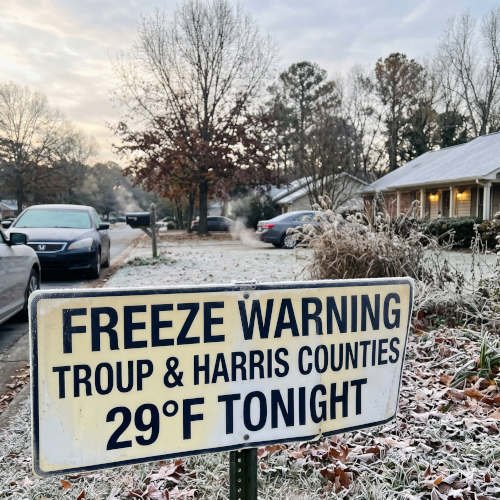
Residents across Troup and Harris counties in west-central Georgia should prepare for freezing temperatures as the National Weather Service (NWS) issues a cold-weather alert for the region. Temperatures could fall as low as 29 degrees Fahrenheit, creating a risk of frost, damage to sensitive plants and problems with exposed outdoor plumbing.
The approaching cold weather is part of a broader temperature drop affecting several communities across Georgia. Clear skies, dry air and changing atmospheric conditions are contributing to the potential for colder overnight temperatures.
The weather alert is particularly important for homeowners, gardeners, farmers and people with outdoor water pipes. Even a short period of temperatures below freezing can damage vulnerable vegetation and create problems for unprotected plumbing.
According to the National Weather Service office in Peachtree City, Georgia, a Freeze Warning is scheduled from 1 a.m. until 9 a.m. EST on Saturday, November 14, 2026, for Troup and Harris counties and other parts of the state. The agency expects temperatures as low as 29°F, with colder readings possible at higher elevations.
Is There a Freeze Watch for Troup and Harris Counties?
Yes, the National Weather Service initially issued a Freeze Watch for Troup and Harris counties, warning that temperatures could fall below freezing late Friday night into Saturday morning.
However, the situation subsequently changed. The NWS upgraded the initial alert to a Freeze Warning for Saturday morning as freezing temperatures became expected rather than simply possible.
The official warning covers Troup, Harris, Meriwether and numerous other Georgia counties.
The distinction between a Freeze Watch and a Freeze Warning matters for residents preparing for cold weather.
A Freeze Watch means conditions are favorable for freezing temperatures, but the exact outcome may remain uncertain. A Freeze Warning indicates that freezing conditions are expected or occurring and that residents should take protective action.
The National Weather Service specifically warns that temperatures could reach 29°F, while elevated locations could experience even colder conditions.
Residents should therefore take the warning seriously and avoid waiting until temperatures begin falling to protect plants and outdoor plumbing.
When Will the Freeze Warning Begin and End?
The National Weather Service has scheduled the Freeze Warning for the following period:
- Affected areas: Troup County, Harris County and other parts of Georgia.
- Warning begins: 1 a.m. EST, Saturday, November 14, 2026.
- Warning ends: 9 a.m. EST, Saturday, November 14, 2026.
- Expected minimum temperature: As low as 29°F.
- Primary risks: Frost, freezing conditions, plant damage and potential problems with exposed pipes.
The warning covers the early morning hours when temperatures are expected to be lowest.
Residents should prepare before going to bed Friday night because temperatures can fall significantly during the overnight period.
The NWS also advises people to protect tender plants and take precautions to prevent outdoor pipes from freezing.
Why Temperatures Could Drop So Quickly in Georgia
The approaching freeze is connected to changing atmospheric conditions that can encourage overnight cooling.
One important factor is the movement of higher-pressure air into the region. Rising atmospheric pressure often accompanies sinking air and more stable weather conditions.
As air sinks, it generally warms and becomes drier. This process can help reduce cloud formation and support clearer skies.
Clear skies are important because the ground loses heat through radiation after sunset. When clouds are limited, more heat can escape from the surface into the atmosphere.
As a result, temperatures can fall quickly overnight, particularly when winds are light.
The weather information supplied by CNAW2 also highlighted a pressure increase of approximately 1.8 millibars over six hours and a dew point near 36°F at the time of its observation.
These measurements provide useful context about the changing weather environment. However, atmospheric pressure alone does not determine the overnight minimum temperature. Cloud cover, wind speed, humidity, local elevation and the movement of colder air also influence how much temperatures fall.
How Dry Air and Dew Point Influence Overnight Temperatures
The dew point is another important measurement during a potential freeze.
Dew point describes the temperature at which air becomes saturated with water vapor. A lower dew point generally indicates less moisture in the atmosphere.
When the air is relatively dry and skies remain clear, the ground can lose heat efficiently after sunset.
This can create a noticeable difference between afternoon and early morning temperatures.
For example, a location may experience relatively comfortable afternoon conditions before temperatures fall close to or below freezing overnight.
The combination of dry air, clear skies and light winds can therefore create favorable conditions for frost and freezing temperatures.
However, residents should rely on official temperature forecasts and weather alerts rather than assuming that the dew point will predict the exact overnight low.
Which Areas of Georgia Are Included in the Freeze Warning?
The National Weather Service warning extends beyond Troup and Harris counties.
Its coverage includes several communities across north-central, northeast, northwest and west-central Georgia.
Affected counties include:
- Troup
- Harris
- Meriwether
- Heard
- Coweta
- Carroll
- Douglas
- Paulding
- Polk
- Haralson
- Cobb
- Cherokee
- Forsyth
- Bartow
- Floyd
- White
- Lumpkin
- Dawson
- Pickens
- Gordon
- Chattooga
- Walker
- Dade
- Catoosa
- Whitfield
- Murray
- Fannin
- Gilmer
- Union
- Towns
Communities including LaGrange, West Point, Pine Mountain, Franklin, Newnan, Carrollton and Douglasville are among the locations covered by the broader alert.
Local temperatures may vary depending on elevation, distance from open land and other geographic conditions.
People living in rural areas and elevated locations should pay particular attention because temperatures can fall below the forecast minimum in some places.
What a 29-Degree Freeze Means for Homes, Gardens and Farmers
A temperature of 29°F is below the freezing point of water, which is 32°F.
Even a few hours below freezing can create problems for outdoor plants, agricultural operations and exposed water systems.
The National Weather Service warns that frost and freezing conditions could kill crops, damage sensitive vegetation and affect unprotected outdoor plumbing.
For homeowners, the most immediate concern is often outdoor faucets, irrigation systems and exposed pipes.
Gardeners should also consider protecting flowers, vegetables and other plants that are sensitive to cold temperatures.
Farmers may need to take additional precautions for vulnerable crops and agricultural equipment.
The impact will depend on how long temperatures remain below freezing and how exposed individual properties are to the cold.
Practical Steps to Protect Your Property Before the Freeze
Residents can reduce the risk of cold-weather damage by taking several simple precautions.
1. Cover sensitive plants
Move potted plants indoors when possible. Cover vulnerable outdoor plants with frost cloth or suitable protective material before temperatures fall.
2. Protect exposed water pipes
Wrap exposed pipes with appropriate insulation. Pay particular attention to pipes located outside, in crawl spaces or in other areas without adequate heating.
3. Protect outdoor faucets
Disconnect garden hoses and cover outdoor faucets with suitable insulated covers.
4. Drain irrigation equipment
If possible, drain vulnerable irrigation lines and outdoor water equipment before freezing conditions arrive.
5. Check vulnerable areas around your home
Inspect garages, sheds and other spaces where pipes or water systems may be exposed to cold air.
6. Bring sensitive containers indoors
Move outdoor plants, gardening supplies and other items that could be damaged by freezing temperatures.
Taking these steps before Friday night can help prevent unnecessary damage.
What Residents Should Know About the Next Freeze Watch
The November 14 Freeze Warning is not necessarily the end of the cold-weather threat.
In an additional update issued early Friday, November 13, the National Weather Service also announced a separate Freeze Watch for late Saturday night into Sunday morning.
The agency indicated that temperatures could fall as low as 25°F during this subsequent period, with even colder conditions possible at elevated locations.
This means residents may face another round of freezing conditions after the Saturday morning warning expires.
The two alerts cover different periods and should not be confused.
The Saturday morning Freeze Warning calls for temperatures as low as 29°F. The subsequent Freeze Watch indicates the possibility of a more significant temperature drop, potentially reaching 25°F.
Residents should continue monitoring official forecasts because a Freeze Watch can be updated as weather conditions become clearer.
How to Follow Official Georgia Weather Updates
People living in Troup and Harris counties should monitor updates from the National Weather Service throughout the cold-weather event.
The agency provides information about temperature forecasts, warning areas, expected timing and recommended safety precautions.
Residents can also monitor local weather reporting services for updated radar images and community-level forecasts.
Weather conditions can differ between nearby communities, so checking the forecast for a specific location is important.
The official National Weather Service website provides the latest information about watches, warnings and advisories.
What Happens Next for Troup and Harris Counties?
The immediate concern for Troup and Harris counties is the possibility of freezing temperatures during the early hours of Saturday, November 14.
With lows potentially reaching 29°F, residents should prepare their homes, protect sensitive vegetation and take precautions against frozen pipes.
The additional Freeze Watch for Saturday night into Sunday morning suggests that colder conditions could continue across parts of Georgia.
For residents, preparation is more important than waiting for the temperature to reach freezing.
Homeowners should protect exposed plumbing, gardeners should cover vulnerable plants, and farmers should review their cold-weather protection plans.
The National Weather Service will continue providing updates as the forecast develops. Residents should check the latest official alerts before making weather-related decisions.