
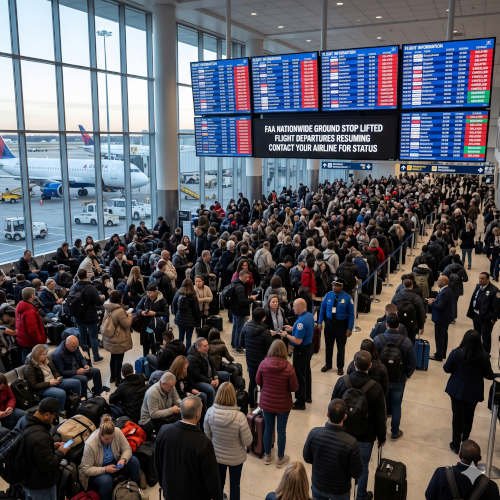
Air travel across the United States faced an extraordinary disruption on Friday, November 13, 2026, after the Federal Aviation Administration (FAA) ordered a nationwide ground stop because of a telecommunications failure affecting air traffic control operations. The decision temporarily halted departures at airports across the country, leaving passengers facing cancellations, missed connections and hours of uncertainty.
The FAA later lifted the nationwide restriction after approximately four hours. However, the end of the ground stop did not immediately restore normal flight operations. Airlines continued dealing with delays, cancellations and aircraft scheduling problems as they worked to move passengers and reposition planes.
U.S. Transportation Secretary Sean Duffy attributed the disruption to problems involving aging air traffic control technology and overloaded network routers. The incident has renewed questions about aviation infrastructure, air traffic control modernization, airline reliability and the financial impact of widespread flight cancellations.
FAA Lifts Nationwide Ground Stop After Airspace Disruption
The FAA ordered the nationwide ground stop after a communications problem affected Air Route Traffic Control Centers across the United States. These facilities coordinate aircraft movement over long distances and play an essential role in maintaining safe separation between planes.
The agency initially instructed airports to stop departures because of safety concerns. International flights were handled on a case-by-case basis, while aircraft already airborne were accounted for and managed by air traffic controllers.
The restriction was particularly significant because nationwide flight stoppages are extremely rare. The previous comparable disruption occurred in January 2023, when an outage involving the FAA’s Notice to Air Missions system caused widespread delays.
On November 13, the FAA eventually announced that the nationwide ground stop had ended. Nevertheless, the disruption had already affected airline schedules across the country.
According to Associated Press reporting, the shutdown also affected cargo operations, diverted flights and travelers trying to reach domestic and international destinations. Airlines warned that the consequences could continue beyond Friday evening.
Why Did the FAA Stop Flights Across the United States?
The immediate problem involved a telecommunications outage affecting air traffic control centers.
Transportation Secretary Sean Duffy said the FAA experienced instability in radar and communications systems. He explained that aging technology and overloaded routers contributed to inconsistent data, creating operational concerns.
The FAA’s air traffic control network relies on communications infrastructure to exchange information between controllers, pilots and other aviation facilities. When that information becomes unreliable, controllers may have difficulty coordinating aircraft movements safely and efficiently.
Duffy described the technology supporting parts of the national air traffic control system as outdated. He argued that the incident demonstrated why the United States needs substantial investment in modern aviation infrastructure.
The government chose to stop departures while technicians investigated the problem. Although the decision caused significant disruption, aviation safety remained the priority.
Was the Flight Ground Stop Caused by a Cyberattack?
The telecommunications failure raised questions about whether a cyberattack or another security incident was responsible.
However, Homeland Security Secretary Markwayne Mullin said officials had no indication that the disruption was a malicious attack. He described the problem as a telecommunications outage and said investigators were continuing to examine the circumstances.
Officials also cautioned against connecting the incident to unrelated technology problems without evidence.
The distinction matters because a technical failure, a cybersecurity incident and an intentional attack require different investigations and responses. As of the latest information used for this report, authorities had not established a cyberattack as the cause.
How Many Flights and Passengers Were Affected?
The nationwide ground stop created significant disruption for airlines and passengers.
Flight-tracking data reported by major news organizations showed thousands of delays and cancellations during Friday’s operations. Associated Press reporting described at least 600 diverted flights, while FlightAware figures cited by NPR showed more than 10,000 delays and approximately 5,000 cancellations in the United States by around 8 p.m. Eastern Time.
These figures represent reported snapshots during a developing disruption. Totals can change as airlines update flight records and classify cancellations, delays and diversions.
CNN’s Spanish-language live coverage cited Cirium estimates suggesting that approximately 1.5 million people were stranded by the wider disruption. That figure reflects the reported scale of passenger impact, rather than a final official count of every affected traveler.
Airports experienced crowded terminals, longer customer-service lines and uncertainty over replacement departures. Travelers with connecting flights faced additional problems because a delay at one airport could affect several later flights.
Major Airports Faced Passenger Disruptions
The effects extended across major U.S. aviation hubs.
Airports such as Hartsfield-Jackson Atlanta International Airport, Chicago O’Hare International Airport, Dallas Fort Worth International Airport and New York-area airports serve large numbers of connecting passengers.
When departures stop nationwide, the impact can spread quickly through the airline network. Aircraft and crews may remain in the wrong locations, while passengers miss connections and require new reservations.
Even after the FAA lifts a restriction, airlines need time to restore aircraft schedules, arrange replacement crews and accommodate travelers whose original flights were canceled.
What the Flight Disruption Means for Airline Passengers
The nationwide ground stop created immediate problems for people traveling for business, family emergencies, vacations and other commitments.
Passengers whose flights were canceled or delayed may face several expenses, including replacement transportation, hotel stays, meals and missed work. The available assistance depends on the reason for the disruption, the airline’s policies and applicable passenger-protection requirements.
Travelers should take several practical steps:
- Check flight status: Use the airline’s official website or mobile application before leaving for the airport.
- Contact the airline: Ask about rebooking options if the original flight has been canceled.
- Keep receipts: Save documentation for eligible expenses and any additional travel costs.
- Check connecting flights: A delayed first flight can affect the rest of an itinerary.
- Review refund rights: Passengers may qualify for a refund when an airline cancels a flight and they choose not to travel.
- Monitor airport updates: Departure boards and airline notifications may change as operations recover.
Travelers should avoid relying exclusively on third-party flight trackers when making important decisions. Airline notifications and official airport information are more appropriate for confirming individual reservations.
Airline Refunds, Compensation and Travel Insurance
Flight cancellations can create financial losses for passengers, making airline refund policies and travel insurance important considerations.
Under U.S. Department of Transportation rules, passengers are generally entitled to a refund if an airline cancels or significantly changes a flight and the passenger chooses not to accept the alternative transportation or travel credit.
However, additional compensation is not automatically guaranteed for every delay or cancellation. The circumstances and airline commitments matter.
Passengers should review the airline’s customer-service plan and the terms of any travel insurance policy. Coverage for missed connections, accommodation and other expenses depends on the policy’s exclusions and conditions.
Travelers using credit cards that provide travel protection should also review their card benefits. Some premium travel credit cards offer trip-delay or cancellation coverage, but eligibility requirements and reimbursement limits vary.
For official information, passengers can consult the U.S. Department of Transportation’s Air Consumer Protection resources.
Aging Air Traffic Control Technology Raises Modernization Questions
The November 13 disruption has renewed attention on the condition of America’s aviation infrastructure.
Air traffic control depends on a combination of radar, telecommunications networks, computer systems and operational procedures. These systems must work together to help controllers manage aircraft movement across a large and heavily used national airspace.
Duffy argued that the outage demonstrated the risks associated with outdated equipment. He repeatedly called on Congress to provide additional funding for modernization.
The discussion is important because aviation technology upgrades require substantial investment, careful implementation and coordination across federal agencies, airports and airlines.
Modernization projects may involve replacing aging communications equipment, improving network reliability, strengthening backup systems and introducing updated software.
The goal is not simply to make air traffic control more technologically advanced. It is also to improve reliability, reduce operational disruptions and maintain safety as air travel demand changes.
Why Congress Faces Pressure to Fund FAA Upgrades
The FAA modernization debate has important financial and political implications.
Upgrading the national air traffic control system requires long-term funding, procurement decisions and technical planning. Lawmakers must consider how much money should be allocated, which projects should receive priority and how agencies will measure progress.
Duffy warned that similar disruptions could happen again without improvements. His comments placed additional pressure on Congress to consider the administration’s funding requests.
For airlines, airports and passengers, reliable air traffic control is essential. A failure affecting multiple control centers can create costs throughout the aviation industry, including lost revenue, additional fuel expenses, passenger compensation obligations and operational delays.
What Happens Next for U.S. Air Travel?
Although the FAA lifted the nationwide ground stop on November 13, airlines still faced the challenge of restoring normal schedules.
The recovery process can take longer than the technical repair itself. Aircraft may be positioned at unexpected airports, flight crews may reach duty-time limits and passengers may need replacement reservations.
Weather conditions and existing congestion can add further pressure to airline operations.
Passengers traveling over the weekend should therefore continue checking their flight status, even if their airline has resumed departures.
The FAA and federal transportation officials also face questions about the precise technical failure, the reliability of backup systems and the steps required to prevent another nationwide disruption.
The incident has highlighted how dependent the U.S. aviation network is on communications infrastructure. It has also demonstrated how quickly a technical problem can affect millions of travel plans.
Frequently Asked Questions About the U.S. Airspace Disruption
1. Why were flights grounded across the United States on November 13, 2026?
The FAA ordered a nationwide ground stop after a telecommunications outage affected Air Route Traffic Control Centers. Officials cited safety concerns while technicians investigated the problem.
2. Has the FAA lifted the nationwide flight suspension?
Yes. The FAA lifted the nationwide ground stop after approximately four hours on Friday, November 13. However, delays and cancellations continued during the recovery period.
3. Was the U.S. airspace disruption caused by a cyberattack?
Officials said they had no indication that a cyberattack caused the outage. The incident was described as a telecommunications failure, although investigations were continuing.
4. How many flights were affected?
Flight-tracking figures cited in news reports showed thousands of delays and approximately 5,000 cancellations by around 8 p.m. Eastern Time. The figures were changing as airlines updated their operations.
5. Can passengers receive refunds for canceled flights?
Under U.S. Department of Transportation rules, passengers generally qualify for a refund if an airline cancels or significantly changes a flight and they choose not to travel or accept alternative transportation.
6. Will flight delays continue after the ground stop ends?
Yes. Airlines may need additional time to reposition aircraft, organize crews and rebook passengers. Travelers should check directly with their airlines for current information.
7. What did Sean Duffy say caused the disruption?
The Transportation Secretary pointed to outdated air traffic control technology and overloaded routers that contributed to inconsistent data and communication problems.
Final Takeaway
The November 13 U.S. airspace disruption exposed the vulnerability of a national aviation network that depends on reliable communications and air traffic control technology. Although the FAA lifted the nationwide ground stop after several hours, the resulting cancellations and delays continued to affect passengers and airlines.
The incident has strengthened calls for investment in modern air traffic control infrastructure. For travelers, the immediate priority is checking flight status, understanding refund options and allowing extra time for possible schedule changes.
The FAA’s investigation and the government’s modernization plans will be important in determining how the aviation system can reduce the risk of similar disruptions in the future.