

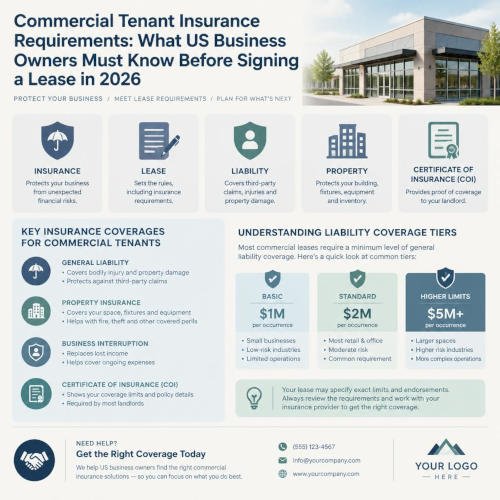
Insurance News USA: Read everything about the Commercial Tenant Insurance Requirements on this portal. Business owners, have a look at this helpful article.
Renting commercial property in the United States involves more than paying monthly rent and signing a lease agreement. Business owners must also understand commercial tenant insurance requirements, which determine how they protect their operations, employees, customers, and business property against unexpected financial losses.
Whether someone is opening a retail store, renting an office, operating a restaurant or leasing warehouse space, insurance requirements can become an important part of the commercial leasing process.
In 2026, commercial landlords continue to request proof of insurance before allowing tenants to occupy leased premises. Many commercial leases require general liability coverage, specific insurance limits and additional insured endorsements. Depending on the business and property, landlords may also request commercial property insurance, workers’ compensation, umbrella liability and business interruption coverage.
Understanding this difference can help business owners avoid unexpected insurance expenses, lease violations and potentially expensive legal disputes.
This guide explains the major commercial tenant insurance requirements in the USA, common coverage limits, insurance costs and the steps businesses should take before signing a commercial lease.
What Is Commercial Tenant Insurance?
Commercial tenant insurance refers to the business insurance coverage a company maintains while renting a commercial property.
It protects against financial risks associated with operating from a leased location. Depending on the selected policies, protection may include customer injuries, accidental property damage, stolen equipment, damaged inventory, employee workplace injuries and income losses following certain covered events.
Commercial general liability insurance is one of the most frequently requested policies in US commercial lease agreements.
It generally protects businesses against covered third-party claims involving:
- Bodily injuries suffered by customers, visitors or other third parties.
- Accidental damage to another person’s property.
- Certain personal and advertising injury claims.
- Covered legal defence costs and settlements.
For example, a customer visiting a restaurant could slip on a recently cleaned floor. If the customer files a lawsuit, the restaurant’s general liability policy may help cover eligible legal expenses and damages.
How much general liability insurance do commercial tenants need?
A common commercial lease requirement is:
| Coverage | Commonly requested limit |
|---|---|
| Per occurrence | $1 million |
| General aggregate | $2 million |
| Personal and advertising injury | $1 million |
| Products and completed operations aggregate | $2 million |
These figures are common market benchmarks, not universal legal requirements. Some landlords request higher limits, particularly for restaurants, shopping centres, warehouses and businesses with substantial customer traffic.
A landlord may also request an umbrella liability policy to increase the available protection beyond the primary general liability limits.
Business owners should check the exact insurance limits in their lease before purchasing a policy.
2. Commercial Property Insurance for Business Tenants
Commercial property insurance protects the physical assets a business owns or is responsible for insuring.
Many tenants mistakenly believe their landlord’s commercial building insurance automatically covers everything inside the rented premises. This assumption can create serious financial problems after a fire, burglary or other covered loss.
Generally, a landlord’s insurance protects the building and the property interests assigned to the landlord. The tenant may need separate coverage for:
- Office furniture and computers.
- Retail inventory and merchandise.
- Manufacturing equipment and machinery.
- Business tools and supplies.
- Point-of-sale systems.
- Certain fixtures and tenant improvements.
- Business-owned equipment stored at the location.
The National Association of Insurance Commissioners (NAIC) advises businesses leasing commercial premises not to rely on the landlord’s policy to protect their equipment and business property.
Coverage limits should reflect the actual replacement value of the assets rather than outdated purchase prices.
For example, a retail business with $80,000 in inventory and $35,000 in equipment should evaluate whether its commercial property insurance provides sufficient protection for those assets.
Businesses should also review exclusions involving floods, earthquakes, windstorms and other location-specific risks.
3. Workers’ Compensation Insurance Requirements
Workers’ compensation insurance is another important consideration for commercial tenants employing staff.
Unlike general liability insurance, workers’ compensation requirements are primarily established through state laws rather than individual landlord preferences.
The coverage generally provides benefits for eligible employees who experience work-related injuries or occupational illnesses. Depending on the applicable state system, benefits may include medical treatment, wage replacement and rehabilitation.
For example, if an employee working in a warehouse suffers an injury while performing job duties, workers’ compensation may help cover eligible medical expenses and lost wages.
Are all US businesses required to carry workers’ compensation insurance?
The answer depends on the state, workforce size, business structure and applicable exemptions.
Some states require coverage when a business hires its first employee, while others apply different employee thresholds or industry-specific rules.
The US Department of Labor directs private-sector employers to their respective state workers’ compensation agencies because these programs operate primarily at the state level.
Business owners should check the applicable state rules before hiring employees or opening a commercial location.
4. Business Interruption Insurance: Protecting Income During Unexpected Closures
Business interruption insurance, also called business income insurance, can help businesses manage financial losses when a covered property incident interrupts normal operations.
Imagine a restaurant experiences a major fire that damages its kitchen and forces it to close temporarily.
Even if the landlord arranges repairs to the building, the restaurant may continue facing financial obligations, including:
- Employee payroll.
- Rent payments, depending on the lease.
- Utility and service expenses.
- Loan payments.
- Other continuing operating costs.
Business income coverage may help replace covered lost income and eligible continuing expenses during the restoration period.
However, coverage depends on the policy wording, covered cause of loss, waiting period, limits and exclusions.
This is particularly important for tenants whose commercial lease does not automatically suspend rent following property damage.
The National Association of Insurance Commissioners recommends that businesses evaluate interruption coverage based on their operations and the time they might need to recover after a disruption.
5. Additional Insured Requirements
Commercial landlords frequently require tenants to name them as additional insureds on the tenant’s general liability policy.
This arrangement provides the landlord with certain liability protection under the tenant’s policy for claims connected to the tenant’s covered operations or occupancy, subject to the endorsement’s wording.
For example, if a customer suffers an injury inside a rented store and brings a claim involving both the tenant and landlord, an applicable additional insured endorsement may provide protection to the landlord.
However, additional insured status does not make the landlord the owner of the tenant’s policy or provide unlimited protection against every lawsuit.
There is also an important difference between two insurance terms:
Additional insured: A party receives certain coverage rights under another party’s insurance policy.
Certificate holder: A party receives documentation showing that an insurance policy exists. Certificate-holder status alone does not provide insurance coverage.
Tenants should confirm that their insurance company has issued the required additional insured endorsement rather than assuming that listing the landlord on a certificate provides coverage.
6. Certificate of Insurance (COI)
A Certificate of Insurance (COI) is an important document in commercial property leasing.
Landlords and property managers commonly request a COI before handing over the keys or allowing a tenant to begin business operations.
The certificate generally provides information about:
- The insured business’s name.
- The insurance company’s details.
- Policy numbers and effective dates.
- Types of insurance coverage.
- Liability limits.
- Certificate holder information.
Landlords may also request supporting endorsements showing additional insured status, waiver of subrogation and other contractual insurance requirements.
One important detail: A certificate of insurance does not change the actual terms of an insurance policy.
If a landlord requests coverage that the tenant’s policy does not provide, the tenant must contact the insurance company or agent to arrange the appropriate endorsement or policy change.
Providing an updated COI before the existing policy expires can also help prevent lease compliance problems.
Umbrella Liability Insurance and Other Special Coverage
Some commercial landlords require more liability protection than a standard general liability policy provides.
An umbrella liability policy can increase the available limits above certain underlying insurance policies.
For example, a business carrying $1 million in general liability coverage might purchase an additional umbrella policy to provide another $2 million in eligible coverage.
Depending on the business, landlords may also request:
- Professional liability insurance: Important for consultants, accountants, architects and other professional service providers facing claims involving alleged errors or negligence.
- Cyber liability insurance: Useful for businesses handling customer information, payment details and sensitive digital records.
- Liquor liability insurance: Relevant to bars, restaurants and other businesses serving alcoholic beverages.
- Commercial auto insurance: Important for businesses using vehicles for deliveries, transportation or other commercial activities.
- Equipment breakdown insurance: Can help protect against certain mechanical or electrical equipment failures.
Not every commercial tenant needs every policy. The business’s activities, lease obligations and potential financial exposure determine the appropriate coverage.
How Much Does Commercial Tenant Insurance Cost in the USA?
The cost of commercial tenant insurance varies considerably across the United States.
There is no single national price because insurance companies evaluate multiple factors before calculating premiums.
These include:
- Business industry and operations.
- Commercial property location.
- Annual revenue.
- Number of employees.
- Building characteristics.
- Inventory and equipment values.
- Previous insurance claims.
- Selected coverage limits.
- Deductibles and policy endorsements.
For example, a small consulting office may have different insurance costs from a restaurant with cooking equipment, customer seating and substantial daily foot traffic.
Businesses should compare commercial insurance quotes from multiple licensed insurers or independent insurance agents.
A Business Owners Policy (BOP) can also be worth considering.
A BOP typically combines general liability and commercial property coverage into one insurance package. Depending on the insurer and policy, additional coverage options may also be available.
The US Small Business Administration identifies general liability, commercial property and business owners policies among the common insurance options businesses should evaluate.
However, business owners should compare policy exclusions, deductibles and limits instead of selecting coverage based only on the lowest premium.
What Happens If a Commercial Tenant Does Not Maintain Required Insurance?
Failing to maintain insurance required by a commercial lease can create significant problems.
Depending on the contract, a landlord may have the right to:
- Issue a notice of insurance noncompliance.
- Require the tenant to provide updated proof of coverage.
- Obtain insurance at the tenant’s expense if the lease permits it.
- Treat the failure as a lease default.
- Pursue available contractual remedies, potentially including lease termination.
The exact consequences depend on the lease language and applicable state law.
An insurance lapse can also leave the business financially exposed if a customer injury, property damage incident or other covered-risk event occurs during the uninsured period.
Business owners should set renewal reminders, maintain automatic premium payments where appropriate and request updated certificates before policy expiration.
Commercial Tenant Insurance Checklist Before Signing a Lease
Before signing a commercial lease in the United States, business owners should review the insurance section carefully.
The following checklist can help identify important requirements.
| Insurance requirement | What tenants should check |
|---|---|
| General liability | Required limits and covered operations |
| Commercial property | Responsibility for equipment and inventory |
| Workers’ compensation | Applicable state employment requirements |
| Business interruption | Lost income and continuing expenses |
| Additional insured | Landlord and property manager endorsements |
| Umbrella liability | Whether extra liability limits are required |
| Waiver of subrogation | Whether the lease requires an endorsement |
| Primary and noncontributory | Required insurance priority wording |
| Certificate of insurance | Submission deadline and renewal process |
| Tenant improvements | Who insures fixtures, flooring and renovations |
Tenants should also examine indemnification clauses, insurance deductibles, and responsibility for damage to the leased premises.
An insurance agent can review the proposed requirements and identify coverage gaps. A commercial real estate attorney can help evaluate contractual obligations before the tenant signs.
Frequently Asked Questions (FAQs)
1. Is commercial tenant insurance legally required in the USA?
There is no single federal law requiring every commercial tenant to purchase the same insurance package. However, landlords commonly make general liability and other coverage mandatory through commercial lease agreements. Certain separate insurance obligations, including workers’ compensation, depend on applicable state laws.
2. What is the minimum liability insurance for a commercial lease?
Many commercial leases request $1 million per occurrence and $2 million in general aggregate coverage. However, these are common contractual benchmarks, not nationwide legal minimums. Your actual requirements depend on your lease and landlord.
3. Does landlord insurance cover commercial tenants?
Generally, landlord insurance protects the building and the landlord’s insured property interests. It does not automatically cover the tenant’s inventory, equipment, furniture, business income or liability claims.
4. Can a landlord require a tenant to have $2 million in liability insurance?
Yes. A landlord can generally negotiate specific insurance limits as part of a commercial lease, subject to applicable law. Tenants should review these requirements before signing and discuss any concerns during negotiations.
5. What is a certificate of insurance for commercial tenants?
A Certificate of Insurance is a document summarising a business’s insurance coverage. Landlords commonly request it as proof that tenants maintain the policies and limits specified in their lease.
6. Does a small business need a Business Owners Policy?
A Business Owners Policy can be a practical option for eligible small businesses because it generally combines commercial property and general liability coverage. However, businesses should check whether the policy meets every requirement in their commercial lease.
7. When should tenants purchase commercial insurance?
Ideally, tenants should arrange the required insurance before taking possession of the premises. Many commercial leases require proof of coverage before the business can begin operating.
Conclusion
Commercial tenant insurance requirements are an important part of operating a business in the United States.
Whether someone rents an office, restaurant, retail store or warehouse, understanding insurance responsibilities can help prevent unexpected expenses and contractual problems.
General liability insurance, commercial property coverage, workers’ compensation and business interruption protection can each address different financial risks.
However, the most important step is reviewing the commercial lease before signing it.
Business owners should confirm required coverage limits, additional insured endorsements, certificate deadlines and responsibility for tenant improvements. They should also compare insurance quotes and verify state-specific requirements.
The bottom line: Having the right commercial tenant insurance is not simply about satisfying a landlord. It is about protecting business assets, employees, customers and long-term financial stability.
Reference Links
These resources can help readers verify insurance requirements and understand their responsibilities:
- Small Business Administration – Business Insurance Guide
- US Department of Labor – State Workers’ Compensation Officials
- National Association of Insurance Commissioners – Small Business Insurance
- US Department of Labor – Workers’ Compensation Information
- Commercial Lease Insurance Requirements – 2026 Guide
Editorial note: This is a general US business guide, not legal or insurance advice. Insurance obligations, exclusions, and workers’ compensation rules vary by state, policy and commercial lease.
