

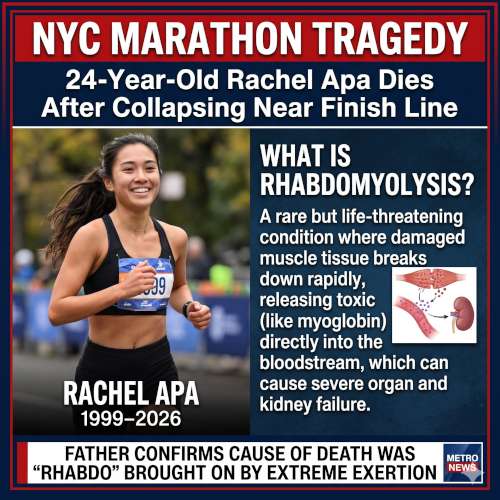
The death of a 24-year-old woman following the 2026 TCS New York City Marathon has raised serious questions about a rare but potentially life-threatening medical condition known as rhabdomyolysis. The condition, which involves the rapid breakdown of muscle tissue, can cause severe kidney damage, dangerous heart complications and, in extreme cases, death.
Rachel Apa, a Pennsylvania resident and former college field hockey player, died after experiencing a medical emergency during Sunday’s marathon on November 1, 2026. She was participating in her first New York City Marathon and had reportedly trained extensively before the event.
According to her father, Steve Apa, his daughter died from rhabdomyolysis, a condition that can develop following extreme physical exertion. However, the New York City medical examiner’s investigation had not officially established her cause of death as of November 3.
The heartbreaking incident has highlighted an important health warning for marathon runners, professional athletes and everyday fitness enthusiasts: being young, physically active and apparently healthy does not eliminate the risk of serious exercise-related medical emergencies.
Rachel Apa Dies Following Medical Emergency During NYC Marathon
Rachel Apa collapsed near mile 24 of the 2026 New York City Marathon, approximately two miles before the finish line in Central Park.
According to reports, spectators and medical personnel provided emergency assistance after she collapsed. A bystander reportedly began CPR before race medical staff took over and arranged for her transportation to a nearby hospital.
She was subsequently taken by ambulance to Mount Sinai Medical Center, where doctors attempted to save her life. She later died that evening.
The New York Road Runners (NYRR), the organization responsible for the marathon, confirmed her death in a statement Tuesday.
“We are deeply saddened by Rachel’s passing following running in Sunday’s race,” the organization said, expressing sympathy for her family, friends and the wider running community.
Apa’s death shocked people who knew her because she had reportedly been in excellent physical condition.
Her father told The New York Times that his daughter died from rhabdomyolysis. He described the loss as unfathomable, particularly because she was just 24 years old and appeared to be in excellent health.
The medical examiner’s office was still investigating the circumstances surrounding her death, meaning the family’s account should not be confused with an officially confirmed medical finding.
What Is Rhabdomyolysis and Why Can It Become Life-Threatening?
Rhabdomyolysis, commonly called rhabdo, is a serious medical condition that develops when skeletal muscle tissue becomes damaged and breaks down.
When muscle cells are injured, they release substances that normally remain inside the cells into the bloodstream. These include myoglobin, creatine kinase, potassium and other electrolytes.
The release of these substances can overwhelm the body’s normal filtering processes and damage important organs.
The kidneys are particularly vulnerable because they help remove waste products from the blood. When large amounts of muscle proteins enter the bloodstream, they can contribute to kidney injury and, in severe cases, acute kidney failure.
Rhabdomyolysis can also cause dangerous changes in potassium levels. Excess potassium in the bloodstream can interfere with the electrical signals controlling the heart, potentially triggering life-threatening irregular heart rhythms.
According to the Centers for Disease Control and Prevention (
