

NASA’s Voyager 1 Goes Silent for Two Days, Triggering Fresh Alarm 16 Billion Miles From Earth
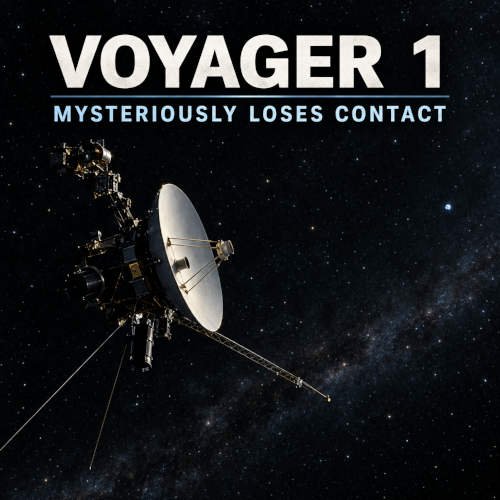
NASA’s most distant spacecraft has given mission controllers another worrying reminder of how difficult it is to operate a nearly 50-year-old machine millions of miles beyond the reach of ordinary engineering support. Voyager 1 unexpectedly stopped communicating with Earth for approximately 48 hours in October, prompting concern among the team responsible for keeping the historic mission alive.
The spacecraft missed two scheduled communication sessions on October 18 and 19, 2026. NASA’s Deep Space Network detected no signal during either attempt. Then, on October 20, Voyager 1’s signal returned without engineers first sending commands to resolve the problem.
Although communication has remained stable since the incident, NASA engineers are still investigating what caused the interruption. The team has identified an unexpected change involving the spacecraft’s thrusters, but has not confirmed that this event directly caused the communication outage.
The incident comes as NASA works to conserve Voyager 1’s limited electrical power and prepare it for an extraordinary milestone: traveling so far from Earth that radio communication takes approximately one full day in each direction.
What Happened When Voyager 1 Suddenly Went Silent?
According to NASA’s October 29 update, the Deep Space Network failed to detect Voyager 1 during two scheduled communication attempts on October 18 and 19. The spacecraft was approximately 16 billion miles, or 24 billion kilometers, from Earth.
The missed check-ins immediately attracted attention because Voyager 1 operates in an extremely distant environment. Unlike a spacecraft orbiting Earth, it cannot be reached quickly by engineers, and every command must travel across an enormous distance before the spacecraft can receive it.
The good news arrived on October 20, when the spacecraft’s radio signal reappeared. NASA’s mission team regained contact before sending troubleshooting commands, and communication has continued since then, according to the agency.
The cause remains under investigation. NASA has not announced that the spacecraft suffered a permanent failure, nor has it confirmed that the communication interruption resulted from a specific hardware defect.
For a mission that began in 1977, even a short communication interruption can create significant concern. Voyager 1 depends on aging onboard systems that have operated far beyond their original planetary exploration mission.
Why Did Voyager 1’s Thrusters Switch to Backup Systems?
One of the most important discoveries during NASA’s investigation involved the spacecraft’s thrusters.
Engineers found that one group of thrusters had gone offline while a backup group took over. These small propulsion units do not exist to accelerate Voyager 1 like a rocket engine. Instead, they help control the spacecraft’s orientation and keep its antenna pointed toward Earth.
Maintaining the correct position is essential. Voyager 1 communicates through a high-gain antenna that must remain accurately directed toward our planet. If the spacecraft cannot maintain the correct orientation, its ability to exchange information with mission controllers could be affected.
NASA designed Voyager’s onboard computers with automatic fault-protection systems. When the spacecraft detects a problem with an active system, its computers can switch to backup equipment and place the spacecraft into a safer operating configuration.
This automatic response is intended to protect the mission when engineers cannot immediately intervene.
However, NASA has not established exactly why the thruster group switched off or whether that change triggered the two-day communication interruption. The engineering team continues to examine the available information.
Kareem Badaruddin, Voyager mission manager at NASA’s Jet Propulsion Laboratory, described the incident as something the team had not previously seen in this form. He also emphasized that engineers must expect unexpected behavior as the mission continues to age.
How NASA’s Deep Space Network Communicates With Voyager 1
The Deep Space Network, commonly called the DSN, is one of NASA’s most important communication systems. It uses large radio antennas at facilities around the world to communicate with spacecraft operating far beyond Earth.
The network has major antenna complexes in California, Spain and Australia. Their geographic separation allows NASA to maintain contact with spacecraft as Earth rotates.
Voyager 1 sends scientific information and engineering data through radio signals. Mission controllers use the same network to transmit commands, monitor spacecraft health and receive updates.
But communicating with Voyager 1 is no ordinary exchange. Radio signals travel at the speed of light, yet the spacecraft is so distant that a message takes almost a full day to reach it as it approaches the one-light-day milestone.
That delay makes troubleshooting difficult. Engineers cannot send a command and expect an immediate response. They must account for the time needed for a signal to travel to the spacecraft and for its response to return.
The October incident demonstrated why NASA needs reliable backup systems and careful planning. Even when a spacecraft is functioning normally, the distance creates a major challenge for mission operations.
Voyager 1’s Shrinking Power Supply Creates Another Challenge
Communication is only one part of Voyager 1’s struggle to remain operational. The spacecraft also faces a long-term power shortage.
Voyager 1 does not use solar panels. It relies on a radioisotope thermoelectric generator, or RTG, which converts heat produced by the natural radioactive decay of plutonium into electricity.
This technology allowed the spacecraft to operate far from the Sun, where sunlight is too weak to provide dependable power through conventional solar panels.
However, the generator gradually produces less electricity as its radioactive fuel decays. NASA says the spacecraft loses approximately four watts of electrical power each year.
That decline forces engineers to make difficult decisions about which systems and scientific instruments can continue operating.
NASA has already switched off several instruments and other equipment to preserve electricity. The objective is to keep the spacecraft functioning for as long as possible while protecting the scientific capabilities that remain.
The power challenge is especially important because some spacecraft systems also generate heat. Turning off equipment requires engineers to consider not only electricity consumption but also the temperatures needed to keep sensitive components operating.
NASA’s “Big Bang” Power-Saving Plan
In September 2026, NASA engineers completed another major effort to extend Voyager 1’s operating life. The project, nicknamed the “Big Bang,” involved switching off three devices and replacing them with three lower-power alternatives.
The objective was to reduce electrical consumption without immediately sacrificing another major scientific instrument.
NASA had previously carried out the same type of power-saving operation on Voyager 2. The team completed the Voyager 1 operation in early September, approximately six weeks after the corresponding work on its twin spacecraft.
The operation required careful coordination. Some of the equipment involved helps keep the spacecraft warm enough to function in the extremely cold environment of interstellar space.
Engineers therefore had to manage the changes together to distribute heat appropriately and avoid exposing critical systems to dangerous temperature conditions.
NASA said the power-saving work could delay the need to turn off another Voyager 1 instrument until as early as summer 2027.
This does not mean the spacecraft has unlimited power again. Instead, the operation gives the mission team additional time to continue collecting scientific information while managing its declining electrical supply.
Voyager 1 Is Approaching a Historic One-Light-Day Milestone
Despite its age and recent communication problem, Voyager 1 continues moving farther from Earth at approximately 38,000 miles per hour.
NASA expects the spacecraft to reach a distance of one light-day on November 18, 2026. At that point, it will be approximately 16.09 billion miles, or 25.9 billion kilometers, from Earth.
A light-day is a measurement of distance, not time. It describes how far light travels in 24 hours.
Because radio signals travel at the speed of light, the milestone has a practical consequence for mission controllers. A signal sent from Earth will take approximately 24 hours to reach Voyager 1. A response will require another 24 hours to return.
In simple terms, sending a command and receiving a reply could take about two days.
NASA explains that the milestone will not cause a physical change to the spacecraft. Voyager 1 will not suddenly enter a new region or experience a special event when it crosses the distance threshold.
Its importance is symbolic and scientific. No other human-made object has traveled this far from Earth, making the achievement a remarkable demonstration of engineering endurance.
From a 1977 Launch to Interstellar Space
Voyager 1 launched on September 5, 1977, as part of NASA’s ambitious mission to explore the outer planets.
The spacecraft conducted close encounters with Jupiter and Saturn, returning valuable information about planetary atmospheres, moons, magnetic fields and rings.
Its discoveries helped scientists develop a better understanding of the outer solar system. Voyager 2 followed a different route and became the only spacecraft to visit Uranus and Neptune up close.
Voyager 1 reached interstellar space in August 2012 after crossing the heliopause, the boundary where the Sun’s protective bubble of particles and magnetic fields meets the surrounding interstellar environment.
Its twin, Voyager 2, crossed that boundary in November 2018.
The two spacecraft remain the only human-made probes to have directly explored this region beyond the heliosphere.
Their continued operation gives scientists an opportunity to study conditions outside the Sun’s protective influence. The information is valuable because spacecraft measurements provide direct observations of a region that cannot be examined in the same way using instruments near Earth.
What Happens Next for NASA’s Voyager 1 Mission?
NASA has not announced a final end date for Voyager 1. The mission team continues monitoring its condition, investigating the October communication interruption and managing the spacecraft’s remaining power.
The return of the signal is encouraging, but it does not mean the underlying issue has been fully explained. Engineers still need to understand the thruster behavior and determine whether additional precautions are necessary.
The spacecraft’s declining power supply will remain one of the biggest challenges. More equipment may need to be switched off in the coming years, and NASA will have to balance energy conservation against the scientific value of each remaining instrument.
For now, Voyager 1 continues its journey through interstellar space. Its November 18 milestone will mark another extraordinary achievement for a spacecraft launched nearly five decades ago.
The October silence was a reminder that the mission is operating at the limits of engineering endurance. Yet Voyager 1 is still communicating, still traveling and still helping humanity explore a region of space no other spacecraft has directly studied.
Frequently Asked Questions
1. Why did NASA lose contact with Voyager 1?
NASA has not confirmed the exact cause. The spacecraft missed two scheduled communication sessions on October 18 and 19, 2026, before its signal returned on October 20.
2. Is Voyager 1 communicating with Earth again?
Yes. NASA reported that communication was restored on October 20 and remained stable in its October 29 update.
3. What happened to Voyager 1’s thrusters?
One group of thrusters went offline and backup thrusters activated automatically. Engineers are investigating the event.
4. How far away is Voyager 1?
NASA reported that Voyager 1 was approximately 16 billion miles from Earth during the October communication interruption.
5. When will Voyager 1 reach one light-day from Earth?
NASA expects Voyager 1 to reach the one-light-day distance milestone on November 18, 2026.
6. How does Voyager 1 get electricity?
It uses a radioisotope thermoelectric generator that converts heat from radioactive plutonium decay into electrical power.
7. Is Voyager 1 still exploring interstellar space?
Yes. Voyager 1 entered interstellar space in August 2012 and continues its extended mission beyond the heliosphere.
Sources and References
- NASA Jet Propulsion Laboratory — NASA’s Voyager 1 Conserves Power, Resolves Brief Communications Pause
- NASA Science — Where Are Voyager 1 and 2 Now?
- NASA Science — Voyager 1: What Is a Light-Day?
- NASA Jet Propulsion Laboratory — NASA Shuts Off Instrument on Voyager 1 to Keep Spacecraft Operating
- NASA — Voyager Mission
Editorial note: NASA’s October 29 update confirms the two-day communication interruption and the thruster switch, but it does not establish that the thruster event caused the signal loss. The article keeps that distinction clear rather than presenting an unconfirmed explanation as fact. NASA Jet Propulsion Laboratory
