
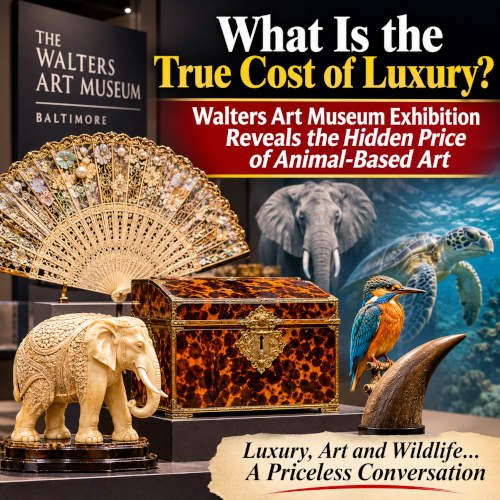
USA Business news : Luxury has always been associated with beauty, rarity, craftsmanship, and wealth. For centuries, wealthy collectors and powerful families have purchased extraordinary objects decorated with precious materials, including elephant ivory, rhinoceros horn, tortoiseshell, and brightly colored bird feathers. However, behind the beauty of these historical treasures lies a troubling story about wildlife exploitation and environmental destruction.
A new exhibition at the Walters Art Museum in Baltimore, Maryland, aims to bring that hidden history into the spotlight. Titled “Luxury & Loss: Feather, Shell, Tusk, Horn,” the exhibition opens on November 7, 2026, and examines how the demand for beautiful animal-based materials contributed to declining wildlife populations.
Curated by Dany Chan, Associate Curator of Asian Art at the Walters, the exhibition explores the complicated relationship between artistic achievement, consumer demand, and the natural world. It encourages visitors to consider an important question: What is the real cost of luxury when the materials used to create beautiful objects threaten the animals they come from?
Walters Art Museum’s Luxury & Loss Exhibition Opens November 7
The Walters Art Museum’s new exhibition brings together historical artworks made using materials obtained from four animal groups: kingfishers, marine turtles, elephants, and rhinoceroses.
For generations, these materials attracted artists, wealthy consumers, and royal households because of their unusual appearance and limited availability. Their distinctive textures, colors, and durability made them valuable for decorative objects, jewelry, furniture, accessories, and other luxury products.
According to the museum, the exhibition examines how these materials became symbols of wealth and status while exploring the environmental consequences of their widespread use.
The exhibition includes objects from the Walters’ collections of Asian, European, American, and African art. It also highlights how society’s understanding of wildlife protection has changed over time.
The exhibition will remain open through January 24, 2027, giving visitors several weeks to explore the historical relationship between luxury goods and wildlife conservation.
The museum’s announcement identifies Dany Chan as the exhibition’s curator. Her approach focuses on presenting the objects within their historical and environmental contexts rather than simply celebrating their artistic beauty.
Four Animal Materials Behind Centuries of Luxury
The exhibition concentrates on four materials that played important roles in historical decorative arts. Each material tells a different story about human creativity, consumer demand, and the pressure placed on wildlife.
1. Kingfisher Feathers: The Beauty Behind Traditional Chinese Featherwork
Kingfisher feathers are famous for their striking blue and turquoise appearance. Their natural iridescence made them particularly attractive to traditional Chinese artisans.
For more than 2,500 years, Chinese craftspeople used kingfisher feathers to decorate jewelry, hair ornaments, clothing accessories, and decorative screens.
These objects were especially associated with wealthy and high-ranking women. Their brilliant colors created an appearance that was difficult to reproduce using ordinary materials.
However, producing these decorative items required harvesting birds from the wild. According to the Walters Art Museum, a single ornament could require feathers from dozens of kingfishers.
As demand continued, intensive hunting placed pressure on wild populations across Southeast Asia. Some kingfisher species became particularly vulnerable, while certain populations experienced severe declines.
The exhibition includes historical hair ornaments that demonstrate the extraordinary craftsmanship associated with this tradition.
It also raises an important question about traditional luxury: Can an object still be celebrated without acknowledging the environmental damage associated with its production?
2. Tortoiseshell: A Beautiful Material With a Dangerous History
Tortoiseshell was another highly desirable material used in luxury manufacturing.
Despite its name, commercial tortoiseshell traditionally came from the protective shell plates of marine turtles, particularly the hawksbill sea turtle.
Its attractive patterns, warm colors, transparency, and polished appearance made it popular among European and Asian artisans.
For centuries, manufacturers used tortoiseshell to create jewelry, combs, furniture decorations, household accessories, musical instruments, and decorative boxes.
The Walters exhibition features several historical examples, including ornamental Chinese hair combs, a German writing case, and a cabinet decorated with tortoiseshell inlaid into brass.
These objects demonstrate how artisans transformed natural materials into sophisticated decorative products.
However, the popularity of tortoiseshell came at a serious environmental cost. Commercial harvesting contributed to the dramatic decline of hawksbill sea turtle populations.
The international trade in hawksbill sea turtles was brought under strict CITES protection in 1977, when the species was listed in Appendix I. This listing prohibits international commercial trade in specimens covered by the convention, subject to its rules and exceptions.
The history of tortoiseshell demonstrates how a material once considered a sign of elegance became associated with the exploitation of an endangered marine species.
3. Elephant Ivory: Wealth, Art, and the Global Wildlife Trade
Elephant ivory is perhaps the most recognizable material featured in the exhibition.
Its smooth texture, creamy color, and ability to be carved into intricate shapes made it highly valuable to artists and wealthy collectors.
For centuries, ivory appeared in sculptures, religious objects, decorative furniture, jewelry, household accessories, and elaborate personal items.
The Walters Art Museum exhibition includes approximately 50 ivory works, making this material a significant part of the display.
Among the highlighted objects are a decorative bust of a Florentine woman by French artist Augustin Jean Moreau-Vauthier, a delicate Chinese brisé fan, and a Japanese articulated sculpture of a lobster.
These objects reveal the exceptional technical skill required to transform elephant tusks into detailed works of art.
But the popularity of ivory also helped drive large-scale elephant hunting.
According to the Walters Art Museum, global demand for ivory grew substantially over centuries, with the trade reaching its height between the 15th and 19th centuries. This demand contributed to serious declines in African and Asian elephant populations.
International efforts to control the trade eventually became stronger.
In 1989, the Convention on International Trade in Endangered Species of Wild Fauna and Flora (CITES) introduced restrictions that effectively prohibited international commercial ivory trade for most elephant populations, subject to specific population annotations and exceptions.
The United States also introduced additional restrictions through federal wildlife laws.
Today, ivory remains a sensitive conservation issue. Some older ivory objects can be legally possessed under particular circumstances, but buying, selling, importing, or exporting them may be subject to strict federal and international rules.
The exhibition encourages visitors to recognize both the artistic significance of historical ivory objects and the wildlife losses connected to the material’s popularity.
4. Rhinoceros Horn: A Luxury Material Linked to Wildlife Exploitation
Rhinoceros horn completes the exhibition’s four-material focus.
Historically, rhinoceros horn attracted consumers because of its unusual appearance, translucency, and distinctive patterns.
Artisans carved it into cups, goblets, and decorative accessories. In some historical traditions, people also believed that rhinoceros horn could detect poison or provide medicinal benefits.
These beliefs contributed to its commercial value, although such historical claims should not be confused with scientifically established medical benefits.
As demand increased, rhinoceroses faced additional pressure from hunting and illegal wildlife trade.
Today, rhinoceros species remain threatened by habitat loss, poaching, and international trafficking. Conservation organizations continue to work with governments and local communities to protect remaining populations.
By including rhinoceros horn alongside ivory, tortoiseshell, and kingfisher feathers, the Walters exhibition demonstrates that the pursuit of luxury has affected wildlife across different habitats and continents.
Why These Luxury Materials Became Symbols of Wealth
The popularity of animal-based materials was not accidental. Their scarcity made them attractive to wealthy consumers, while the difficulty of collecting and processing them increased their perceived value.
In earlier centuries, access to rare materials often depended on international trade networks, specialized craftspeople, and wealthy patrons.
An object decorated with kingfisher feathers or carved from ivory could communicate social position, financial resources, and cultural sophistication.
Luxury was therefore about more than appearance. It also represented access to resources that ordinary consumers could not easily obtain.
However, this system created a problem. As more people sought rare animal materials, harvesting increased, putting additional pressure on wildlife populations.
The same qualities that made these materials desirable also made them difficult to replace in traditional manufacturing.
The Walters exhibition explores this historical contradiction: Human creativity produced remarkable works of art, but the demand for their materials sometimes came at the expense of nature.
How Wildlife Protection Changed the Luxury Industry
Growing awareness of wildlife decline eventually encouraged governments and international organizations to introduce stronger protections.
One important development was the Convention on International Trade in Endangered Species of Wild Fauna and Flora, commonly known as CITES.
The agreement regulates international trade in wild animals and plants to ensure that commercial activity does not threaten their survival.
Different species receive different levels of protection depending on their conservation status and applicable international rules.
Elephants, hawksbill turtles, and rhinoceroses are among the animals covered by significant international trade controls.
These protections changed the way luxury manufacturers and collectors could obtain certain materials.
The historical use of ivory, tortoiseshell, and rhinoceros horn became increasingly restricted, while conservation awareness encouraged the development of alternative materials.
However, legal protections have not eliminated every problem. Illegal wildlife trafficking, demand for traditional products, and difficulties enforcing regulations continue to challenge conservation efforts.
The Walters exhibition provides an opportunity to understand how consumer preferences can influence the survival of wildlife.
What Visitors Can Learn From Luxury & Loss
The exhibition is not simply a display of historical decorative objects. It also encourages visitors to examine their relationship with nature and the products they value.
By presenting these objects in their historical context, the museum connects art history with modern environmental concerns.
Visitors can see how natural materials influenced artistic traditions across different cultures. At the same time, they can consider the consequences of extracting those materials on a large scale.
The exhibition also raises questions about the responsibilities of museums.
Historical objects are important cultural records. Removing them from public collections or ignoring their history would not necessarily help conservation. Instead, museums can use their collections to explain how societies once viewed nature and how those attitudes have changed.
The exhibition’s broader message is that appreciating historical craftsmanship does not require ignoring the harm associated with the materials.
Contemporary Artists Offer New Perspectives on Sustainable Luxury
The exhibition also connects historical traditions with contemporary artistic responses.
According to the Walters Art Museum, the display explores changing relationships between humans and nature, including the growing awareness of environmental consequences.
Contemporary artists can challenge traditional ideas of luxury by experimenting with alternative, repurposed, or ethically sourced materials.
This approach demonstrates that artistic creativity does not have to depend on continued exploitation of endangered wildlife.
It also reflects a broader change in consumer expectations. Modern discussions about sustainable fashion, responsible manufacturing, and ethical sourcing increasingly consider where materials originate and how they affect the environment.
The exhibition invites visitors to think about whether beauty and craftsmanship can be maintained without placing vulnerable species at risk.
When and Where to Visit the Walters Art Museum Exhibition
People interested in art history, wildlife conservation, and historical luxury goods can visit the exhibition at the Walters Art Museum in Baltimore.
Important visitor information includes:
- Exhibition: Luxury & Loss: Feather, Shell, Tusk, Horn
- Opening date: November 7, 2026
- Closing date: January 24, 2027
- Location: Centre Street Building, First Floor
- Museum: Walters Art Museum
- Curator: Dany Chan, Associate Curator of Asian Art
- City: Baltimore, Maryland
The museum is also hosting opening-day artist talks on November 7, from 3 p.m. to 4 p.m. The program features Baltimore-based artists Amy Boone-McCreesh and Luci Jockel, with Dany Chan moderating the discussion.
The event is listed as free by the museum.
Visitors should consult the museum’s official website for current opening hours, visitor information, and event details.
The Real Price of Luxury Goes Beyond Money
The Walters Art Museum’s “Luxury & Loss” exhibition offers an important reminder that the value of an object cannot always be measured by its price, rarity, or artistic quality.
Kingfisher feathers, tortoiseshell, elephant ivory, and rhinoceros horn helped create extraordinary works of art. Yet the demand for these materials also contributed to the decline of vulnerable wildlife populations.
The exhibition does not ask visitors to reject art or forget historical craftsmanship. Instead, it encourages a more complete understanding of the objects people admire.
As modern consumers become increasingly aware of sustainability and ethical sourcing, the lessons behind these historical materials remain relevant.
Ultimately, the true cost of luxury may be measured not only in money but also in the environmental damage and wildlife losses left behind.
The question raised by the Walters exhibition is worth considering long after visitors leave the museum: Is something truly luxurious if its beauty comes at the expense of nature?