
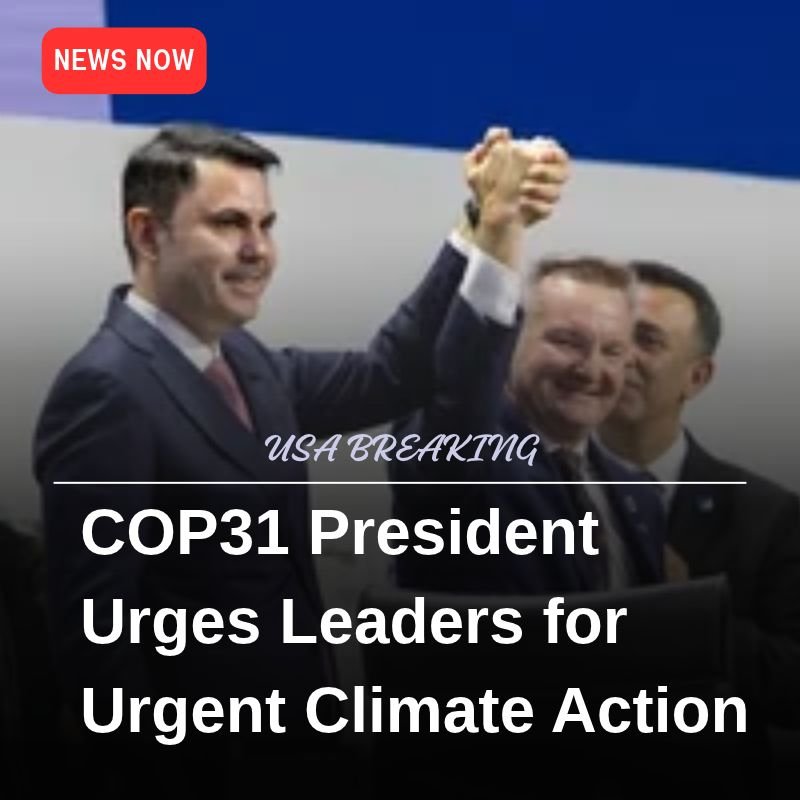
COP31 President Murat Kurum has challenged world leaders to move beyond climate promises and deliver practical solutions as the United Nations Climate Change Conference opens in Antalya, Türkiye. His message is direct: countries must turn their environmental commitments into measurable progress that improves people’s lives.
Speaking at the opening of COP31 on November 9, 2026, Kurum described the summit as an opportunity to close the growing gap between international climate agreements and real-world action. He called for stronger cooperation, increased investment and policies that connect climate protection with economic development.
The conference comes at a critical time for the global economy. Rising temperatures, extreme weather, food insecurity, energy challenges and financial pressures are affecting communities across different regions. Developing countries, particularly those with limited financial resources, face growing difficulties in preparing for climate-related disasters.
Kurum wants COP31 to become an “Implementation COP,” where governments focus on delivering results rather than making additional promises without clear plans.
COP31 Antalya: Murat Kurum Calls for Immediate Climate Action
The 31st United Nations Climate Change Conference officially opened in Antalya on November 9 and will continue through November 20, 2026.
The conference brings together government representatives, climate scientists, international organizations, businesses and civil society groups to discuss global climate policies and solutions.
Kurum said climate change can no longer be treated as an isolated environmental issue. He explained that climate policy is directly connected to development, food production, energy systems, urban planning and public health.
His message reflects the growing recognition that climate risks affect almost every part of modern society.
For example, prolonged droughts can reduce agricultural production and increase food prices. Flooding can damage roads, homes and businesses, while extreme heat can place additional pressure on hospitals, electricity networks and water supplies.
These challenges are particularly serious for developing economies that have limited resources to respond to repeated disasters.
Kurum called on countries to strengthen international cooperation and ensure that climate commitments translate into practical improvements for vulnerable populations.
Why COP31 Is Being Called an Implementation COP
One of the main themes of COP31 is the need to move from climate negotiations toward measurable action.
Over the years, countries have announced different climate targets, including reducing greenhouse gas emissions, expanding renewable energy and improving protection against extreme weather.
However, announcing a target and achieving it are two different things.
Governments must develop policies, secure financing, build infrastructure and establish clear timelines to meet their commitments.
Kurum’s Implementation COP approach aims to address this challenge by encouraging countries to focus on practical delivery.
The goal is to connect climate agreements with projects that improve energy access, strengthen infrastructure and protect communities from environmental risks.
UN Climate Change Executive Secretary Simon Stiell also warned during the opening discussions that global progress remains far too slow and unfair.
His message highlighted the importance of cooperation while acknowledging that no single international climate conference can solve the climate crisis.
The challenge for delegates in Antalya is to demonstrate that international agreements can produce meaningful results.
35-by-35 Global Electrification Pledge: A Major COP31 Priority
One of the key initiatives associated with the Turkish COP31 Presidency is the 35-by-35 Global Electrification Pledge.
The initiative aims to increase electricity’s share of global final energy consumption to 35% by 2035.
Electrification means replacing energy systems that rely on direct fossil-fuel consumption with electricity-based alternatives where practical.
Examples include electric vehicles, electric heating systems, industrial equipment and modern energy infrastructure.
However, expanding electricity use requires more than encouraging households and businesses to purchase electric equipment.
Countries also need reliable power generation, modern electricity grids, battery storage and affordable access to energy.
Renewable energy sources such as solar and wind could play an important role in supporting this transition.
Developing countries face additional challenges because many communities still lack reliable electricity services.
For these nations, electrification can support education, healthcare, manufacturing, agriculture and economic development.
The 35-by-35 pledge therefore connects climate objectives with energy security and economic opportunity.
Its success will depend on whether governments can mobilize investment and create the infrastructure required to expand electricity access.
COP31 Climate Finance: $300 Billion Target and $1.3 Trillion Ambition
Climate finance is another major issue facing delegates in Antalya.
Developing countries have repeatedly argued that they need financial assistance to reduce emissions, strengthen infrastructure and prepare for climate-related disasters.
Many vulnerable nations contribute relatively little to historical greenhouse gas emissions but face serious consequences from rising temperatures, flooding, droughts and coastal erosion.
Kurum highlighted the importance of mobilizing at least $300 billion annually in climate finance for developing countries by 2035, alongside the broader ambition of scaling climate finance from all sources toward $1.3 trillion annually.
These figures reflect the wider international climate finance debate and the need to increase funding for countries facing significant climate risks.
The challenge is not simply announcing financial targets. Governments must also determine where the money will come from, how it will be distributed and whether vulnerable countries can access it without excessive administrative barriers.
Climate finance can support several important areas:
- Renewable energy projects and clean electricity infrastructure.
- Flood protection and coastal resilience.
- Drought-resistant agriculture and water management.
- Early-warning systems for extreme weather.
- Climate-resilient hospitals, schools and transportation networks.
- Recovery and reconstruction following climate-related disasters.
For developing countries, accessible financing could help reduce the economic damage caused by increasingly severe environmental events.
The question facing COP31 delegates is whether financial commitments will translate into funding that reaches communities most in need.
WMO Climate Report Warns of Rising Global Temperatures
The urgency of COP31 was reinforced by the World Meteorological Organization’s State of the Climate Update 2026, released on November 9.
The report shows that the past 12 years, from 2015 through 2026, are expected to be the warmest 12 years on record.
It also identifies 2023 through 2026 as the four warmest years in the historical record.
According to the WMO, global average surface temperatures from January through September 2026 were approximately 1.47°C above the 1850–1900 pre-industrial average.
The report also highlights record ocean heat and rising sea levels.
These developments increase concerns about the effects of climate change on coastal communities, marine ecosystems and infrastructure.
The WMO also warned that a strong El Niño event could intensify heat and increase the risks of drought and heavy rainfall into 2027.
El Niño is a natural climate pattern involving unusually warm ocean temperatures in the central and eastern tropical Pacific. It can influence weather conditions across many parts of the world.
The scientific findings provide an important backdrop to the negotiations in Antalya.
They also underline why countries need stronger climate monitoring, reliable weather forecasts and effective disaster-preparedness systems.
Ghana and Africa Face a Critical Climate Finance Challenge
COP31 carries particular importance for African countries, where climate change is creating serious challenges for agriculture, infrastructure and economic development.
Agriculture remains an important source of employment and income across much of the continent.
However, changing rainfall patterns, droughts, flooding and extreme heat can threaten crop production and rural livelihoods.
Coastal communities also face risks from rising sea levels, erosion and flooding.
For Ghana, climate adaptation is particularly important for farmers, fishing communities and residents living in vulnerable coastal and urban areas.
Investment in irrigation, resilient agricultural practices, drainage systems and early-warning technology could help communities prepare for changing environmental conditions.
African governments also need access to affordable financing to develop clean energy infrastructure and strengthen essential public services.
The climate finance discussions in Antalya therefore have direct implications for the continent.
The important question is whether international financial commitments will translate into practical support for African communities rather than remaining broad targets discussed at international meetings.
Chris Bowen and Simon Stiell Emphasize International Cooperation
Australia’s Climate Change and Energy Minister Chris Bowen, who serves as COP31 President of Negotiations, also emphasized the importance of international cooperation.
He described the conference as an opportunity to demonstrate how countries can work together to address climate challenges while strengthening global energy security.
His role is important because the negotiations must bring together countries with different economic priorities, energy systems and development needs.
Meanwhile, UN Climate Change Executive Secretary Simon Stiell warned that international climate progress remains insufficient.
His comments highlighted the need for stronger implementation and greater fairness in global climate action.
The challenge for negotiators is to find common ground on issues including emissions reduction, energy transition, adaptation and financial support.
COP31 November 9–20: What Happens Next?
COP31 continues in Antalya through November 20, with discussions covering climate finance, electrification, adaptation, energy security and other international climate priorities.
The World Leaders’ Summit is scheduled for November 11 and 12, bringing additional attention to the commitments made by national governments.
The coming days will be important for determining whether the conference can build agreement around practical climate solutions.
Investors, businesses and developing countries will also watch for announcements involving renewable energy, electricity infrastructure and international funding.
For vulnerable communities, the most important outcome will be whether these discussions lead to stronger protection against floods, droughts, extreme heat and other climate-related threats.
Frequently Asked Questions About COP31
1. What is COP31?
COP31 is the 31st United Nations Climate Change Conference. It is being held in Antalya, Türkiye, from November 9 to November 20, 2026.
2. Who is the president of COP31?
Murat Kurum, Türkiye’s Minister of Environment, Urbanisation and Climate Change, is the nominated COP31 President.
3. What is Murat Kurum demanding at COP31?
Kurum is urging countries to turn climate commitments into measurable action, increase investment and strengthen international cooperation.
4. What is the 35-by-35 Global Electrification Pledge?
It is an initiative aimed at increasing electricity’s share of global final energy consumption to 35% by 2035.
5. How much climate finance is being discussed at COP31?
The priorities highlighted include at least $300 billion annually for developing countries by 2035 and a broader ambition to scale climate finance from all sources toward $1.3 trillion annually.
6. Why is COP31 important for Africa?
African countries face serious climate risks involving agriculture, water security, coastal communities and infrastructure. Climate finance and adaptation investment could help vulnerable populations prepare for these challenges.
7. When will COP31 end?
COP31 is scheduled to conclude on November 20, 2026, in Antalya, Türkiye.
Conclusion: COP31 Must Deliver More Than Climate Promises
COP31 President Murat Kurum has placed implementation at the centre of the Antalya climate summit.
His message reflects a growing international concern that climate commitments must produce practical results for people, businesses and vulnerable communities.
The 35-by-35 Global Electrification Pledge, climate finance targets and renewed focus on adaptation provide important areas for cooperation.
However, the real test will come after the speeches and negotiations.
Countries must secure funding, strengthen infrastructure and implement policies that reduce climate risks.
For Ghana, Africa and other developing regions, the success of COP31 will depend on whether international promises become accessible financing, reliable electricity and stronger protection for communities facing climate change.
As the conference continues until November 20, the world will be watching to see whether Antalya becomes a turning point from climate commitments to measurable action.