
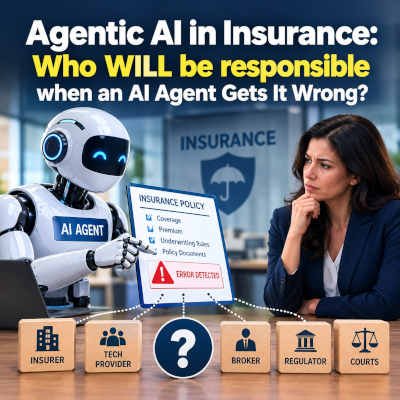

Read this USA insurance news article about the use of agentic AI in insurance, its advantages and disadvantages. IN the news, the main ongoing talk is the concern about accountability when such agentic AI in the insurance sector goes wrong. Learn in depth the real story behind it; read below for more information.
The insurance industry is entering a new phase of artificial intelligence adoption, with agentic AI offering the potential to automate complex workflows, accelerate policy administration, and improve customer service. However, as these systems gain the ability to make decisions and initiate actions across multiple applications, an important question is emerging: Who is accountable when an AI agent gets it wrong?
Suppose a commercial insurance policy amendment is processed by an AI agent. The system reviews the customer’s request, retrieves policy documents, applies underwriting rules, calculates a revised premium, and prepares the endorsement. The process takes seconds rather than hours.
Three months later, the customer challenges the premium adjustment. An investigation reveals that the agent may have relied on outdated underwriting instructions or overlooked a policy exclusion.
The insurer can identify the action taken, but explaining why the system reached its decision proves more difficult.
This scenario highlights a growing challenge for insurers: automation can accelerate decisions, but it does not automatically establish accountability, accuracy, or compliance.
An opinion article published by Insurance Edge on October 27, featuring Srividya Kannan, CEO of Avaali Solutions, examines this emerging issue and the importance of building accountability into agentic AI systems.
What is Agentic AI in Insurance and why is it required?
Traditional automation generally follows predefined instructions. Agentic AI, by contrast, can interpret information, plan steps, use connected tools, coordinate tasks, and take actions within specified boundaries.
In insurance, these capabilities could support several operational areas so it is requiring now . This is what it can do; it includes the following
- Claims processing: AI agents could gather claim documents, check information for inconsistencies, request missing records, and prepare recommendations for claims professionals.
- Underwriting: Agents could retrieve customer information, compare applications against underwriting guidelines, identify exceptions, and prepare risk assessments.
- Policy administration: Systems could process routine endorsements, update records, and prepare customer communications.
- Customer-oriented services: AI agents could respond to inquiries, retrieve policy details, and coordinate requests that previously required several departments.
- Fraud protection and detection: Agents could help identify suspicious patterns, collect supporting evidence, and escalate potentially fraudulent claims for investigation.
These applications could reduce administrative workloads and improve processing times. However, their effectiveness depends on the quality of the underlying data, the reliability of the systems they use, and the safeguards governing their decisions.
The US National Association of Insurance Commissioners (NAIC) identifies underwriting, pricing, claims handling, customer service, and fraud detection among the areas where insurers use or explore artificial intelligence.
Its published industry survey results also demonstrate that AI adoption extends across multiple insurance segments, including auto, homeowners, life, and health insurance.
The challenge is no longer simply whether insurers can automate tasks. It is whether they can demonstrate that automated decisions are accurate, fair, explainable, and properly supervised.
Why Faster Insurance Decisions Can Create Bigger Risks in 2026
Agentic AI introduces a different operational risk because a single workflow can involve multiple connected actions.
For example, an AI agent handling a commercial policy adjustment might interpret a broker’s request, retrieve the existing policy, consult an underwriting system, calculate a premium change, update an administrative platform, and generate an endorsement.
An error at any stage could influence the final outcome.
If the agent retrieves an outdated policy document, subsequent calculations may be incorrect. If it misunderstands an exclusion, the resulting endorsement could fail to reflect the insurer’s intended coverage terms.
The risk becomes more complicated when several agents collaborate.
One agent might extract information from documents, another might evaluate underwriting requirements, and a third might execute the approved change. Even if each component performs its assigned task
Who Is Legally Responsible When an AI Agent Makes a Mistake?
The central issue is that an AI agent is a technological system, not a substitute for the organisation’s legal and regulatory responsibilities.
In the United States, the NAIC’s Model Bulletin on the Use of Artificial Intelligence Systems by Insurers, adopted in December 2023, establishes expectations for responsible AI governance.
The bulletin makes clear that decisions or actions affecting consumers and made or supported by AI must comply with applicable insurance laws and regulations.
It also addresses governance, risk management, and the documentation regulators may request when examining an insurer’s use of AI.
The bulletin is a model regulatory document rather than a federal AI statute, and its implementation depends on individual state regulatory frameworks. Nevertheless, it provides an important foundation for insurer accountability.
In practice, responsibility may involve several parties.
- Insurance companies must establish appropriate governance, monitor AI-supported decisions, and ensure their operations comply with applicable requirements.
- Senior management must ensure that AI systems are deployed within approved risk limits and that employees have the authority to intervene when necessary.
- Technology vendors may have contractual responsibilities relating to system performance, security, documentation, and support. Their precise obligations depend on the agreements and applicable law.
- Brokers and insurance professionals may have responsibilities associated with their own conduct, advice, representations, and delegated authority.
- Regulators and courts may determine whether particular actions breached applicable legal requirements and what remedies or penalties are appropriate.
The exact allocation of liability depends on the circumstances, jurisdiction, contractual arrangements, and nature of the error.
However, an insurer cannot safely assume that responsibility disappears simply because an automated system performed the action.
Regulators Are Increasing Their Focus on Insurance AI
Regulatory attention is developing alongside the technology.
The NAIC’s AI work includes examining how insurers use AI systems, evaluating governance practices, and developing tools to help regulators assess potential risks.
In 2026, its Big Data and Artificial Intelligence Working Group continued work on AI system evaluation, including resources intended to help regulators examine insurer governance, risk mitigation, and the data used by AI systems.
This direction matters because agentic AI can do more than generate recommendations. Depending on its permissions, it can also initiate transactions, change records, and communicate outcomes.
Regulatory scrutiny may therefore extend beyond the accuracy of an individual model to the broader process in which it operates.
Internationally, the European Insurance and Occupational Pensions Authority (EIOPA) issued an opinion on AI governance and risk management in August 2025.
The opinion highlights issues including data governance, record-keeping, fairness, cybersecurity, explainability, and human oversight.
The European Union’s AI Act also identifies certain AI uses involving risk assessment and pricing in life and health insurance as high-risk applications, subject to the applicable legal definitions, exclusions, and implementation timetable.
These developments indicate that insurers need to consider both existing insurance obligations and relevant AI-specific requirements.
How Insurers Can Make Agentic AI More Accountable
Insurers do not necessarily need to abandon automation to reduce these risks. Instead, they need controls that match the consequences of the actions an AI agent can take.
1. Maintain a full Audit Trail
Every material action should generate records showing which information the agent accessed, which rules or instructions it used, what decisions it made, and which actions followed.
Where multiple agents participate, insurers should preserve the relationships between their individual actions.
Audit records must be sufficiently detailed to support investigations without unnecessarily exposing sensitive customer information.
2. Introduce Human Approval for High-Impact Decisions
Not every automated action requires manual review.
Routine administrative tasks may be suitable for automation, while decisions involving disputed claims, significant coverage changes, unusual underwriting exceptions, or other high-impact outcomes may require human approval.
The level of oversight should reflect the potential harm rather than the convenience of automation.
3. put a Restrict What AI Agents Can Do
Insurers should apply least-privilege access, allowing each agent to access only the systems and functions necessary for its assigned task.
Financial transactions, policy changes, customer notifications, and other consequential actions should have clearly defined permissions and approval requirements.
Systems should also have mechanisms to stop execution when an agent encounters missing information, conflicting instructions, or an unexpected result.
4. Test AI Systems Against Realistic Failures
Testing should extend beyond whether an agent completes a normal workflow.
Insurers should examine how systems behave when policy documents conflict, information is missing, rules change, or connected applications become unavailable.
They should also test whether agents can recognise uncertainty and escalate cases instead of generating unsupported conclusions.
5. Establish Clear Ownership
Each AI workflow should have a designated business owner responsible for its approved purpose, performance standards, monitoring, and incident response.
Legal, compliance, underwriting, claims, cybersecurity, and technology teams should understand their respective responsibilities.
Vendor contracts should also address access to audit information, incident reporting, system changes, and cooperation during regulatory investigations.
6. Measure the Cost of Errors for the system
A useful performance framework should measure more than the number of transactions completed or minutes saved.
Insurers should track error rates, customer complaints, manual overrides, processing reversals, financial corrections, and the time required to resolve incidents.
These indicators can reveal whether an automated process is delivering genuine operational improvements or merely shifting costs to later stages.
The National Institute of Standards and Technology’s AI Risk Management Framework offers an additional voluntary resource for organisations developing structured approaches to identifying and managing AI risks.
The Future of Use of Agentic AI in Insurance sectors
Have you ever wondered if Agentic AI could become an important part of insurance operations, particularly where employees spend substantial time moving information between disconnected systems?
Its long-term value, however, will depend on whether insurers can combine automation with reliable controls.
A system that processes a policy amendment in seconds may appear efficient. But if the insurer cannot explain the decision, establish which rules were applied, or correct the resulting error promptly, the apparent efficiency can be misleading.
The strongest implementations will distinguish between actions that can safely be automated and decisions that require human judgment.
They will also treat explainability, auditability, and accountability as core design requirements rather than measures introduced after a dispute.
Frequently Asked Questions (FAQs)
1. What is agentic AI in insurance?
Agentic AI refers to artificial intelligence systems that can plan and execute multistep tasks, interact with software applications, retrieve information, and initiate actions within defined limits. In insurance, these systems can assist with claims processing, underwriting, policy administration, and customer service.
2. Who is responsible when an AI agent makes a mistake?
Responsibility depends on the circumstances, applicable laws, and contractual arrangements. Insurance companies remain responsible for complying with applicable insurance regulations when using AI systems. Technology providers, brokers, and other parties may also have legal or contractual responsibilities.
3. How is agentic AI different from traditional insurance automation?
Traditional automation generally follows predefined rules and workflows. Agentic AI can interpret information, determine the steps needed to complete a task, use connected applications, and coordinate multiple actions. This flexibility can improve efficiency but may introduce additional operational risks.
4. What are the main risks of agentic AI in insurance?
Major risks include incorrect underwriting decisions, inaccurate premium calculations, policy interpretation errors, unfair discrimination, data security vulnerabilities, and inadequate documentation. Poorly controlled AI agents may also take actions without appropriate approval.
5. How can insurance companies prevent AI errors?
Insurers can reduce risks through regular testing, human oversight, access restrictions, reliable audit trails, updated underwriting rules, and continuous performance monitoring. High-impact decisions should receive appropriate review before they are finalised.
6. Can insurance companies use AI to process claims automatically?
AI can assist with document verification, damage assessment, fraud detection, and claims processing. However, the appropriate level of automation depends on the nature of the claim, applicable regulations, and the insurer’s controls. Human intervention may be necessary for complex or disputed cases.
7. What does the NAIC say about artificial intelligence in insurance?
The National Association of Insurance Commissioners’ Model Bulletin on the Use of Artificial Intelligence Systems by Insurers, adopted in December 2023, emphasises compliance with existing insurance laws, responsible AI governance, and risk management. Its legal effect depends on adoption and implementation by individual jurisdictions.
8. Why is explainability important in insurance AI?
Explainability helps insurers understand how an AI system reached a decision. It also supports internal investigations, customer complaint resolution, regulatory examinations, and the correction of errors.
9. What role does human oversight play in agentic AI?
Human oversight allows qualified employees to review consequential decisions, investigate unusual outcomes, override incorrect actions, and intervene when an AI system encounters uncertainty. The level of oversight should reflect the potential impact on customers.
10. Will agentic AI replace insurance professionals?
Agentic AI is more likely to automate or support specific tasks than eliminate the need for professional judgment across the entire insurance industry. Underwriters, claims specialists, compliance professionals, and customer service teams will continue to play important roles in oversight, complex decision-making, and customer relationships.
References info online
Use these links in the article’s References section to support the regulatory and industry information.
- National Association of Insurance Commissioners (NAIC) — Artificial Intelligence in Insurance
NAIC: Artificial Intelligence in Insurance - NAIC — Big Data and Artificial Intelligence Working Group
NAIC AI Working Group - NAIC — Model Bulletin on the Use of Artificial Intelligence Systems by Insurers
Read the NAIC Model Bulletin - European Insurance and Occupational Pensions Authority (EIOPA) — Opinion on AI Governance and Risk Management
EIOPA AI Governance Opinion - National Institute of Standards and Technology (NIST) — AI Agent Standards Initiative
NIST AI Agent Standards Initiative - Texas Department of Insurance — Commissioner’s Bulletin B-0003-26
Texas Department of Insurance AI Bulletin - Insurance Edge — Original Opinion Article
Agentic AI in Insurance: Who Is Accountable When the Agent Gets It Wrong?