
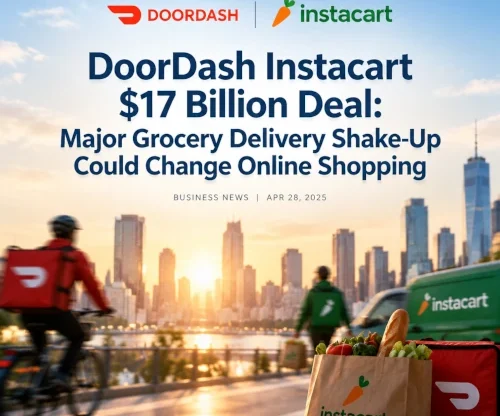

Business News USA: Is DoorDash buying Instacart? IN the latest news we have , DoorDash has agreed to acquire Instacart in a deal valued at approximately $17 billion, setting the stage for a major consolidation in the U.S. grocery delivery market. Announced on October 29, 2026, the transaction would bring together DoorDash’s extensive delivery network and Instacart’s grocery technology, retailer relationships, and established shopping platform.
The proposed acquisition could expand consumer access to grocery stores, change subscription benefits, and create new opportunities for delivery workers. However, the transaction still requires shareholder and regulatory approvals, with completion expected toward the end of 2027 or during the first half of 2028.
The agreement represents a significant development for online grocery shopping as delivery companies compete with major retailers, including Walmart, Amazon, and Costco.
DoorDash Agrees to Buy Instacart for Approximately $17 Billion
Under the definitive agreement, DoorDash will acquire Instacart’s parent company, Maplebear Inc., at a transaction value of $65 per share, representing an equity value of approximately $17 billion.
The agreed price represents a 26% premium over Instacart’s closing share price on October 22, 2026, the last trading day before media reports about a possible transaction.
Instacart’s board of directors unanimously approved the agreement. Shareholders holding approximately 19% of Instacart’s outstanding shares have also agreed to vote in favor of the transaction.
The consideration will consist of at least 75% cash. Eligible Instacart shareholders can elect to receive $65 in cash per share, 0.3372 shares of DoorDash stock per Instacart share, or a combination of $48.75 in cash and 0.0843 DoorDash shares. The stock component is subject to a cap and allocation rules.
DoorDash plans to finance the cash portion using existing cash resources and debt financing.
Although the companies have reached a definitive agreement, the acquisition has not yet closed. Both businesses will continue operating independently while they work through the approval process.
Why DoorDash Wants to Acquire Instacart
DoorDash initially built its business around restaurant delivery. Over time, it expanded into groceries, convenience items, pet supplies, electronics, and other local-commerce categories.
Instacart, founded in 2012, developed a platform focused on grocery and convenience-store delivery. It also provides technology that helps retailers operate online storefronts, manage fulfillment, and reach customers through digital channels.
Combining these capabilities could give DoorDash a stronger position across the grocery and restaurant delivery markets.
DoorDash brings its delivery infrastructure, consumer reach, and experience coordinating a large network of delivery workers. Instacart contributes specialized grocery technology, relationships with supermarkets, and experience managing online grocery orders.
The companies say the combination could help local retailers compete with larger businesses that have invested heavily in delivery networks, digital shopping platforms, and membership programs.
DoorDash co-founder and CEO Tony Xu said the deal could help retailers of different sizes compete in an increasingly technology-driven marketplace.
However, the acquisition’s longer-term success will depend on how effectively the businesses combine their operations and whether promised benefits reach consumers, retailers, and delivery workers.
Will the Instacart App and Brand Name Remain? :
One of the most important details for existing customers is that DoorDash expects to retain Instacart’s brand name and app after the transaction closes.
The company also expects to preserve Instacart’s enterprise technology products, which retailers use to support their own digital shopping experiences.
This means the proposed acquisition does not currently signal an immediate replacement of Instacart with DoorDash.
Until the deal closes, the companies will continue to operate as separate and independent businesses. Customers should therefore not assume that subscription terms, ordering procedures, or other services will change immediately.
Following completion, DoorDash plans to combine its delivery network with Instacart’s grocery technology. The precise implementation of future services will depend on how the companies execute their integration plans.
For grocery retailers, maintaining Instacart’s technology platform could be particularly important because some stores rely on these systems for online ordering and fulfillment.
DashPass and Instacart+ Members Could Save on Subscriptions :
The transaction could also affect customers who currently pay for both DoorDash’s DashPass and Instacart+ membership programs.
According to DoorDash, eligible members could eventually pay one membership fee instead of maintaining two separate subscriptions. The company estimates that this arrangement could save members approximately $100 million annually in membership fees.
The programs currently cost customers around $9.99 per month each, according to the companies’ announcement.
Combining membership benefits could make grocery and restaurant delivery more convenient for households that regularly use both platforms.
Customers may also gain access to a wider selection of retailers. DoorDash says Instacart customers could gain access to more than 50,000 additional stores through the combined platform, on top of the nearly 100,000 stores already available through Instacart.
However, these benefits are forward-looking expectations, not changes that have already taken effect. Customers should check the companies’ official announcements for confirmed membership terms and implementation dates.
What the Deal Could Mean for Grocery Stores :
The proposed acquisition could reshape how supermarkets and other local retailers reach online customers.
Large retailers have invested in digital storefronts, fulfillment operations, delivery services, and customer loyalty programs. Smaller grocery businesses may find it more difficult to develop comparable systems independently.
DoorDash and Instacart say the combined business could provide retailers with access to delivery infrastructure, grocery technology, advertising tools, and digital ordering systems.
Retailers could potentially use these capabilities through the delivery apps or their own websites.
DoorDash has also committed to keeping the platform open to local grocers, stating that retailers will be able to work with delivery platforms of their choice rather than being required to use an exclusive grocery-delivery arrangement.
That commitment could matter to stores that want to reach customers through multiple channels.
Nevertheless, the benefits for individual retailers will depend on service costs, commission arrangements, customer demand, and the terms offered after the acquisition closes. Greater scale does not automatically guarantee lower prices or higher profits for participating businesses.
Can DoorDash and Instacart Compete With Walmart and Amazon? :
Competition with major retailers is a central factor behind the proposed transaction.
Walmart has a substantial presence in U.S. grocery retail and has been expanding its delivery services beyond traditional supermarket orders. It has also explored restaurant delivery partnerships, extending its reach into another part of the convenience market.
Amazon and Costco are also major competitors in grocery and household shopping.
DoorDash and Instacart approach this market differently. DoorDash has built a broad delivery marketplace with strong restaurant-ordering capabilities, while Instacart has concentrated on grocery delivery and technology for retailers.
Combining these strengths could make it easier for the businesses to offer customers groceries, restaurant meals, and other everyday products through connected services.
The companies may also gain opportunities to expand advertising and data-driven services for retailers and consumer brands.
Still, the combined business would face competition from retailers that operate their own digital platforms and fulfillment networks. Pricing, delivery speed, product availability, customer service, and reliability will remain important factors in attracting and retaining customers.
What Happens to Instacart’s 600,000 Shoppers?
The proposed acquisition also raises questions about the future of Instacart’s independent contractors.
Instacart has approximately 600,000 shoppers who fulfill customer orders. DoorDash says these workers would be able to continue fulfilling Instacart orders under the planned arrangement.
The company has also said Instacart shoppers would retain flexibility over how much they work and the ability to decide which orders to accept. They could also have the option to take on DoorDash orders.
If implemented as described, this arrangement could give some workers access to a broader range of delivery opportunities.
For example, workers might be able to choose grocery deliveries during one period and restaurant orders at another time, depending on demand and platform availability.
However, actual earnings will depend on order volume, delivery distances, customer tips, operating expenses, and platform policies. More available orders do not necessarily mean higher take-home pay for every worker.
The transaction’s effects on contractors will become clearer as the companies provide additional details about their post-acquisition operations.
Regulatory Approval Could Be a Major Hurdle :
The $17 billion transaction must clear several important steps before it can be completed.
These include approval from Instacart shareholders, the expiration or termination of the applicable waiting period under the Hart-Scott-Rodino Antitrust Improvements Act, additional regulatory approvals, and other customary closing conditions.
The companies also identified regulatory approvals in Canada and Israel as part of the process.
The scale of the transaction could attract scrutiny because it would bring two major delivery platforms under common ownership. Regulators may examine the potential effects on competition, retailers, delivery workers, and consumers.
New York City’s Department of Consumer and Worker Protection raised concerns about the proposed transaction in a statement published on October 28, before the definitive agreement was announced. The department said it would continue enforcing delivery workers’ rights regardless of whether the merger proceeds.
That statement highlights how worker protections and competition may remain part of the public discussion surrounding the deal.
The companies are targeting completion toward the end of 2027 or during the first half of 2028. That timeline remains subject to the required approvals and closing conditions.
What the DoorDash-Instacart Deal Means for Consumers
For customers, the potential benefits include access to more stores, possible subscription savings, and a broader range of delivery options.
Households that regularly order groceries and restaurant meals could find it more convenient to manage those purchases through connected services.
Retailers may gain access to a larger delivery network and additional technology, while delivery workers could have more opportunities to accept orders across the platforms.
However, the transaction also raises questions about market concentration and how competition might evolve. Consumers will need to watch whether the combined business delivers on its promises regarding affordability, availability, and service quality.
The deal is therefore more than a change in corporate ownership. It could influence how Americans order groceries, how local stores reach customers, and how delivery platforms compete in the years ahead.
For now, the acquisition remains subject to regulatory and shareholder approvals. The next major developments will involve the approval process, integration plans, and any confirmed changes to subscriptions and services.
Frequently Asked Questions (FAQs)
1. Is DoorDash buying Instacart for $17 billion?
Yes. DoorDash and Instacart announced a definitive acquisition agreement on October 29, 2026, valuing Instacart’s equity at approximately $17 billion, or $65 per share. The transaction has not yet closed.
2. Will Instacart disappear after the acquisition?
DoorDash expects to retain Instacart’s brand name, app, and enterprise technology products after closing. Both companies will continue operating independently until the transaction is completed.
3. Will DashPass and Instacart+ become one membership?
DoorDash says eligible members could eventually pay one membership fee instead of maintaining separate DashPass and Instacart+ subscriptions. The companies estimate potential annual membership-fee savings of approximately $100 million. Implementation details remain subject to the transaction’s completion and subsequent plans.
4. When will the DoorDash-Instacart deal close?
The companies expect the transaction to close toward the end of 2027 or during the first half of 2028, subject to shareholder approval, regulatory clearance, and other closing conditions.
5. What happens to Instacart shoppers?
DoorDash says Instacart shoppers will be able to continue fulfilling Instacart orders and retain flexibility over their work. The company also plans to offer opportunities to take DoorDash orders, although individual earnings will depend on several factors.
6. Why does DoorDash want Instacart?
The acquisition would combine DoorDash’s delivery network and consumer reach with Instacart’s grocery technology and retailer relationships. The companies say the combination could expand customer choice and help local retailers compete with larger businesses.
Conclusion
The proposed DoorDash-Instacart acquisition marks a major development in the online grocery and delivery industry. Valued at approximately $17 billion, the transaction could expand store access, change membership benefits, and create new opportunities for retailers and delivery workers.
Its ultimate impact will depend on regulatory approval, the integration of the two businesses, and whether the promised consumer and retailer benefits materialize. Until the deal closes, DoorDash and Instacart will continue operating separately.