
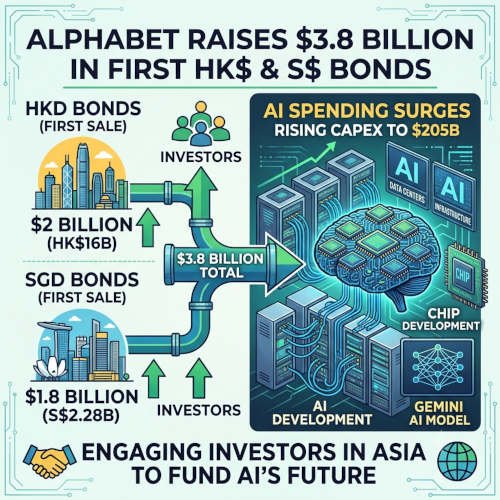
Alphabet, the parent company of Google, has raised approximately $3.8 billion through its first bond offerings denominated in Hong Kong dollars and Singapore dollars. The seven-part debt sale exceeded the company’s original $3 billion fundraising target after attracting more than $7 billion in combined investor orders.
The transaction marks another major step in Alphabet’s international borrowing strategy as the technology giant increases investment in artificial intelligence (AI), cloud computing and data center infrastructure. It also comes during a period of uncertainty in technology markets, where investors are closely examining the financial returns and costs associated with the AI boom.
According to Reuters, Alphabet sold HK$16 billion, worth approximately $2 billion, in Hong Kong dollar bonds and S$2.28 billion, worth around $1.8 billion, in Singapore dollar bonds. Strong demand allowed the company to increase the size of the offering beyond its initial target.
The deal gives Alphabet access to two additional Asian debt markets and expands its funding options as it finances long-term business requirements.
Alphabet Bond Offering Exceeds $3 Billion Fundraising Target
Alphabet initially planned to raise approximately $3 billion through its first Hong Kong dollar and Singapore dollar bond sales. However, investor demand exceeded expectations, allowing the company to secure around $3.8 billion.
The Hong Kong dollar portion included three bond maturities: two years, five years and 10 years. The Singapore dollar offering included four maturities: two years, five years, 10 years and 30 years.
The final Hong Kong dollar issuance consisted of HK$7.5 billion in two-year bonds, HK$7 billion in five-year bonds and HK$1.5 billion in 10-year bonds.
The Singapore dollar sale included S$370 million in two-year bonds, S$900 million in five-year bonds, S$330 million in 10-year bonds and S$680 million in 30-year bonds.
The combined transaction attracted more than $7 billion in orders. Reuters reported that the Hong Kong dollar bond order book exceeded HK$32.5 billion, while orders for the Singapore dollar offering topped S$4 billion.
These figures indicate substantial demand for Alphabet’s corporate debt, although order-book totals do not represent the amount of money ultimately raised. The final proceeds came from the bonds actually issued.
Bond Yields Tighten After Strong Investor Demand
One of the most important details of the transaction was the reduction in borrowing costs compared with Alphabet’s initial pricing guidance.
For the Hong Kong dollar bonds, the final reoffer yields were 4.35% for the two-year notes, 4.70% for the five-year notes and 5.20% for the 10-year notes.
The initial guidance had been 4.60%, 5.00% and 5.50%, respectively.
The Singapore dollar bonds also priced below their initial yield guidance. The final yields were 2.50% for the two-year notes, 3.00% for the five-year notes, 3.40% for the 10-year notes and 3.80% for the 30-year notes.
The initial guidance for those maturities ranged from 2.75% to 4.00%.
This tightening suggests investors were willing to accept lower yields than initially indicated as demand developed. For Alphabet, stronger demand and lower final yields can help reduce the interest expense associated with the new borrowing.
However, bond yields should not be confused with the company’s overall cost of capital. Currency, maturity, market conditions and other financing expenses also influence the economics of a debt transaction.
Why Alphabet Is Raising Money in Asian Bond Markets
Alphabet’s latest financing move reflects a broader effort to diversify its sources of corporate funding.
Companies with large infrastructure requirements often issue bonds in different currencies and markets. This approach can help them reach a wider investor base, manage financing needs across regions and create additional flexibility when raising long-term capital.
The Hong Kong and Singapore dollar offerings expand Alphabet’s presence in Asian fixed-income markets. They also follow several significant debt transactions in other currencies during 2026.
Reuters reported that Alphabet raised €6 billion, equivalent to approximately $6.7 billion, through a euro-denominated bond sale the previous week. The company also sold $25 billion in U.S. dollar bonds in August and issued A$5.5 billion, worth approximately $3.8 billion, in Australian dollar bonds during the same month.
The latest Asian transaction therefore forms part of a much larger borrowing program rather than a standalone financing event.
According to the bond term sheets reported by Reuters, the proceeds will be used for general corporate purposes. This category can cover a range of business needs and may include repayment of existing debt.
It is important to note that Alphabet has not publicly identified the entire $3.8 billion as funding exclusively for AI projects. The company has described the proceeds as general corporate funding.
Nevertheless, the financing comes as Alphabet continues to commit substantial resources to AI-related infrastructure.
AI Infrastructure Spending Increases Alphabet’s Financing Needs
Artificial intelligence has become one of the largest investment priorities for major technology companies. Developing and operating advanced AI services requires expensive computing equipment, data centers, networking systems and reliable energy supplies.
Alphabet is investing heavily in these areas to support Google Cloud, Gemini and AI-powered features across its products.
The company’s third-quarter 2026 financial results provide a clearer picture of the scale of this investment.
Alphabet reported revenue of $127.6 billion for the quarter ended September 30, 2026, representing a 25% increase from the same period a year earlier. Google Cloud revenue increased 103% to $30.7 billion, reflecting strong demand for cloud infrastructure and enterprise AI services.
The company also reported capital expenditure of $51.4 billion during the quarter. Alphabet said the vast majority of this spending went toward technical infrastructure supporting its AI investments.
Approximately 65% of its technical infrastructure investment during the quarter was related to servers and networking equipment. The remaining 35% went toward data centers.
Alphabet maintained its full-year 2026 capital expenditure guidance at $195 billion to $205 billion during its third-quarter earnings call. Management also said capital expenditure would increase significantly in 2027, although it did not provide a specific full-year figure during that call.
These investments help explain why Alphabet continues to access international debt markets. Building AI infrastructure requires substantial funding, and bond issuance provides one way to finance long-term corporate requirements.
Strong Cash Reserves Do Not Eliminate the Need for Borrowing
Alphabet’s borrowing activity may raise questions about why a company with substantial financial resources continues to issue billions of dollars in bonds.
Its latest financial disclosures show that the company had $265.1 billion in cash and marketable securities at the end of September 2026. This figure included $90.4 billion in marketable equity securities. Alphabet also reported $125.1 billion in long-term debt.
The company generated $42.3 billion in operating cash flow during the third quarter. However, its free cash flow was negative $9.1 billion for the quarter, partly because of heavy capital expenditure, inventory investment and a $5.2 billion cash payment related to a European Commission fine.
These figures illustrate the difference between having substantial financial reserves and generating enough free cash flow to cover every investment without additional financing.
Alphabet’s infrastructure plans involve large, long-term commitments. Accessing debt markets can help the company maintain financial flexibility while continuing to invest in growth opportunities.
What the Bond Sale Means for Alphabet Stock and Investors
The latest bond transaction is relevant to investors following Alphabet stock, listed on Nasdaq under the ticker GOOGL, and the wider technology sector.
A successful bond sale can indicate that institutional investors remain willing to lend to a major technology company despite concerns about the cost of AI development.
The more than $7 billion in combined orders show that demand for this particular offering was strong. The final yields also came below initial guidance, suggesting that investors accepted tighter pricing as the transaction progressed.
However, strong demand for corporate bonds does not automatically mean Alphabet shares will rise. Bondholders and stockholders have different financial interests and face different risks.
Bond investors generally receive contractual interest payments and repayment of principal according to the terms of the securities, subject to credit and other risks. Shareholders, by contrast, participate in the company’s potential earnings growth but face greater exposure to changes in market valuation.
For stock investors, the central question remains whether Alphabet can generate enough revenue and profit from its AI infrastructure to justify the scale of its spending.
The company’s recent cloud growth provides one positive indicator. Google Cloud revenue increased 103% year over year in the third quarter, while cloud operating income reached $11.1 billion, more than tripling from the previous year.
Still, infrastructure investment carries risks. Data centers require significant upfront capital, and equipment depreciation, energy expenses and ongoing operating costs can affect future profit margins.
Credit Ratings and November 19 Settlement Date
The Hong Kong and Singapore dollar bonds are expected to receive ratings of Aa2 from Moody’s and AA+ from S&P, according to Reuters’ report on the transaction.
These are expected ratings, not confirmation that both agencies have completed their final rating assignments.
The securities are scheduled to settle on November 19, 2026. HSBC and JPMorgan served as joint global coordinators for the offerings.
Other financial institutions also participated in arranging the transactions. Bank of China (Hong Kong), ICBC and Standard Chartered arranged the Hong Kong dollar bond sale. DBS, OCBC and United Overseas Bank arranged the Singapore dollar offering.
The seven separate maturities allow investors to choose different investment periods, from short-term two-year notes to a 30-year Singapore dollar bond.
AI Spending and Corporate Debt: What Comes Next?
Alphabet’s latest bond sale highlights an important financial development in the technology industry: the AI investment race is increasingly connected to corporate borrowing and global capital markets.
Major technology companies are competing to expand computing capacity, develop advanced models and provide AI services to businesses and consumers. These ambitions require substantial investment before all the expected financial returns become clear.
For Alphabet, the challenge is to convert its infrastructure spending into sustainable revenue growth, stronger cloud demand and improved long-term profitability.
The company has said it expects its AI investments to create attractive returns over time. Its recent results also show that Google Cloud is growing rapidly. However, investors will continue monitoring capital expenditure, free cash flow, operating margins and debt levels.
The latest $3.8 billion bond sale gives Alphabet another source of financing and demonstrates strong investor demand for its debt. It does not, by itself, prove that the company’s AI investments will deliver the returns management expects.
The next major test will be whether revenue and operating cash flow grow enough to support the enormous cost of building and operating AI infrastructure.
Frequently Asked Questions About Alphabet’s $3.8 Billion Bond Sale
1. How much money did Alphabet raise through its Hong Kong and Singapore bond sales?
Alphabet raised approximately $3.8 billion through its first Hong Kong dollar and Singapore dollar bond offerings. The transaction included HK$16 billion in Hong Kong dollar bonds and S$2.28 billion in Singapore dollar bonds.
2. Why did Alphabet issue bonds in Hong Kong and Singapore?
The offerings expand Alphabet’s access to Asian debt markets and diversify its funding sources. The proceeds are intended for general corporate purposes, which may include repayment of existing borrowings.
3. How much investor demand did Alphabet’s bond sale attract?
The combined order books exceeded $7 billion. Orders topped HK$32.5 billion for the Hong Kong dollar bonds and S$4 billion for the Singapore dollar bonds.
4. What interest rates did Alphabet offer on the new bonds?
The final Hong Kong dollar reoffer yields ranged from 4.35% to 5.20%. The Singapore dollar bond yields ranged from 2.50% to 3.80%, depending on maturity.
5. Will Alphabet use the $3.8 billion specifically for AI development?
Alphabet said the proceeds would be used for general corporate purposes. Although the company is investing heavily in AI infrastructure, the