
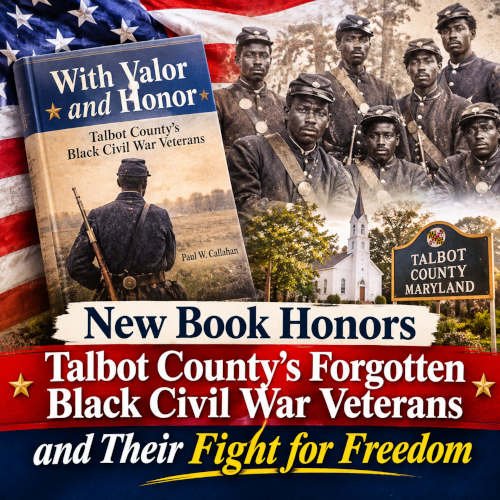
A new book is bringing long-overlooked African American Civil War veterans back into the history of Talbot County, Maryland. The publication, With Valor and Honor, documents the military service and lasting contributions of Black men who fought for the Union during a period when slavery and racial discrimination shaped American life.
Written by Paul W. Callahan, the book highlights the courage of hundreds of men from Talbot County who joined the United States Colored Troops (USCT) during the Civil War. According to Callahan, more than 600 African American men from the county enlisted in the Union Army, while others served in the United States Navy. His recent account identifies and documents the military service of 651 local veterans.
The book arrives at a time when communities and historians are working to preserve the stories of soldiers whose contributions received limited attention in traditional accounts of the war. Their service was not only part of the Union’s military effort but also a struggle for freedom, citizenship and a different future for their families.
New Book Brings Forgotten Black Civil War Veterans Into Focus
With Valor and Honor records the experiences of African American men from Talbot County who served during the Civil War. Many were born into slavery, while others were free Black residents who saw military service as an opportunity to help defeat the Confederacy and advance the cause of freedom.
Callahan’s November 11, 2026, Veterans Day message explained that Talbot County supplied more Black recruits to the Union Army than any other county in Maryland. The newly identified veterans represent an important part of the state’s Civil War history.
The book also explores what happened after the war. Many returning soldiers helped establish communities, support churches and schools, and build lives for their families in a society that continued to impose racial barriers.
Their experiences demonstrate that the end of the Civil War did not automatically bring equality. Veterans still faced discrimination and economic challenges, even after risking their lives for the nation.
Why Talbot County Played an Important Role in Black Military History
Talbot County, located on Maryland’s Eastern Shore, became an important source of African American recruits during the Civil War.
Maryland was a border state that remained in the Union during the conflict, but slavery continued there until the state’s emancipation in November 1864. The Emancipation Proclamation, effective January 1, 1863, did not apply to Maryland because the state had not joined the Confederacy. However, the broader wartime movement toward emancipation and the Union government’s recruitment policies opened military opportunities for Black men.
The formation of the United States Colored Troops allowed African American soldiers to serve in organized Union military units. Nearly 180,000 Black men served in the Union Army during the war, according to historical accounts. Maryland contributed 8,718 of those soldiers, with more than 600 coming from Talbot County.
The men served despite facing unequal treatment, racial prejudice and difficult military conditions. They also risked particularly harsh treatment if captured by Confederate forces.
Frederick Douglass Helped Advance the Cause of Black Soldiers
One important figure connected to this history was Frederick Douglass, the famous abolitionist, writer and public speaker who was born in Talbot County.
Douglass strongly advocated for African Americans to receive the opportunity to serve in the Union military. He argued that Black Americans should be allowed to defend the country and demonstrate their commitment to freedom and citizenship.
His advocacy helped build pressure on President Abraham Lincoln’s administration to expand Black participation in the war.
For many African Americans, military service represented more than a chance to fight. It offered an opportunity to challenge the institution of slavery and claim a place in the nation they helped defend.
The Veterans Helped Establish the Historic Community of Unionville
One of the most lasting contributions of Talbot County’s Black Civil War veterans was the establishment of Unionville.
After the war, 18 former United States Colored Troops soldiers helped establish the historic community in 1867. The village developed on land associated with the Cowgill family, which leased parcels to returning veterans.
These men had previously experienced slavery or racial restrictions. After returning from military service, they worked to create a community where their families could live, build homes and develop institutions of their own.
The community became an important example of African American independence during the years following emancipation.
The veterans and their families helped establish a church and educational opportunities for their children. St. Stephens African Methodist Episcopal Church became a central institution in Unionville and remains an important part of its history.
St. Stephens Church Preserves the Veterans’ Legacy
St. Stephens AME Church is closely connected to the history of Unionville’s founders. The church and its cemetery provide an important link to the soldiers who helped establish the community.
Historical accounts identify 18 veterans of the 7th Regiment Infantry of the United States Colored Troops among the original founders. Their graves are located in the cemetery behind the church.
The story of Unionville demonstrates how military service continued to shape African American communities long after the fighting ended. These veterans returned home with the experience of serving the United States and worked to create a more secure future for their families.
The Maryland State Archives also preserves individual records of Talbot County soldiers. These records help historians and descendants learn about the men who enlisted, the units in which they served and the lives they built after the war.
Unknown Civil War Soldier Receives Full Military Honors at Arlington
The renewed attention to overlooked Civil War veterans comes alongside another significant act of remembrance in Virginia.
An unidentified Union infantryman who died during the Second Battle of Manassas in 1862 received a military funeral at Arlington National Cemetery on November 4, 2026, more than 160 years after his death.
Archaeologists discovered his remains in March 2024 at Manassas National Battlefield Park in Prince William County. The location was associated with a Civil War field hospital.
Forensic analysis estimated that the soldier was between 16 and 19 years old. His identity remains unknown, but investigators determined that he was a Union infantryman who died during the battle.
The ceremony at Arlington included a casket team, firing party, bugler and military band. The American flag was folded and presented to an Army Arlington Lady, a volunteer who attends Army funerals to help ensure that soldiers are not buried alone.
Chaplain Capt. Phil Morlock described the soldier’s sacrifice as worthy of the nation’s gratitude, even though his personal story could not be fully recovered.
David Duncan, president of the American Battlefield Trust, also described the ceremony as deeply emotional. The organization works to preserve historic battlefields and educate the public about American military history.
The soldier is being buried beside two other unidentified Union soldiers.
Two Stories Highlight the Importance of Remembering Civil War Veterans
The Talbot County book and the Arlington burial concern different historical stories. There is no established evidence that the unidentified soldier found at Manassas was one of the Black veterans documented in With Valor and Honor.
However, both developments highlight the importance of preserving military history and recognizing people whose names or contributions were left out of public memory.
The Talbot County project identifies hundreds of African American soldiers through historical research and military records. The Arlington ceremony honors a soldier whose identity may never be known.
Together, these efforts show how historians, families, local organizations and preservation groups continue to recover pieces of the nation’s past.
Why the New Book Matters for American History
The story of Talbot County’s Black Civil War veterans is important because it expands the understanding of who fought to preserve the Union.
African American soldiers did not simply participate in the conflict. Their service challenged racial assumptions, strengthened the Union military and contributed to the larger struggle against slavery.
Their postwar achievements also deserve attention. The creation of Unionville demonstrates that returning soldiers worked to build institutions and communities despite the discrimination that continued after emancipation.
Callahan’s book gives readers a way to understand these contributions through the experiences of identifiable individuals rather than treating Black soldiers as an unnamed group.
The research also has value for descendants who want to understand their family histories. Military records, historical archives and local cemetery information can help connect present-day families with ancestors who served more than a century ago.
The Talbot Historical Society has also played a role in preserving this history through its With Valor and Honor exhibit, which documented the county’s United States Colored Troops and highlighted research developed with descendants and community organizations.
Frequently Asked Questions
1. What is the new book about Talbot County’s Black Civil War veterans?
The book is titled With Valor and Honor and was written by Paul W. Callahan. It documents the military service and contributions of African American men from Talbot County who served during the Civil War.
2. How many Black Civil War veterans came from Talbot County?
Callahan says more than 600 African American men from Talbot County enlisted in the Union Army. His latest account identifies and documents 651 veterans.
3. What were the United States Colored Troops?
The United States Colored Troops were Union military units that allowed African American men to serve during the Civil War. Their members fought to preserve the Union and advance the cause of emancipation.
4. What is Unionville in Maryland known for?
Unionville is a historic Talbot County community established in 1867 by 18 Black Civil War veterans and their families. It became an important example of African American community-building after the war.
5. Who was the unidentified soldier buried at Arlington?
He was a Union infantryman, estimated to have been between 16 and 19 years old, who died during the Second Battle of Manassas in 1862. His remains were discovered in 2024, and his identity remains unknown.
Conclusion
The publication of With Valor and Honor gives renewed attention to the African American soldiers who helped shape Talbot County and the history of the Civil War. Their military service, sacrifice and work to establish communities such as Unionville remain important parts of the American story.
More than 160 years after the war, historical research and remembrance ceremonies continue to recognize soldiers whose contributions deserve to be remembered. Whether through the identification of 651 veterans or the burial of an unknown Union soldier at Arlington, these efforts help ensure that the sacrifices of the past are not lost to future generations.