
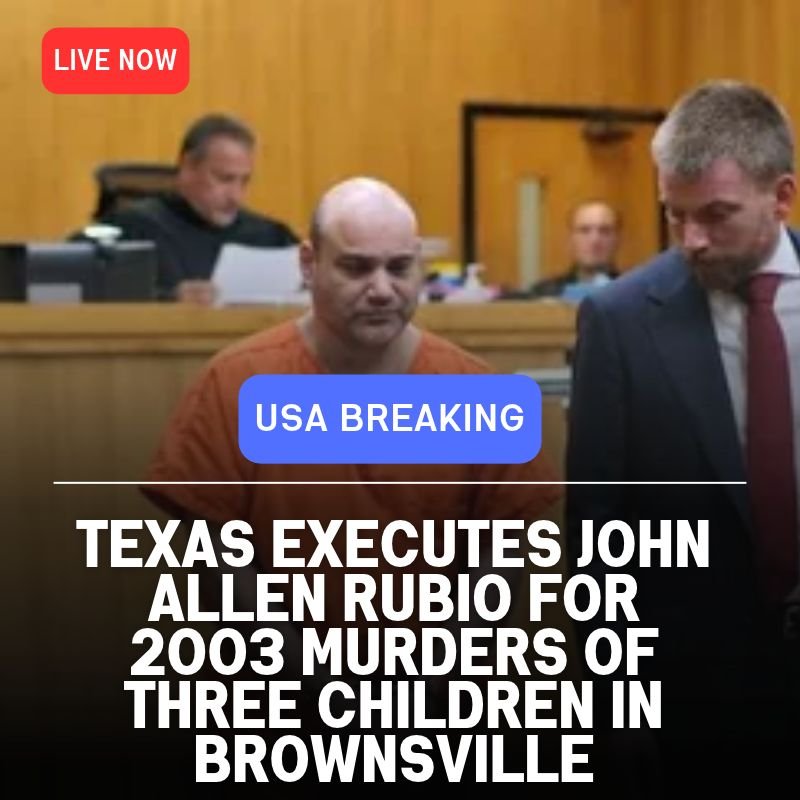
Texas has executed John Allen Rubio, the man convicted of killing three young children in Brownsville in 2003. Rubio, 46, died by lethal injection at the state prison in Huntsville on Thursday, November 12, 2026, more than two decades after the case shocked the community near the US-Mexico border.
The execution followed years of court proceedings, appeals and unsuccessful efforts to stop the death sentence. The case involved the deaths of three children: three-year-old Julissa Quesada, 14-month-old John Esteban Rubio and two-month-old Mary Jane Rubio.
According to the Associated Press, Rubio was pronounced dead at 6:47 p.m. Thursday. Before his death, he expressed remorse, thanked people who had supported him and spoke about his family and faith.
John Allen Rubio Executed in Texas After More Than 20 Years
The Texas Department of Criminal Justice carried out Rubio’s execution at the Huntsville Unit. He had been sentenced to death for the 2003 killings of the three children in Brownsville, a city in South Texas.
The case attracted national attention because of the children’s ages and the circumstances surrounding their deaths. Authorities said Rubio and his common-law wife, Angela Camacho, were involved in the killings.
Camacho was also convicted for her role in the case and is serving life sentences in prison. Rubio’s execution brought the lengthy criminal proceedings to a close for him, although the case continues to raise difficult questions about mental health, criminal responsibility and capital punishment.
What Happened to the Three Children in Brownsville?
The victims were Julissa Quesada, John Esteban Rubio and Mary Jane Rubio. Julissa was three years old, John was approximately 14 months old, and Mary Jane was just two months old when they were killed in March 2003.
Investigators found the children had been killed in an apartment in Brownsville. The details of the crime were deeply disturbing, and the case had a lasting impact on the local community.
Court records describe disagreements over the reason for the killings. Rubio reportedly told investigators that he believed the children were possessed. Prosecutors, however, argued that financial difficulties were a factor in the crime.
These explanations were presented as competing accounts during the legal proceedings. They should not be confused with an independently established explanation of Rubio’s mental state at the time.
Rubio’s Conviction Was Overturned Before His Second Trial
Rubio’s legal history included more than one trial. He was initially convicted in 2003, but the Texas Court of Criminal Appeals overturned that conviction in 2007.
The appeals court found that the prosecution had improperly relied on statements made outside court by Camacho before she invoked her Fifth Amendment right against self-incrimination. The ruling meant the original conviction could not stand.
Rubio faced a second trial in 2010. He pleaded not guilty by reason of insanity, but the jury again found him guilty of capital murder and sentenced him to death.
The retrial became an important part of the case because the court had to consider the evidence under the legal requirements established after the first conviction was overturned.
Mental Health Arguments Featured in the Legal Proceedings
Rubio’s mental health was a significant issue during his trials and later appeals. Defense experts diagnosed him with paranoid schizophrenia and presented arguments about his psychological condition.
Prosecution experts disputed the defense position. The disagreement over his mental health became part of the debate about his responsibility for the killings and whether he should face execution.
Rubio’s legal team continued to challenge aspects of the psychiatric evidence. One of the later arguments concerned testimony from a prosecution expert about Rubio’s mental health history.
However, the Texas Court of Criminal Appeals rejected his latest appeal on November 5, 2026. The ruling removed another legal obstacle to the scheduled execution.
Final Appeals and Clemency Efforts Failed
In the days before the execution, Rubio’s legal team made further efforts to stop the state from carrying out the sentence.
The Texas Board of Pardons and Paroles unanimously declined to recommend clemency on November 10. The board did not recommend either a 90-day reprieve or a reduction of the death sentence.
Rubio had also joined a legal challenge concerning Texas’ use of pentobarbital in lethal injections. The lawsuit questioned the condition and sourcing of the drug used by the state. That effort did not prevent the execution.
With the latest appeals and clemency requests unsuccessful, Texas proceeded with the scheduled lethal injection on November 12.
Angela Camacho Is Serving Life in Prison
Angela Camacho, Rubio’s common-law wife and the mother of the three children, was also convicted in connection with the killings.
She received life sentences for her role in the crime and remains incarcerated. Her case was closely connected to Rubio’s prosecution, including the legal dispute over statements she made before invoking her constitutional rights.
The deaths devastated the Brownsville community. Reports said the apartment building where the children were killed was later demolished, and the site was turned into a park and community garden.
The transformation of the location reflects the community’s effort to move forward while remembering the children whose lives were lost.
What the John Allen Rubio Execution Means for Texas
Rubio’s execution was another case in the ongoing use of capital punishment in the United States. Texas remains one of the states that carries out executions for people convicted of capital crimes.
The case also highlights the complex questions that arise when criminal trials involve claims of serious mental illness. Courts must consider evidence, constitutional protections, legal responsibility and the rights of victims’ families while following established procedures.
Supporters of capital punishment often emphasize accountability and the need for finality in serious murder cases. Opponents raise concerns about wrongful convictions, unequal application and whether execution is an appropriate response, particularly when mental health evidence is disputed.
Rubio’s case involved years of legal review, including an overturned conviction, a second trial and later appeals. His execution has now ended the state’s proceedings against him, but broader debates about the death penalty continue.
Frequently Asked Questions
1. Who was John Allen Rubio?
John Allen Rubio was a Texas death row inmate convicted of killing three young children in Brownsville in March 2003.
2. When was John Allen Rubio executed?
Texas executed Rubio by lethal injection on November 12, 2026. He was pronounced dead at 6:47 p.m. local time.
3. Who were the three children killed in the case?
The children were three-year-old Julissa Quesada, 14-month-old John Esteban Rubio and two-month-old Mary Jane Rubio.
4. What happened to Angela Camacho?
Angela Camacho was convicted for her role in the killings and is serving life sentences in prison.
5. Why was Rubio’s first conviction overturned?
The Texas Court of Criminal Appeals overturned his original conviction in 2007 because prosecutors had improperly relied on statements made by Camacho outside court.
6. Did Rubio’s lawyers try to stop the execution?
Yes. His legal team pursued further appeals and challenged the state’s use of pentobarbital. The Texas Board of Pardons and Paroles also declined to recommend clemency.
Conclusion
The execution of John Allen Rubio closes a lengthy legal chapter in one of Brownsville’s most disturbing criminal cases. The deaths of Julissa, John and Mary Jane remain at the center of the tragedy, while the case continues to draw attention to the legal, mental health and ethical questions surrounding capital punishment in Texas.